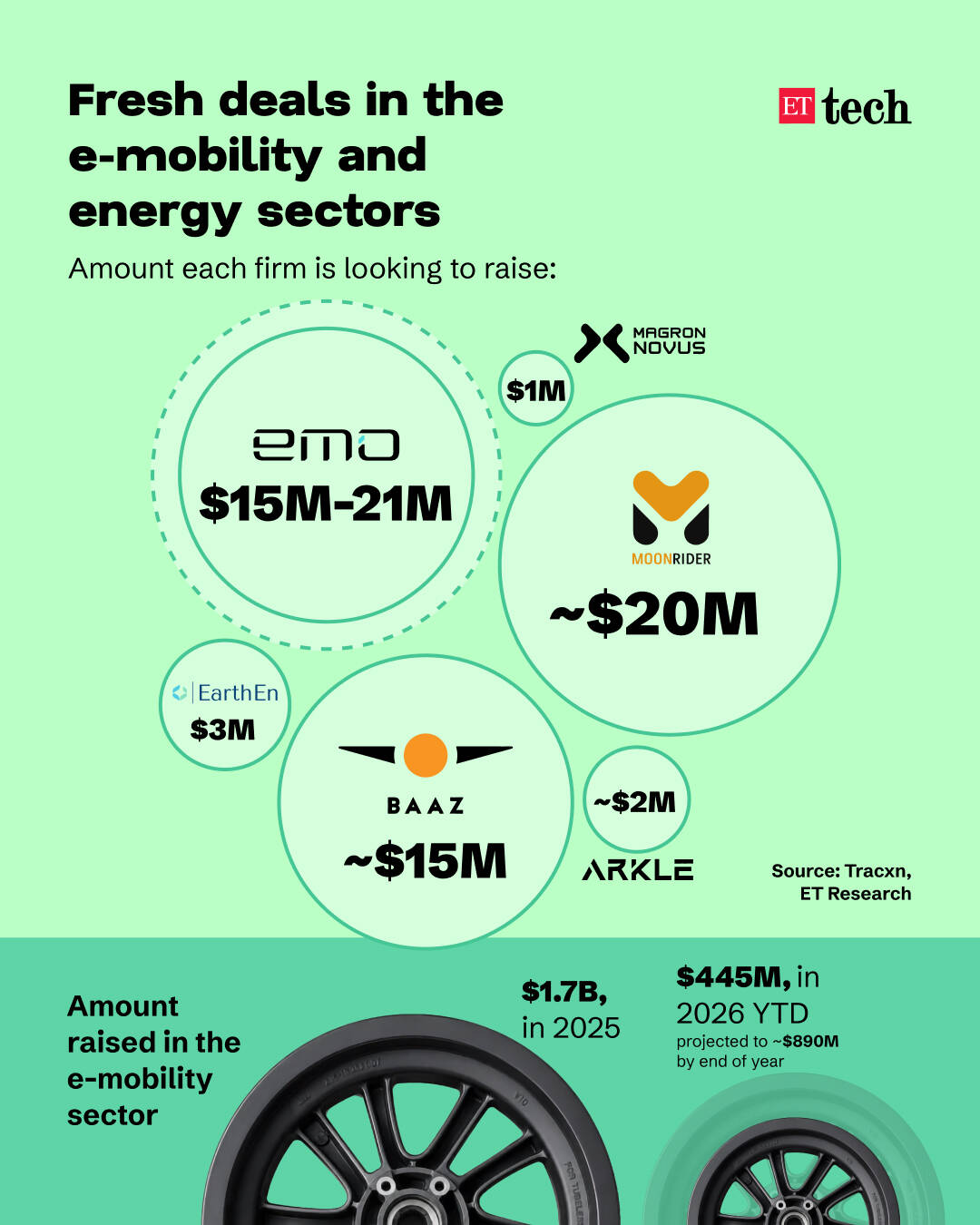
People familiar with the fundraising told ET several startups, including Emo Energy, Baaz Bikes, EarthEn Energy, Arkle Energy, Magron, and Moonrider, are in various stages of talks with investors.
Industry executives say VCs are pulling back from pure electric-vehicle bets and shifting toward the broader EV infra and energy storage.
Founders in the EV sector note that while there remains an overall sense of caution among investors, many still continue to be bullish on the sector, given rising fuel costs and a broader push towards electrification.
“With the current geopolitical turbulence, the interest is certainly returning to this space, as we are seeing a lot of inbound interest,” one founder said.
Among them, Bengaluru-based Emo Energy is in talks to raise Rs 150-200 crore ($16-21 million), sources said. The company is building a fast-charging battery ecosystem for electric two-wheelers used by gig workers. It has previously raised funds from investors such as Gruhas and Subhkam Ventures. Sources said the company is also evaluating an additional debt raise.
Meanwhile, electric mobility startup Baaz Bikes is in talks to raise nearly $15 million in a fresh funding round. The company has already secured a lead investor and is currently bringing additional investors into the round, according to sources.
Baaz counts Rakuten Capital, Kalaari Capital, and BIG Capital as its existing investors.
 ETtech
Money matters
Other startups in fundraising mode include electric tractor startup Moonrider, which is in the market for a $20 million funding round. Electric motorcycle maker Magron Novus is also raising a $1 million bridge round, of which $400,000 has already been secured, sources said. The company is in talks to raise a $3-4 million round later this year ahead of a commercial launch in mid-2027.
Within the energy-storage ecosystem, EarthEn Energy, which is developing heat-storage batteries for industrial customers, is raising a $3 million seed round. Bengaluru-based Arkle Energy, which develops vanadium redox flow batteries, is also in talks to raise about Rs 20 crore (about $2 million). The startup so far has raised $460,000.
“As energy consumption rises globally, fluctuations in demand and supply are increasing, creating a growing need for energy-storage solutions,” said Shantanu Chaturvedi, Partner at Transition VC. He added that energy storage is a complex and highly nuanced space. “The requirements vary significantly by application. A drone prioritises energy and power density, while a data centre focuses on cost and battery life cycles.”
The fresh fundraising activity comes even as overall electric-mobility funding remains sharply lower. So far this year, startups in the electric mobility sector raised a total of $445 million across 36 rounds, data from Tracxn showed. Last year, the sector was able to raise about $1.7 billion in total funding across 121 rounds. Nearly $1 billion of which came from Erisha E Mobility alone.
Investors said capital is now increasingly flowing into battery-tech, storage, and energy infrastructure, while listed EV players such as Ather Energy and Ola Electric continue to raise institutional capital. Earlier this year, Ola Electric raised Rs 780 crore through an oversubscribed issue, and Ather sought to raise up to Rs 2,500 crore to fund expansion and growth plans..
Ravi Jain, investment director at TDK Ventures, said the firm is actively evaluating investments in the energy sector, with a particular focus on new battery chemistries. He said the push for indigenous battery technologies has accelerated amid rising global headwinds.
For early stage investors-Kae Capital, energy transition has become one of its major investment thesis. So far it has already made two investments in this space- Arkahub and Enerzolve. Abhishek Srivastava, partner at Kae Capital, said EVs, data centres, and changing lifestyles are all increasing power consumption.
“EV adoption has also made consumers more aware of peak demand and supply constraints. As EV charging rises, households are increasingly experiencing the realities of energy consumption cycles. That’s making energy transition more visible at the consumer level,” Srivastava added.