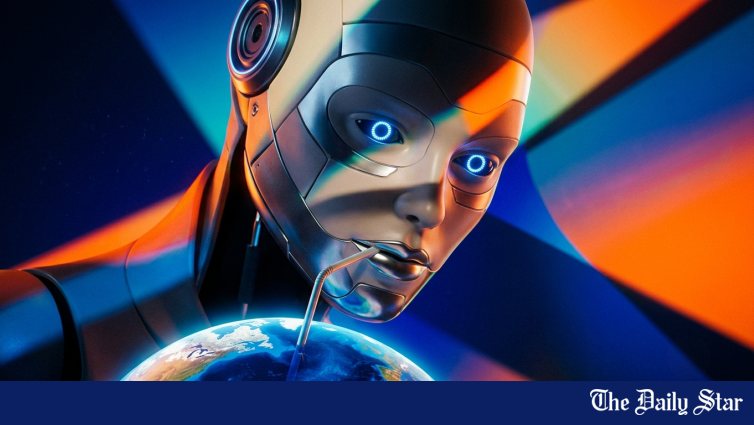
Need help writing something or generating an image? But behind every answer lies a hidden thirst for our freshwater. Artificial intelligence has quickly become a part of our daily lives, something we look up to every minute. Beneath every prompt we type lies a hidden cost that most of us know about: freshwater.
When we ask an AI chatbot our queries about something, it may seem like nothing more than just information about it appearing on a screen. But in reality, our small requests travel to massive data centres filled with thousands of powerful computer chips working around the clock.
These machines generate an enormous amount of heat, and just like any other device that overheats, what they need is cooling. The main difference is that AI servers operate on a much larger scale, often requiring large quantities of fresh water to keep the temperature under control.
The freshwater is primarily used in the cooling system. Many data centres depend on evaporative cooling, a process in which water absorbs the heat and evaporates. More water is also consumed indirectly through electricity generation because power plants often require water to produce energy, which keeps the AI systems running.
To be exact, AI does not drink water itself, but the infrastructure supporting it certainly does. The concern begins when we look at the numbers. The University of California, Riverside, researcher found that a series of 20 to 50 AI queries can consume around 500 millilitres of water when both direct cooling and electrical water usage are included.
If we look closely, that translates to roughly 10 to 25 millilitres per prompt, but some studies place the figure a bit higher than this, at around 10 to 50 millilitres per response. However, the answer is not as straightforward as we think it is.
OpenAI CEO Sam Altman has mentioned that a typical ChatGPT question uses only about 0.32 millilitres of water. Why the difference in result, we might think, right? The difference exists because companies and researchers usually measure water use differently.
Some count only the water directly used inside the data centre; however, others include the water required just to generate electricity. Both figures are technically correct; they just describe different parts of the same process.
Regardless of the result, even if the amount per search appears small, the impact of it grows when billions of people use different AI tools every day. Industry estimated that AI services process billions of prompts daily, turning small amounts of water into millions of litres consumed around the world.
A single large data centre can use up several million gallons of water per day, which can be used by a small town.
The demand for AI does not end with just answering the questions we ask. Training AI models is even more resource-intensive. Researchers claimed that training GPT-3 consumed approximately 700,000 litres of freshwater. Companies are always in a race to build more advanced systems.
So, eventually, the number of data centres and tier water requirements is expected to increase rapidly. We know it is now impossible to stop using AI, but we should be aware of the resources behind the convenience.
In the same way we are conscious about our electricity consumption and using plastic, we may also need to think a little more about the hidden water footprint of our digital habits.
The next time we open AI and use it to get any answer within a second, we need to remember that somewhere, behind the screen and algorithms, we are giving up our freshwater resources for that answer.