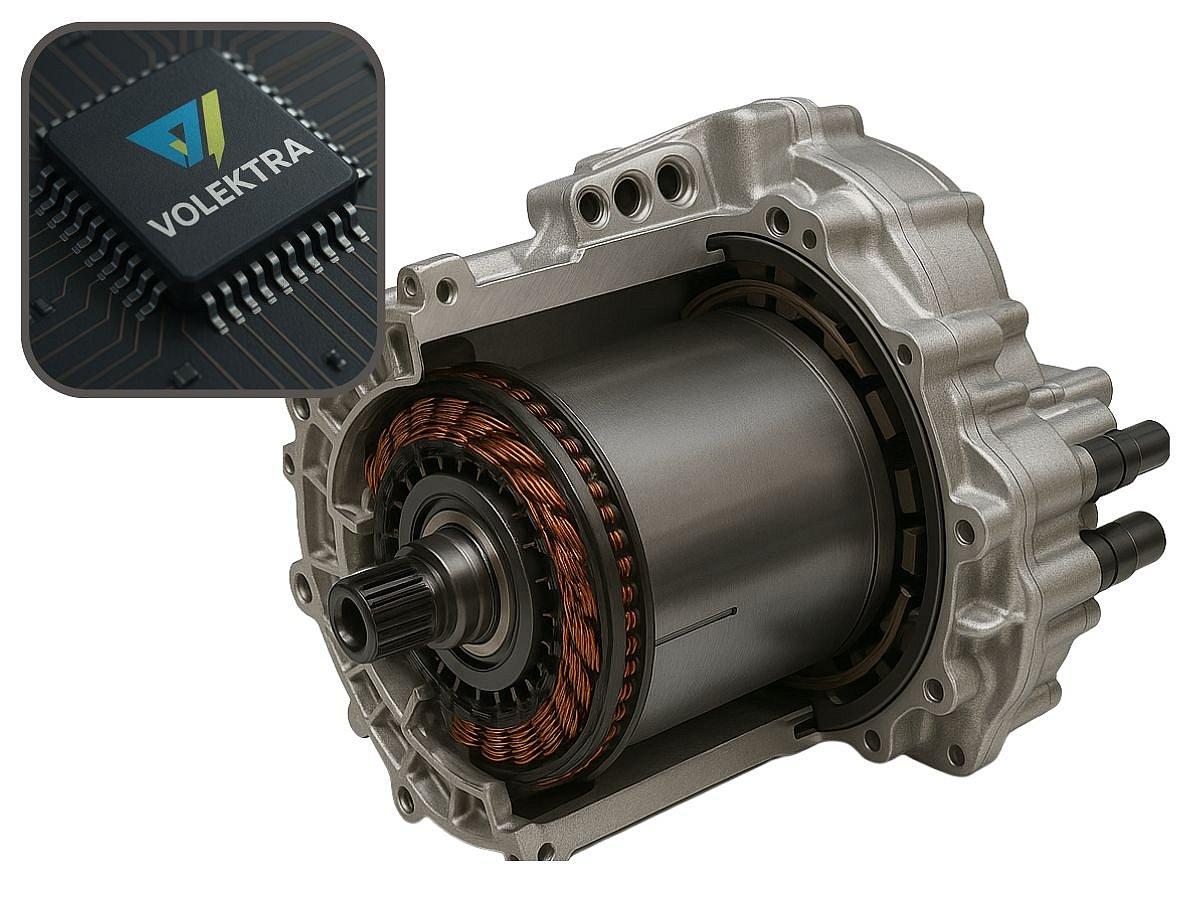
How VMSM could revolutionise rotor production
By eliminating permanent magnets entirely, Vimag’s design shifts the rotor toward a more conventional synchronous or wound-field-like architecture (likely using ferromagnetic materials, copper windings or excitation systems, and a robust core), with the “virtual magnet” effect handled externally through electronics and software.
Potentially, it could lead to simplified structure and fewer parts.
Rotors become primarily laminated steel cores with possible excitation windings or salient poles, without embedded magnets.
This reduces assembly steps: no magnet insertion, gluing, balancing for magnet placement, or specialised retainers.
Manufacturing resembles established induction motor or wound-rotor processes, which are already mature and scalable.
While VMSM cuts direct material costs and exposure to price swings, it could also lead to easier and faster assembly, reduced risk of defects during handling, faster production lines and lowers scrap rates.
Automation becomes simpler without dealing with strong magnetic forces that can interfere with robotic assembly.
Improved thermal, mechanical flexibility
Without demagnetisation risks, designers can optimise for higher operating temperatures or simpler cooling systems.
Rotors may also be lighter or more compact in some configurations, improving overall power density and manufacturing tolerances.
Perhaps the biggest upside: It could also enhance scalability and supply chain resilience — localised production in India or elsewhere becomes viable without rare-earth dependencies, supporting rapid scaling for India’s EV market (two- and three-wheelers especially) and exports.
This could also make end-of-life rotors easier to recycle using standard scrap processes, with no hazardous rare-earth separation needed. This aligns with circular economy goals and regulatory pressures.
Software-driven iteration
Performance tuning (torque, efficiency, field weakening) moves largely to algorithms and over-the-air (OTA) updates rather than hardware redesigns. This accelerates development cycles and allows rotor variants without full retooling.
Reducing dependence on China
To reduce this dependence, governments, universities, national laboratories, and automakers worldwide are developing electric vehicle (EV) motors that use little or no rare earth elements.
In the United States, organisations such as Oak Ridge National Laboratory, the US Department of Energy, General Motors, Stellantis, Tesla, and Niron Magnetics are leading these efforts.
Similar initiatives are also underway in Europe through collaborations like the Passenger consortium.
Suppliers and tech developers
-
Valeo + Mahle (iBEE motor): Jointly developing high-power magnet-free externally excited synchronous motors (up to 350 kW) for upper-segment EVs. Targets series production around 2028.
-
ZF Friedrichshafen: Developed the compact I²SM (In-Rotor Inductive Excited Synchronous Motor), a highly efficient magnet-free design.
-
Advanced Electric Machines (AEM, UK): Specializes in magnet-free motors (e.g., SSRD). Has major development contracts with Tier 1 suppliers and Asian automakers; targeting series production by end of the decade.
-
Niron Magnetics (US): Developing iron-nitride (“Clean Earth”) permanent magnets that are rare-earth-free. Backed by GM, Stellantis, and others; building commercial production facility.
Notable startups
-
Vimag Labs (Bengaluru, India): Recently secured patents for its Virtual Magnet Synchronous Motor (VMSM) — a software-defined, magnet-free design using power electronics and algorithms. Raised $5M Series A in 2026; in pilots with two- and four-wheeler makers.
-
Ola Electric (India): Received government approval for in-house ferrite (rare-earth-free) motors for scooters/motorcycles.
-
Conifer (US): Developing axial-flux motors optimized for ferrite magnets (abundant and cheap).
-
Others: Chara Technologies, Numeros Motors (India), Enedym (switched reluctance motors, backed by Honda), Emil Motors, and C-Motive (electrostatic motors).