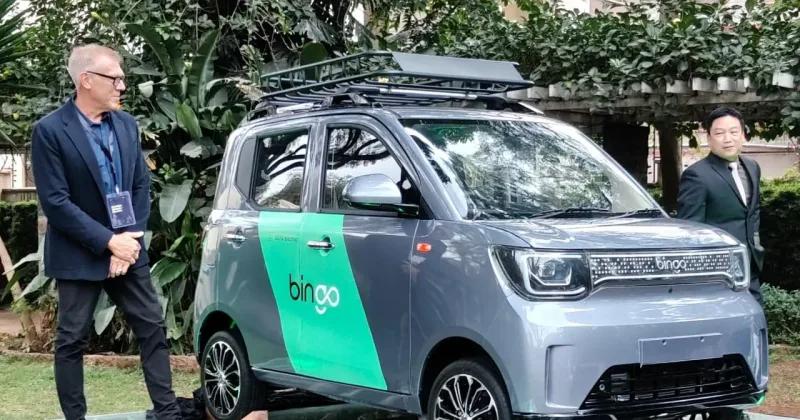


California-based EV startup Bingo has officially entered the Kenyan market, unveiling its E2 electric vehicle for ride-hailing and last-mile delivery drivers and betting on battery-swapping technology and local assembly to bring ownership costs down.
The E2 is built around a dual-battery setup: a fixed battery paired with four swappable battery modules, giving the vehicle a claimed range of up to 440 kilometres on a full charge. Rather than requiring drivers to plug in and wait, depleted battery modules can be swapped out in around two minutes. Bingo also plans to build out battery-swapping stations, DC fast chargers and roadside battery support across the country to address charging infrastructure gaps.
Speaking at the Nairobi launch, Bingo co-founder Christian Scheder framed the rollout as more than a vehicle launch, describing it as the start of a full support system built around ride-hailing and delivery drivers.
The E2 is a compact four-seater, homologated as an L7e heavy quadricycle, and is up for reservation locally at an estimated price of KES 1.8 million, with shipping expected in the fourth quarter of the year. The company — founded by mophie creator Daniel Huang and backed by Trucks VC, Delta40 and a group of family offices — is positioning Kenya alongside South Africa as its first African markets, pointing to government EV-friendly policy and investment in renewable energy as reasons the country is emerging as one of the continent’s stronger electric mobility markets.
Bingo’s entry adds to a growing field of EV and battery-swapping players betting on Africa’s ride-hailing economy, joining companies like Spiro, Kenya’s Arc Ride, and Rwanda’s Ampersand in a sector that has increasingly drawn investor interest for its combination of physical infrastructure and predictable, asset-backed cash flows.
Source link
![Startup unveils game-changing tech that could revolutionize EVs: 'Represent[s] the future'](https://newsx.io/wp-content/uploads/2026/02/Startup-unveils-game-changing-tech-that-could-revolutionize-EVs-Represents-the.jpeg)