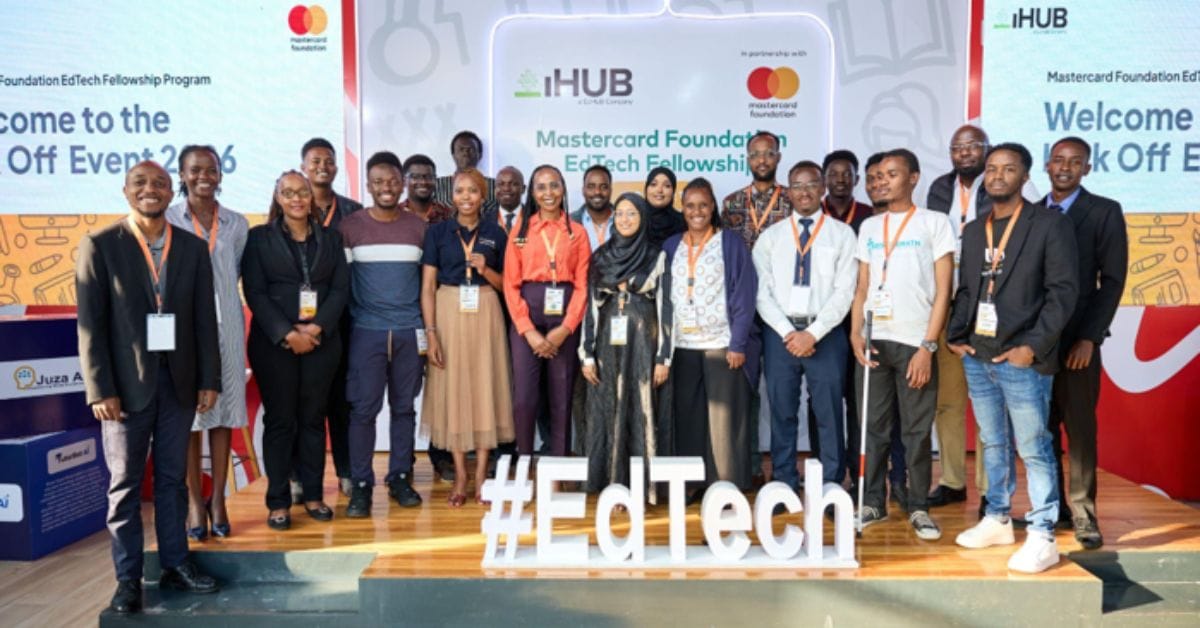
iHUB and the Mastercard Foundation have selected 12 early-stage Kenyan startups for an 18-month EdTech fellowship offering each company up to $100,000 in equity-free funding — with the cohort weighted toward assistive technologies and AI-supported learning products built for learners the education system has historically failed to reach.
The fourth cohort marks a deliberate reversal of the programme’s earlier design. Previous editions ran eight months and targeted growth-stage companies with existing traction. This one runs more than twice as long and backs younger startups building for learners with disabilities, refugees and displaced communities, girls and young women, and people in rural and underserved areas.
The selected companies are DEAFHEALTH, AssistiveMath, Signvrse, Deaf Outreach Program, SmartSteamMinds Edtech, Chipurobo, Neurollect Audread, JUZA AI, Ubuntu Universe, RYEH CBO, Gwiji for Women and Tausi App.
Six of the twelve — DEAFHEALTH, AssistiveMath, Signvrse, Deaf Outreach Program, SmartSteamMinds Edtech and Chipurobo — are building assistive technologies, learning platforms, digital skills programmes and specialised education products for learners with disabilities. Signvrse’s sign-language work sits inside a growing African assistive-AI category that iAfrica has tracked through Kenya’s own AI for Disability project with Huawei and the Kenya Institute of Special Education.
Four more — Neurollect Audread, JUZA AI, Ubuntu Universe and RYEH CBO — are building multilingual, offline and AI-supported learning products aimed at refugees, displaced people and learners in rural and underserved communities. The offline requirement is the technically interesting constraint: AI-supported learning that has to function without reliable connectivity is a materially harder engineering problem than the cloud-dependent products dominating global EdTech, and one that maps directly onto the infrastructure realities across much of East Africa. Gwiji for Women and Tausi App focus on entrepreneurial, vocational and digital skills for girls and young women.
Each startup receives up to $100,000 without giving up equity, alongside technical support covering product development, business strategy, communications and pilot testing, plus access to iHUB’s partner network and support with investor engagement.
“Innovation has the greatest impact when it begins with the learners who have historically been excluded,” said Nissi Madu, managing partner at iHUB. Over the 18 months, she said, iHUB’s role is to help the companies test, refine and “generate evidence for their solutions” while building businesses that can sustain themselves.
That emphasis on evidence lands pointedly. When ADQ and the Gates Foundation announced a $40 million AI and EdTech partnership for sub-Saharan Africa in December, the accompanying analysis found that more than 93% of education technology products in low- and middle-income countries are never tested for proof of learning impact, and that sub-Saharan Africa attracts just 2% of global EdTech venture capital while only 4% of children in the region consistently use digital learning tools. An 18-month programme built around pilot testing and evidence generation is a direct response to the first of those gaps; the equity-free structure addresses the second.
The fellowship has now supported 36 Kenyan EdTech companies since launching in the country in 2023. Those companies have reached more than 700,000 learners and 11,000 educators across more than 2,100 schools, according to iHUB and the Mastercard Foundation, with over 6,000 learners with hearing and visual disabilities using products developed by participating companies.
M-Lugha, which joined in 2025, offers the clearest illustration of what the programme is aiming at. The language-learning platform says it has reached 14,000 learners across 35 Kenyan counties and been downloaded in 130 countries. “The program helped us move beyond building technology to creating meaningful learning experiences,” said founder Abdinoor Ali Mahdi, pointing particularly to underserved communities where access to quality education remains constrained.
The Mastercard Foundation launched the EdTech Fellowship in 2019 through its Centre for Innovative Teaching and Learning, and runs it with technology hubs and EdTech accelerators across Africa.
The cohort arrives during a dense run of African AI and digital skills programming — Tomorrow Foundation’s 100 Million Learners rollout in Nigeria, Tech4Dev’s Women Techsters Sprint Program in Ghana, Google’s reopened Hustle Academy across three markets, and Cassava’s AI Skills and Compute Africa Foundation. What separates this one is its target population. Most of that wave aims at scale: hundreds of thousands or millions of learners, typically reachable through existing digital channels. iHUB’s fourth cohort is deliberately aimed at the learners those programmes structurally miss — deaf students, refugees without connectivity, girls outside the formal skills pipeline. Whether 18 months and $100,000 per company is enough to produce durable products for those groups, rather than well-documented pilots, is what the evidence-generation framing will be measured against.