The most valuable thing a premium electric cab operation sells is not the vehicle. But it is the phone call that never comes at 5:40 a.m., saying the airport ride has been cancelled. That distinction is easy to state and expensive to build. Anybody with a balance sheet can place an order for electric sedans. What cannot be purchased is a depot with enough power to charge them before dawn, a chauffeur who has been trained rather than merely onboarded, and a fare that holds steady when it rains at 6 pm on a Friday.
Electrification, in other words, is the part of the model that arrives on a delivery invoice. Reliability has to be manufactured daily, in shift rosters, charging schedules and utilisation targets. The Indian market has spent a decade solving the first problem. The second is what will separate the operators that scale from the ones that simply expand.
The Depot Problem
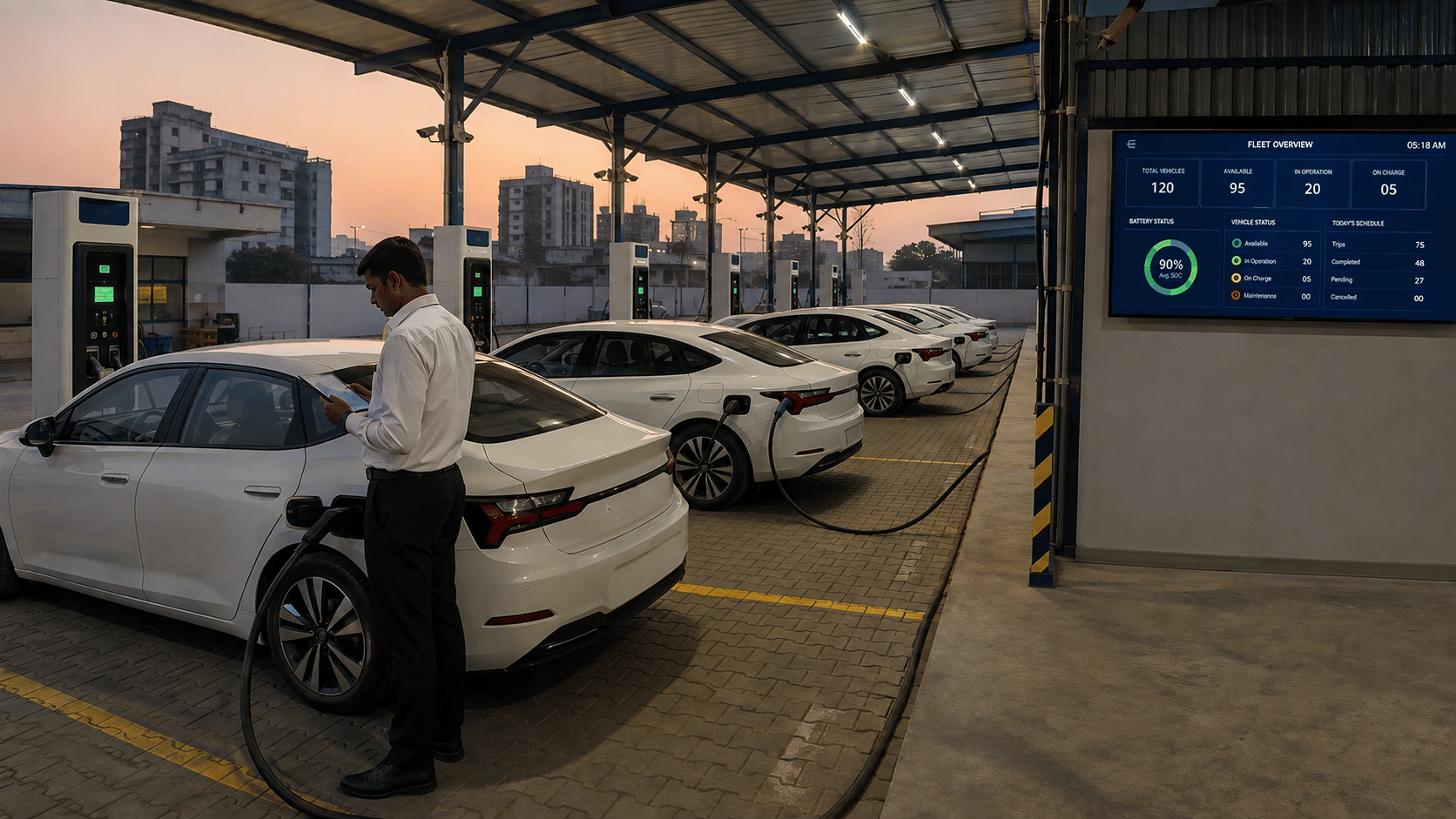
Charging is usually discussed as an infrastructure gap. For a commercial fleet, it is closer to a real estate and scheduling exercise. India’s public network is widening quickly, with 52,718 public charging stations available as of July 2026, of which 16,561 are equipped with fast charging, according to BHEL data cited by the Press Information Bureau, and policy continues to push it further. Under the PM E-DRIVE scheme, ₹2,000 crore has been earmarked for public charging stations across the country.
That network, though, is designed for private owners who charge at home overnight and occasionally top up in public. A fleet has the opposite consumption profile: heavy daily draw, narrow turnaround windows between confirmed bookings, and no tolerance for a queue at 5 am. Scaling therefore means securing depot land near demand clusters, negotiating commercial power tariffs, and designing driver shifts around charge cycles rather than passenger demand alone. Operators who treat charging as a procurement line rather than an operating design constraint tend to stall somewhere around the hundredth vehicle.
Trained, Not Onboarded
The distinction matters commercially. Onboarding adds a driver to a platform. Training produces a chauffeur who arrives early, does not renegotiate the destination and cannot cancel because a better fare appeared elsewhere. The first is a marketplace transaction. The second is an employment relationship, with salary, background verification and supervision attached, and it carries fixed costs that aggregator models are deliberately structured to avoid.
Owning the fleet is what makes this relationship possible. When the vehicle belongs to the operator rather than the driver, service standards can be specified rather than requested, and reliability becomes something a corporate travel desk can contract for. In-cab AI monitoring, live ride tracking and consistent vehicle condition follow from the same structural choice. None of it is available to a platform that only brokers a match between a passenger and an independent driver.
The Fare That Holds
Surge pricing is often described as a market mechanism. From the passenger’s side, it functions as a penalty applied at the exact moment the ride is least optional. A fixed upfront fare that holds through rain, peak hour and airport rush is therefore a genuine product feature, and combined with a zero-cancellation commitment, it converts reliability from a claim into a standard.
This approach also represents a more challenging commercial position. Fixed pricing means the operator absorbs demand volatility instead of passing it on to the customer, which is only survivable at high and predictable utilisation. This is why the premium segment gravitates towards pre-booked airport transfers, corporate accounts and hourly rentals rather than open-market street demand. Business travellers willingly pay the difference because a missed flight costs considerably more than the fare gap.
Capital That Can Wait
All of the above is funded years before it earns. India’s EV ecosystem raised over USD 1.4 billion in FY 2025, roughly 27% more than the previous year, though close to USD 1.2 billion of that went to manufacturers. Service-layer businesses competed for what was left.
Several of the more credible premium fleet ventures have consequently been built on promoter capital from established industrial groups rather than conventional seed and Series A rounds. The trade-off is deliberate. Balance-sheet backing removes the pressure to show steep growth before unit economics settle and buys the three to four years that depots, charging capacity and chauffeur pipelines genuinely take. Venture timelines and fleet timelines are not the same thing, and conflating them has ended more mobility ventures than any charging shortfall.
Policy Is Resetting The Arithmetic
Adoption is no longer the variable. Electric penetration reached 8.26% of new vehicle sales in FY25-26, according to an August 2026 PIB backgrounder. Regulation is now doing what marketing budgets could not. In June 2026, a two-year scheme with an outlay of ₹9,585 crore was approved to replace roughly 2.07 lakh ageing commercial vehicles across Delhi-NCR. Interventions of that scale reshape commercial fleet economics faster than consumer preference does, and they land hardest in exactly the dense urban corridors where premium managed fleets have chosen to begin.
In sum, expansion is a purchasing decision; scale is an operating one. The operators that reach five hundred vehicles will be those that built power capacity, chauffeur pipelines and utilisation discipline before the volume arrived and priced their service so it never has to break a promise made in the early hours.
Sahil Jindal is Co-founder of Trevel and Managing Director of the Jindal Group. Views expressed are the author’s personal.