Author | Q Xiaofen
Editor | Yuan Silai
Up to now, Zhang Yi, the founder of Not Far Future, still occasionally recalls those seagulls in a daze by the Mediterranean seaside five years ago.
He had just experienced extreme ups and downs that ordinary people could hardly imagine. In June 2021, “Zhangmen Education” founded by Zhang Yi was listed on the New York Stock Exchange. On the first day of listing, the company’s market value once exceeded 3 billion US dollars. At the peak of his success, this online education company had 100,000 employees and 60,000 to 70,000 teachers across the country, serving more than 1 million families.
Zhang Yi was only 31 years old at that time.
The turning point came 48 days later. The “Double Reduction” policy was officially implemented, and China’s online education industry was almost wiped out overnight. Within three months, “Zhangmen Education” laid off 100,000 employees at one go. Within a year, the company initiated the delisting process.
“I was very depressed at that time and didn’t know what else I could do”. He wandered aimlessly around the world until he arrived at a city on the Mediterranean coast.
He stayed in the hotel every day looking at the sea view, and a group of seagulls on the beach not far away were also looking at the sea view. Suddenly one day, Zhang Yi looked at the seagulls and felt a little panicked: “If I live such an idle life, what is the difference between me and the seagulls on the Mediterranean coast?”
Zhang Yi immediately bought a flight ticket to Silicon Valley.
At that time, GPT-3 had already come out, ChatGPT had not been released yet, and on the eve of the AI boom, “embodied intelligence” had not really sprouted. After visiting scientist friends at Google and Meta, he keenly captured a judgment that is now a consensus but was very pioneering at that time — large AI models are not just chat boxes, but a “scheduling system” that can understand human intentions, schedule different capabilities to complete tasks, and even become the “brain” that schedules robots to wipe tables and do cleaning.
With this judgment, he then made a large number of user surveys in North America and China, and finally locked in a brand new entrepreneurial direction: building household robots.
But the price of being ahead of the curve is often not being understood.
A close investor friend out of kindness strongly advised Zhang Yi to return to the familiar education field, and vowed: “AI + education will definitely be a hit next year, if you don’t believe me, I will jump off here.”
Zhang Yi did not waver, and founded “Not Far Future”. It was September 2022, when Tesla’s Optimus prototype walked onto the stage without a tether and waved for the first time, and Tesla also played a video of the robot moving boxes at the Montreal factory. This was the first time that the narrative of humanoid robots was spread from the academic circle to the global media. Zhang Yi, who had been in the family business for 7 years, did not follow the trend, but chose the hardest, slowest and most failure-prone home scenario.
“Everyone dares to think about (household robots) but no one dares to do it. If I want to do it, I will directly aim at the final form”, in his view, there is only one way to send household robots into every family: the price must be low enough to be unnoticeable, and directly cut into the rigid needs of users to do real work.
In the following 4 years, Zhang Yi was almost in a state of invisibility. In the first three years of his second venture, Zhang Yi hardly introduced external financing and paid more than 100 million yuan out of his own pocket.
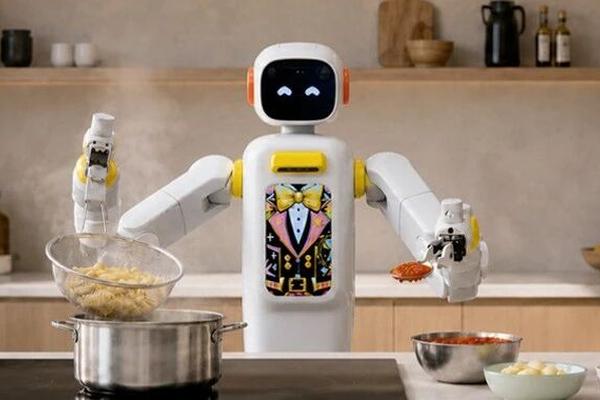
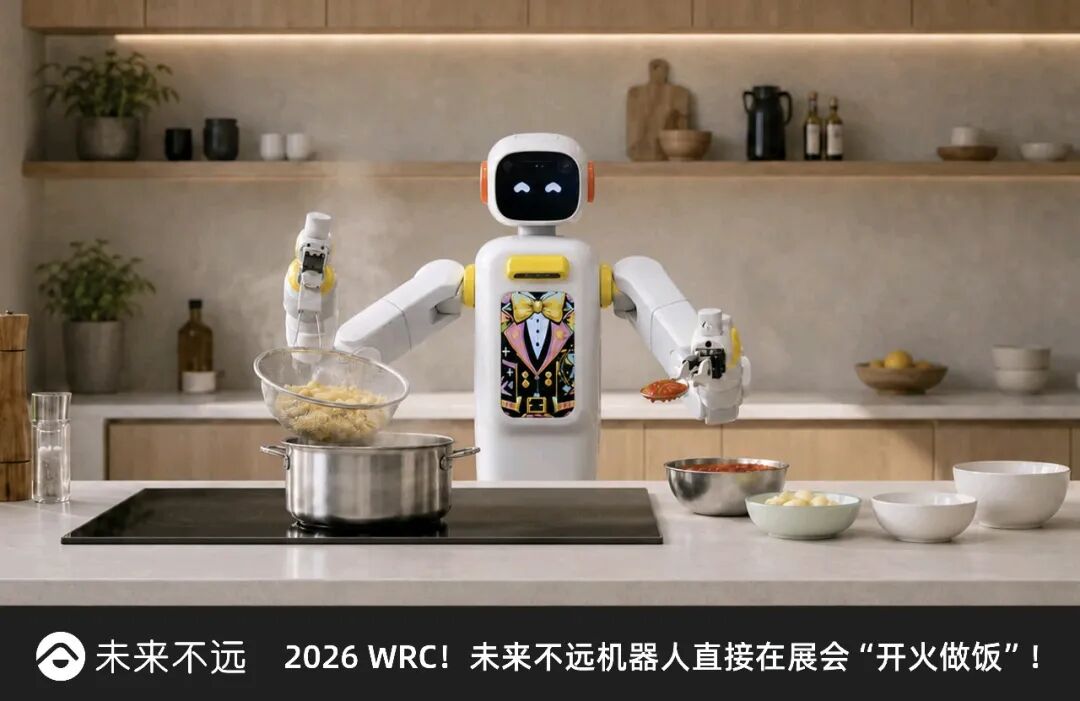
The team of “Not Far Future” has iterated 16 generations of robots, and from the very first robot, they have “fixed” the price at the consumer level, and then forced the technology to reduce costs. Since they could not afford expensive industrial robotic arms, they independently developed large hollow motors, joints and torque sensors, and at the same time used a large number of general parts from mature industrial chains such as sweeping robots.
In the end, they reduced the cost of robots that usually cost hundreds of thousands of yuan in the industry to 20,000 to 30,000 yuan, and opened them to families for trial use at a rental price of 3,000 yuan per month.
In terms of robot brain, “Not Far Future” does not fully bet on general VLA, but chooses a combined route that emphasizes reliability. They independently developed a set of AVLA models, which split complex tasks into hundreds of shorter “expert models”, such as grasping, fine operation, etc., train each separately, and then the scheduler combines and calls them according to the environment.
Zhang Yi believes that compared with a general VLA with an ultra-long sequence, this method, although sacrificing some of the imagination of “unification”, can effectively improve the success rate of each step of execution.
On top of AVLA, they also superimpose the prediction capability of the world model. Before the robot actually takes action, the world model will first “think out” multiple possible action paths and predict the success rate of different paths. When the brain confirms that the risk is low enough, it will be handed over to AVLA for execution. That is to say, the world model is responsible for prediction, and AVLA is responsible for reliably executing the actions.
This year, this route has further evolved into Self-Evolving WAM (Self-Evolving World Action Model) . That is to say, every time the robot enters a real home to perform a task, it not only completes an action, but also precipitates the prediction, actual results and failure cases into training data, making the next judgment more accurate.
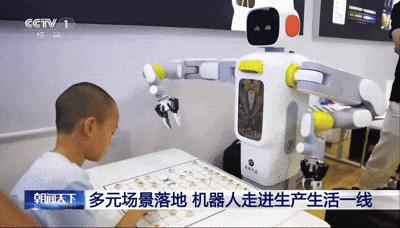
At present, their robots have entered about 500 households in Shanghai, and the reservation was once scheduled to the end of the year.
(Photo source / the enterprise)
Zhang Yi has waited for the tuyere again.
Four years after he started his business, home has become one of the hottest scenarios for embodied intelligence.
The driving force behind this is that capital no longer pays only for backflips and demos, but pays more and more attention to real scenarios and commercialization. In addition, homes can generate real data that hardly exists in factories — tables with one shorter leg, suddenly appearing children, slippers whose positions change every day. These corner cases are almost impossible to exhaust in the laboratory.
“Not Far Future” has suddenly changed from a former “outsider” to a company standing on the tuyere.
In half a year, the company has completed a total of three rounds of financing of nearly 1 billion yuan — in January 2026, “Not Far Future” completed 200 million yuan angel round financing; in March, the company completed several hundred million yuan financing led by Boyu Capital; in July, it completed the Pre-A round of financing. Hard Krypton exclusively learned that one of the investors of this round is ByteDance.
After all, Zhang Yi is an entrepreneur who has seen and experienced the ebb and flow of the tide, and he is rarely carried away by success.
“What embodied intelligence entrepreneurship lacks the most now is money, but if you raise a lot of money very early and the repurchase period comes when the industry is not yet mature, it will be very troublesome”, Zhang Yi said, “Entrepreneurs must think: what is left when the tide recedes?”
(Photo source / the enterprise)
Recently, Hard Krypton talked with Zhang Yi about his experiences in the past four years and his judgment on household robots. (Edited after partial excerpt)
From laying off 100,000 employees to investing 100 million yuan of his own money to start a business
Hard Krypton: The Double Reduction policy had a huge impact on you at that time. After experiencing layoffs, listing and then delisting, how did you get through this trough period?
Zhang Yi: The lowest point was the second half of 2021, when the business of the former company stagnated and 100,000 people were laid off in three months. I felt very depressed at that time. Later, I was in a semi-retired state for a period of time, wandering around. Once I wandered to a small island in Europe called Three Sisters City, which is the prototype of King’s Landing in *Game of Thrones*.
This island is in the middle of the Mediterranean. I just stayed in the hotel and looked at the sea view every day. The seagulls next to me were looking at the sea view just like me. At that time, I had an epiphany: if a person lives like this, there is no difference from a seagull. I still need to do something meaningful.
At its peak, “Zhangmen One-on-One” had 100,000 employees and 60,000 to 70,000 teachers. I was 31 years old when the company went public, and many people in the team were also in their early 30s. We still have decades of life ahead of us. I thought that even if I switch to a completely different industry, there is enough time to do it well.
Hard Krypton: How did you find the robot direction in 2022 specifically?
Zhang Yi: After the Double Reduction policy, I didn’t know what to do, so I went to Silicon Valley and stayed there for a while. At that time, GPT-3.0 was released, and I visited many of my classmates who worked on AI in Silicon Valley, including those at Google and Meta.
At that time, language models could already have conversations and solve thinking problems through the token method. I judged at that time that large models might become a scheduling system in the long run, scheduling various subtasks — even letting robots wipe tables and do facade cleaning.
Later, I sent out a lot of questionnaires in the North American and Chinese markets, the core topic of which was: what functions do household robots need, and how much are you willing to pay for them. After the survey, I found that household robots can indeed meet the core needs of users, and it is a high probability event that every family will buy one, so I directly started to do this.
In addition, my previous education business was for family users, and I had accumulated more than 1 million family users. I used to study at the School of Electronic Information and Electrical Engineering of Shanghai Jiao Tong University. Although I haven’t been engaged in this field for about 7 years, I still have a solid foundation.
Hard Krypton: In 2022 when you started your business, the term embodied intelligence was not yet popular. Could the investors at that time understand your entrepreneurial idea?
Zhang Yi: They couldn’t quite understand. At that time, AI was the hottest field. An investor said to me, “You must do AI education, AI + education will definitely be a hit next year, if you don’t believe me, I will jump off here.” I replied that I wanted to do household robots. At that time, everyone thought this was a very distant thing, and even now it is the same.
Hard Krypton: Why did you refuse the investor’s suggestion at that time?
Zhang Yi: At that time, I thought AI education didn’t make sense. The essence of AI education is AI rather than education. Pure software things change too fast, and they will eventually become the world of large factories, and the success rate of startups is very low. Entrepreneurship is a competition of short boards, you have to try your best to lengthen every board to have a chance. Looking back now, the current situation of the AI education industry has also verified my judgment at that time.
Hard Krypton: You started your business in 2022, but you have made frequent moves this year, promoting financing, public release and so on. What did you experience during these three “silent periods”?
Zhang Yi: We didn’t raise external financing in the first three years for several reasons. First, I have experienced the “Double Reduction” policy. I will not raise financing until I am sure that the product can be sold, otherwise there are many costs of financing, such as possible repurchase obligations. The reason why I didn’t want to raise financing in the early stage is that I can pay for it myself, and I have invested more than 100 million yuan of my own money.
Second, there was no concept of “embodied intelligence” in 2022, and it was very difficult for me to tell this story to change investors’ minds. Third, I didn’t want to start the involution at the very beginning. If I get the money, many people will get the money and start the involution immediately. My philosophy is that I want to make this thing a success, not just make a quick buck.
Household robots: everyone “dares to think but dares not do”
Hard Krypton: After you came back from Silicon Valley, how did you start your robot entrepreneurship specifically?
Zhang Yi: After returning to China, I went to ZhenFund to learn about robots for a period of time. At that time, everyone said that they would eventually make household robots, but in practice, they all did other things first, such as making sweeping robots and lawn mowers first, and then adding an arm to them later. I found this phenomenon very interesting, everyone wants to make household robots but no one dares to do it. For me, if I want to do it, I will directly do the final thing.
Hard Krypton: Why don’t you want to follow most people’s path and iterate step by step first?
Zhang Yi: Because you will find yourself falling into another competition. For example, when allocating resources, do you allocate them to the current battle or the next battle? So I want to directly do to-C business, even if I have to spend more money, I am willing to do it.
I have observed the sweeping robot industry. Ecovacs was the first to make it, and now they rank first in market share. The second is Roborock, which used LDS (Light Detection and Ranging) to innovate the industry. Then there are Dreame and Narwal, who added floor washing functions to the sweeping robots. Each iteration makes the track a little larger, and the penetration rate gradually increases. But the sweeping robot track is too small. After iterating to the floor washing function, the innovation seems to stop, and it becomes the involution of price.
However, the household robot track is very long — for example, it can do floor cleaning in the first year, take care of children in a few years, and take care of the elderly in a few more years. The track is constantly expanding and the ceiling is constantly rising. But you must also reach the critical point of price and technology at a certain time to achieve part of commercialization. At that time, I expected that it would take three or four years to reduce the cost of robotic arms to the consumer level of several thousand yuan, but it actually took four or five years to complete.
Hard Krypton: But this year, suddenly all companies are talking about the narrative of entering households. How did this boom rise?
Zhang Yi: There are three reasons behind it: First, many robot companies want to enter households to collect data, because this part of real data is almost zero, and there are no these corner cases in factories;
Second, only when embodied intelligent robots enter households can the entire industry grow bigger, just like every family buys a car. Otherwise, the entire embodied intelligence industry may become a huge “bubble”;
Third, many previous investors thought that the home scenario was very distant, but finally found that we can indeed land the product, so a wave of follow-up investment emerged. In addition, the valuation of those existing companies in the previous wave was very expensive, and everyone was looking for new stories.
But I don’t care about all these things. I started to enter households four years ago.

Source link