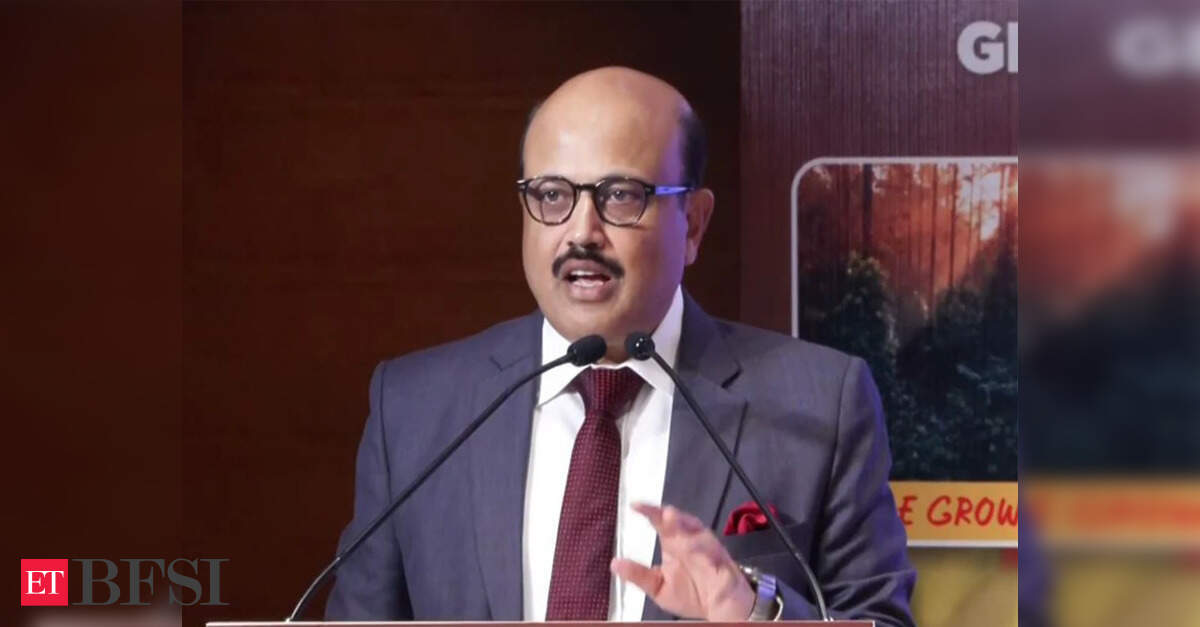



India has the opportunity to expand its fintech services exports nearly tenfold, from around $8 billion currently to $60-80 billion, by taking its digital infrastructure, technology capabilities and fintech solutions to global markets, Commerce Secretary Rajesh Agrawal said at the Global FinTech Fest 2026 on Wednesday.
Agrawal said India’s experience in building digital public infrastructure and delivering financial services at scale gives its fintech ecosystem a strong foundation to address similar challenges in emerging economies, particularly across the Global South.
“If we can partake even 10% of the trade we are talking about, we are talking of a journey of $8 billion to maybe $60 to $80 billion. That should be something that we should look at,” Agrawal said.
He said the opportunity would require closer coordination between government, regulators, startups, financial institutions and partner countries, with fintech increasingly becoming an integral part of India’s trade and economic diplomacy.Fintech-led credit could unlock e-commerce exports
Agrawal identified e-commerce exports by small and medium enterprises (SMEs) as one area where fintech could have an immediate impact.
India is promoting e-commerce exports to bring more SMEs into the global export ecosystem, but access to working capital remains a major constraint for businesses that often lack conventional credit histories or collateral.
He cited the example of an e-commerce exporter that has secured overseas orders but needs short-term capital to fulfil them. While the business may have a visible pipeline of potential sales, traditional lenders may still be reluctant to extend credit without collateral or an established credit history.The Commerce Ministry is therefore experimenting with a Niryat Credit Card for e-commerce exporters and is looking for fintech companies and startups that can develop technology-led short-term credit solutions.
“If SMEs are going to export and they need credit, banks may want collateral. They don’t have any credit history. But there is a potential sale happening on the e-commerce platform. Can we use that to provide some sort of credit?” Agrawal said.
“We look forward to some startups, some fintech solutions coming around that, creating a model or an application which can enable all e-commerce exporters to access short-term credit to meet their fulfilment requirements.”The potential market is significant. Global e-commerce trade is currently estimated at around $1 trillion, while India’s e-commerce exports are only around $5 billion, Agrawal said.
He noted that several product categories that are already traded globally through e-commerce platforms—including artificial jewellery and health and wellness products—align closely with India’s manufacturing and entrepreneurial strengths.
The challenge, he said, is to connect Indian SMEs with global platforms and provide them with the credit and operational support required to fulfil orders on time and at the required quality.‘Build in India, design for the world’
Agrawal said India’s fintech and technology ecosystem should now look beyond exporting individual products and instead develop solutions tailored to the requirements of different markets.
“Selling a product that this is a product we have tested in India and it is a fit for you will not work. Working together based on your experience to find similar solutions or better solutions in their economy is the path forward,” he said.
India has already signed agreements or memoranda with 23 countries for cooperation on digital public infrastructure, while digital payments and payment-system interoperability are increasingly becoming part of India’s trade negotiations, particularly with countries where India has a large diaspora.The government is also using free trade agreements to open pathways for Indian financial services companies, including through commitments covering remote delivery of services and the presence of financial institutions across borders.
Agrawal said India has concluded nine free trade agreements over the past five years, covering economies representing around $60 trillion of global GDP, creating a broader platform for Indian goods and services—including financial services—to access overseas markets.
He also pointed to GIFT City’s IFSC as a potential institutional gateway for exporting financial services.
The objective is to build on the financial services that have already moved to GIFT City from overseas centres and eventually use the platform to serve markets where financial infrastructure is less developed.
AI, data privacy and cyber security critical for global expansion
As Indian fintech companies expand internationally, Agrawal said technology alone would not be enough. Trust, cybersecurity, data protection and regulatory alignment will increasingly determine whether Indian digital financial solutions can travel across borders.
He called for greater use of AI in fraud detection, risk mitigation and improving the efficiency and scale of fintech services.
“When we go cross-border, one of the key challenges that we will have is how we create trust. Cross-border trade and cross-border delivery of financial services will depend upon the trust we are able to convey,” Agrawal said.
He said Indian fintech solutions would need to be customised to local requirements while also meeting global expectations around regulation, cybersecurity and data privacy.
“Responsible technology should therefore not be viewed as a constraint on competitiveness. Increasingly, it is a prerequisite for global competitiveness. In the digital economy, trust itself becomes an export advantage.”
Agrawal said India’s domestic market can continue to serve as a large-scale testing ground for fintech and digital technologies, while international partnerships can become the bridge for taking those capabilities overseas.
According to Agrawal, the combination of India’s digital infrastructure, startup ecosystem, domestic scale, international trade partnerships and growing global demand for digital financial services can position the country as a significant exporter of fintech capabilities.
The next challenge for the ecosystem, he said, is to convert that potential into durable global partnerships and build a more robust financial services export industry from India.
Click here to read our coverage of the Global FinTech Fest 2026
Source link