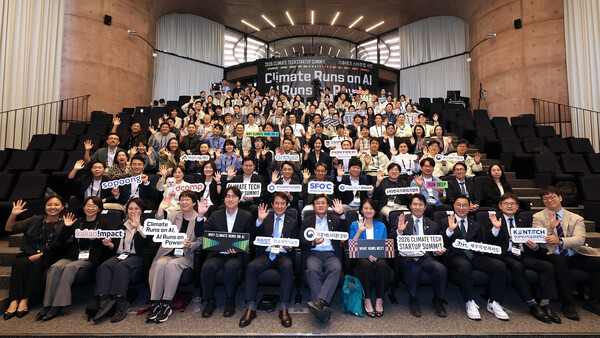
[Digital Today reporter Ho-jung Lee] Kakao Impact Foundation brought together experts in climate tech, AI and energy and moved to expand cooperation among the private sector, government and academia. Marking the event’s fifth anniversary, it also signalled the launch of Korea Climate Week with 11 organisations.
Kakao Impact Foundation said on Sept. 14 it held the Climate Tech Startup Summit (CTSS) in Jeju from Sept. 10 to 12. About 150 people attended, including representatives from climate tech startups, investment and finance firms, government and public institutions, companies, and research and academic circles.
This year’s event ran under the theme, “AI that moves the climate, energy that moves AI.” It addressed both climate response technologies using AI and growing energy issues as AI spreads, including rising power demand from data centres.
In keynote speeches on the first day, Jeon Hae-won (전해원), an associate professor at KAIST’s Graduate School of Green Growth and Sustainability, introduced climate policy analysis and changes in decision-making using AI. Ha Jung-woo (하정우), a standing vice chair of the National AI Strategy Committee, explained data centre power demand and issues in securing computing resources as AI computing expands.
Participants included Kim Sung-hwan (김성환), minister of the Ministry of Climate, Energy and Environment, Ha, Jeju Special Self-Governing Province Governor Wi Sung-gon (위성곤), lawmakers Park Ji-hye (박지혜) and Lee Hak-young (이학영), and KAIST President Bae Chung-sik (배충식).
The event also unveiled plans to launch Korea Climate Week. Kakao Impact Foundation and 10 other organisations, including Sopung Ventures, decided to 추진 a joint event targeting its first edition in September 2027.
Korea Climate Week will focus on expanding cooperation among investors, companies, policy bodies and research institutions, centred on climate tech startups and technologies. Participating organisations also plan to explore ways to connect domestic climate tech companies and technologies with overseas ecosystems.
Over the three days, sessions and discussions covered topics including startup pitching, climate tech investment and capital raising, energy transition and climate AI. A final pitching and awards ceremony for the Climate Tech Startup Challenge was also held with the Ministry of SMEs and Startups, the Korea Entrepreneurship Agency and KAIST.
On the final day, a policy session involving Lee Yu-jin (이유진), secretary for climate, energy and environment at the Presidential Office, also discussed ways to link government policies with the climate tech ecosystem.
The Climate Tech Startup Summit started in 2022. Kakao Impact Foundation said about 580 people from about 420 organisations have taken part over the past five years, and last year it ran a programme linked to the Asia-Pacific Economic Cooperation (APEC) ministerial meeting for small and medium-sized enterprises.
Kim, the climate, energy and environment minister, said, “We will build a foundation at the government level so that technologies held by climate tech startups can expand into global markets.”
Ryu Seok-young (류석영), chairman of Kakao Impact Foundation, said he hopes cooperation among entrepreneurs, researchers, investors and policymakers will lead to a global climate tech ecosystem.