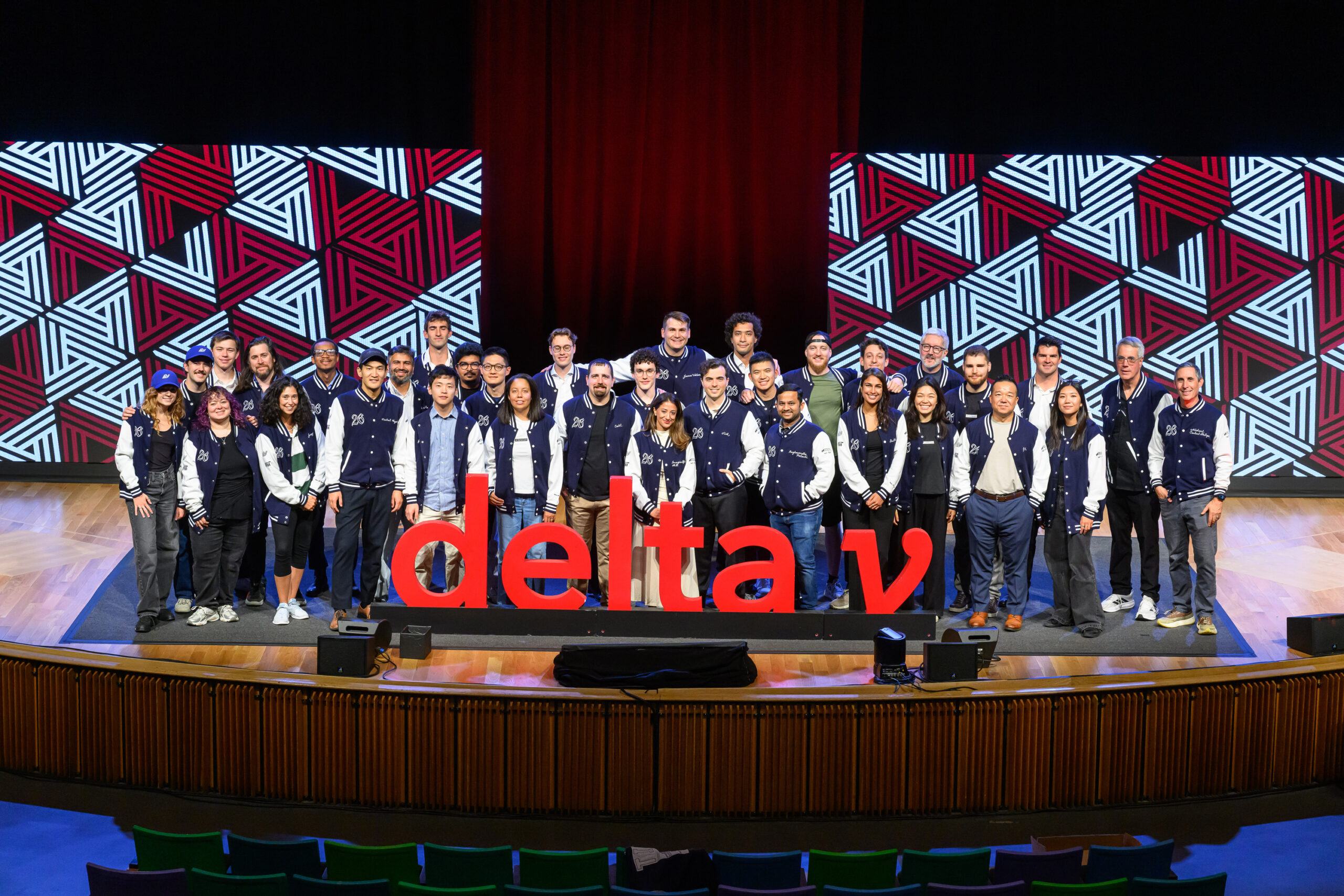
“One of the things I love about delta v is it brings students from all across our community together to approach challenges with different perspectives,” Paula Hammond, dean of the MIT School of Engineering, told the audience. “Their companies are just as wide-ranging. They are working in AI, robotics, health care, aerospace, financial technology, biotech, cybersecurity, and more. At their core, they all share a desire to tackle difficult problems and improve people’s lives.”
This year the Trust Center also announced a new partner model for the delta v program, composed of over 125 leading founders from companies like HubSpot, Okta, and Kayak, along with industry experts and early-stage investors.
The event’s occurrence at the start of the semester is no coincidence: It is timed to attract the next generation of entrepreneurs on campus.
“This is my favorite day of the year,” said Bill Aulet, the managing director of the Trust Center and MIT’s Ethernet Inventors Professor of the Practice at the MIT Sloan School of Management. “Today is about building organizations that will solve the world’s most intractable problems. It’s about more than making money. These presentations will inspire you and make you proud to be a part of the MIT community.”
Artificial intelligence featured prominently in this year’s cohort of companies, which are applying the technology to solve major problems in cybersecurity and manufacturing, improve health care spending, design advanced metal parts, and more.
The company Neural Physics, for instance, is building AI models for manufacturing and other hardware applications. The company’s models are designed to accelerate product design and validation workflows for companies building things like cars, equipment, and machine parts.
“AI can build software overnight,” said co-founder and PhD candidate Mohamed Elrefaie. “AI for software has been solved. The next revolution is physical AI. Design takes too long, and it costs billions. In 1907, it took Henry Ford five years to develop the first Ford car model. Today, it still takes the Ford Motor Company five years to go from design to production. The U.S. advanced manufacturing sector loses roughly $245 billion annually due to engineer delays… [Most] of that time is spent running simulations or making engineering decisions. At Neural Physics, we are building foundation physics models to accelerate those processes.”
Another company, Cerebrus AI, has built a system for detecting when AI agents deviate from approved behavior. The solution builds a baseline of behavior for each deployed agent and monitors their activity to flag unusual behavior that could lead to problems.
“The rollout of revolutionary technology is being held up by three key questions that every executive is asking: Where are my agents? What are they doing? What do they have access to?” co-founder and MBA student Griffin Potrock said. “Security teams want to say yes, but they can’t trust what they can’t see. Cerebrus AI can help those teams.”
The company Talys uses AI agents to help health care organizations find opportunities to lower spending on things like pharmacies, operational processes, and third-party services. The company is already working with health systems and has processed $325 million in spending.
“Decades of attempts to reign in health care spending have fallen short — until now,” co-founder and MBA student Nicolas Berzin said “Why is it so hard? Analytics and dashboards give you pictures of the problem, but not the solution. Meanwhile, consultants are slow and expensive. There are thousands of spend categories, tens of thousands of procedures, and millions of items. Who knows how to save on all of these things? Imagine if you could classify every line, benchmark every item, find every substitution, triage every unprofitable case, and model every scenario across multiple contracts and thousands of procedures and categories like an expert. Talys is a margin-execution system that runs 24/7 to optimize procurement, reduce leakage, and improve case economics.”
Other delta v teams also presented impressive hardware solutions. RBT Resources presented a portable device that simplifies and speeds up blood transfusions, which could be used in hospitals and at the site of traumatic injuries like highways or battlefields.
“Transfusion at the point of injury is an extremely manual process with three key inefficiencies: They are time dependent, gravity dependent, and labor intensive,” explained CEO Anthony Capuano MBA ’26, a former U.S. Navy Seal. “Our goal at RBT Resources is to make transfusions faster and simpler for all medics.”
Gander Robotics developed a low-cost drone submarine that can be used when someone falls overboard on a ship. The hand-thrown, autonomous vessel can sense and travel to the person at sea and give them something to hold onto at the surface, all while providing rescue crews with its exact location.
So-called “man-overboard” situations are surprisingly common on military boats and cruise ships. The device was developed over two years at MIT and the Woods Hole Oceanographic Institute. “Our autonomous rescue swimmer uses a proprietary technique to search with sonar from underneath the surface, where it’s nice and calm even if there’s a storm raging above,” CEO Michael Autery MBA ’26 explained.
The other teams presenting included:
Alpaca is building an integrated ecosystem of hardware and software to allow individuals to host their own frontier AI models without a subscription.
Banzai is building an AI-powered agent to help homeowners, property managers, and asset managers diagnose home repairs faster, improve repair accuracy, and reduce maintenance costs.
Bizon Labs is building a platform for engineering lipid nanoparticles to deliver advanced medicine anywhere in the body.
Cortheon uses AI design optimization to help foundries make complex metal parts at lower cost and with the design freedom of 3D printing.
Exo AI is helping financial institutions automate back-office processes using AI-native software capable of analyzing messy data and connecting fragmented workflows.
Pixology is using agentic AI to help sales teams create visual, engaging pitch materials faster for media rights deals.
Robox is using AI to develop a design engine for physical automation inside systems integrators, robotics firms, and manufacturers.
The Trade Lab is helping importers navigate shifting tariff regulations across the globe and optimize supply chains.