

AI-powered healthcare platform Heidi has secured $475 million in new capital through a blockbuster fundraise that values the business at $1.26 billion.
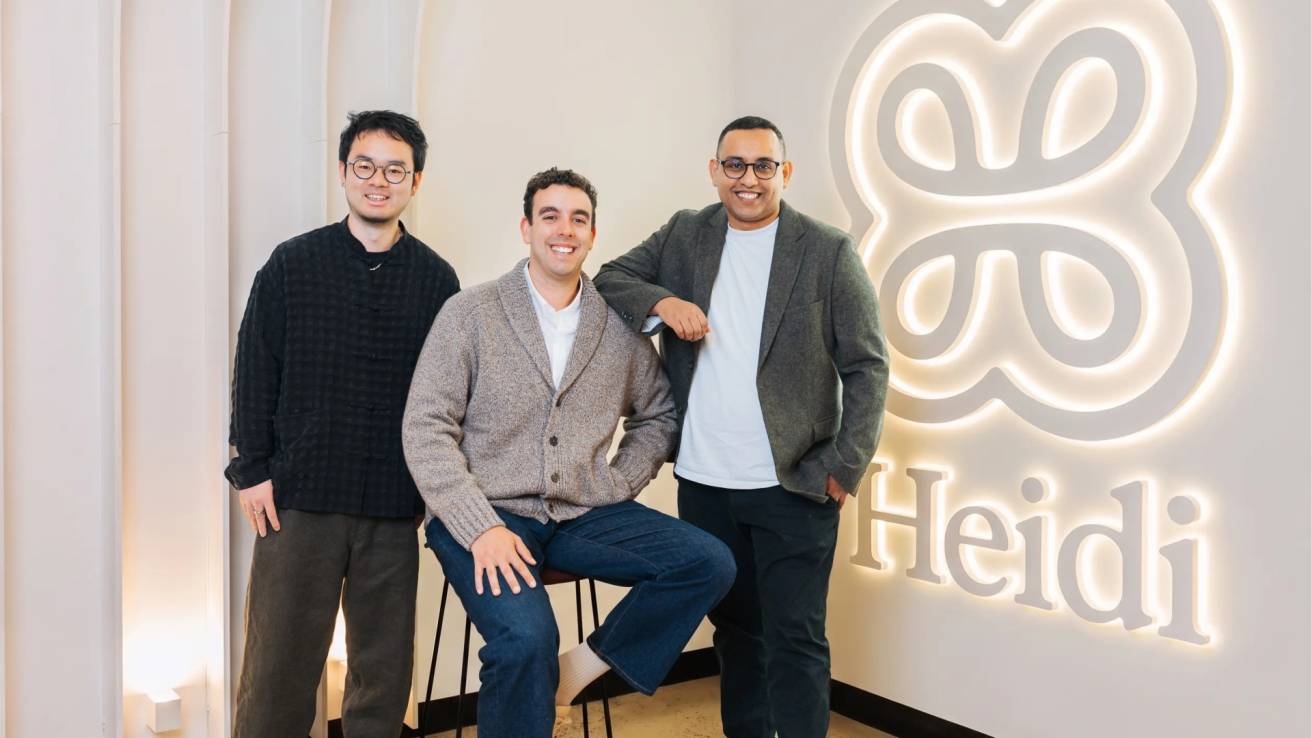
Co-founded in 2021 by Dr Tom Kelly, Waleed Mussa, and Yu Liu, Heidi records appointments and produces structured documents for medical professionals to review.
Related Article Block Placeholder Article ID: 279972
With one of the most significant capital raises of any Australian venture this year, the newly minted unicorn plans to grow further beyond its existing transcription and case management tools.
The next step: scaling what Kelly described as a “fully-fledged AI partner”, capable of handling vital background work and allowing clinicians more time for face-to-face care.
Heidi plans to develop agents to handle “complicated, long-running jobs, things like preparing you for your day tomorrow, doing referrals, follow-ups, and actually giving Heidi agentic capability to do that,” the CEO told SmartCompany.
The platform could assess a patient’s file for half an hour before they walk into the clinic, and prepare a background briefing for the medical professional to assess, he added.
Clinicians could even configure Heidi to contact patients before their appointment, “and as a patient, that might feel magical and very AI-forward”.
Those updates will build on a platform that has already supported 175 million patient visits, and the equivalent of 67 million hours of clinical work, in 190 countries worldwide.
Investors target healthcare worker shortfall
The new funding comes in two parts, with its core $140 million Series C raise led by existing investor Blackbird, with contributions from Phoenix Court, Point72 Private Investments, and Headline.
Related Article Block Placeholder Article ID: 344809
An additional $335 million growth investment comes from American venture capital firm General Catalyst through its Customer Value Fund.
Instead of providing equity investment or debt to growing scaleups, that fund underwrites a company’s spending on sales and marketing, entitling General Catalyst to a cut of the proceeds generated by that spend.
Heidi has now raised $613.4 million to date, including two raises of $98 million and $26.5 million in 2025, and a $10 million Series A in 2023.
The scaleup was last valued at $704 million after its October 2025 Series B raise.
With the World Health Organisation estimating a global shortfall of 11 million medical professionals by 2030, Heidi investors see the Melbourne-born platform as a valuable solution.
In a statement, Blackbird general partner Michael Tolo, whose fund first backed Heidi in its 2021 pre-seed raise, said, “our conviction is greater than ever.”
“The healthcare deficit won’t be solved with generic AI solutions that clinicians ignore,” he added.
Beyond its thesis about the global future of AI-assisted healthcare, Heidi has also won over investors for its approach to AI itself.
Heidi’s core transcription and note-taking technology was built in-house, instead of leveraging third-party AI platforms.
This allows for what the company calls a targeted but cost-effective solution, capable of complying with local regulations around medical data privacy.
“Heidi invested early in deeply understanding what clinicians want, building its own models and training capability to deliver this,” said Tolo.
“This approach has earnt them the right to capture valuable downstream workflows in the most rigorous clinical settings globally.”
No fully-AI clinics, yet
Despite Heidi’s new forays into agentic AI, Kelly said the idea of a fully-AI health clinic, where digital systems make diagnoses and take the lead on care decisions, is still some way away.
“We love doing diagnosis, that’s what doctors love to do,” he said.
“If our customers ask us for these things, we’ll of course look into it.
“But for the most part, it’s usually gathering and summarising information for their judgment.”
There are certain tasks – like a vascular surgery department determining whether to admit a patient for surgery based on whether they have a pulse – that simply must fall on human shoulders, Kelly added.
Related Article Block Placeholder Article ID: 311863
“I can’t speak for 50 years from now, when we have some robots, humanoids that can feel pulses and things like that, but actually doing real healthcare is really tricky, messy, complicated.
“A lot of it is about managing risk. So what I think is that Heidi could help in documenting that patient that I see and I examine.”
Heidi’s new information-gathering powers will still be supervised, “and clinical judgment remains with the clinician”, said Kelly.
“But you’re just extending the amount of work that a clinician can get done in a day.”
Source link