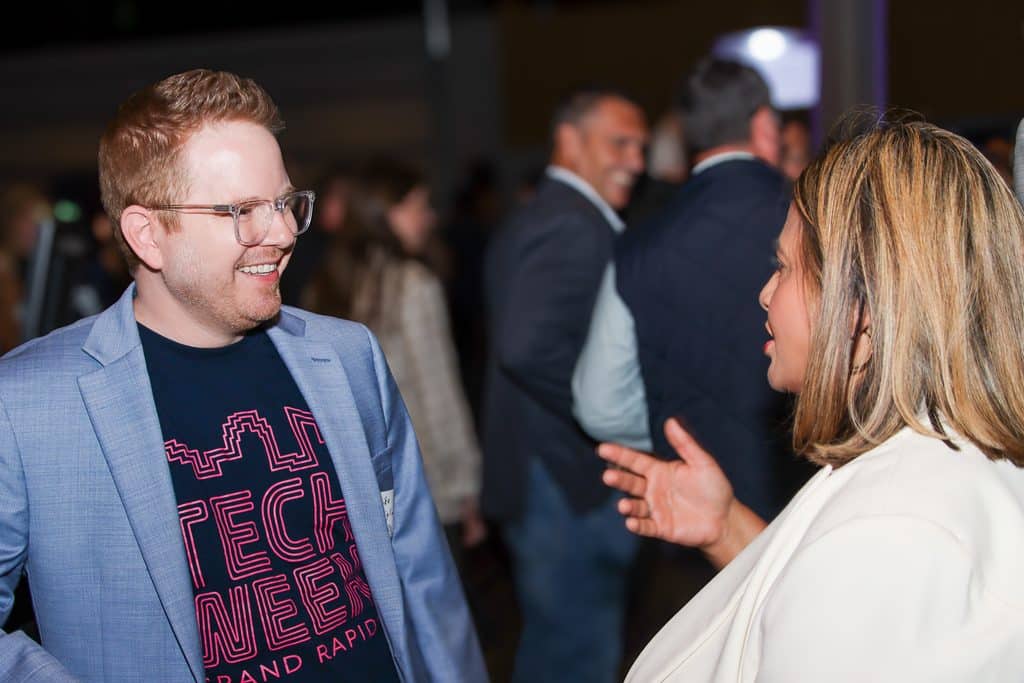
For all the talk about artificial intelligence, cybersecurity, automation, and the search for the next great West Michigan startup, the most useful thing on display during the fifth annual Tech Week Grand Rapids might have been the oldest technology there is: people learning from each other.
As someone who uses tech but doesn’t work in it, it’s easy to think that Tech Week’s 160 events were for other people: coders, entrepreneurs, or anyone who already “speaks” fluent AI. But each year, Tech Week not only offers more, but evolves into something more exciting and welcoming.
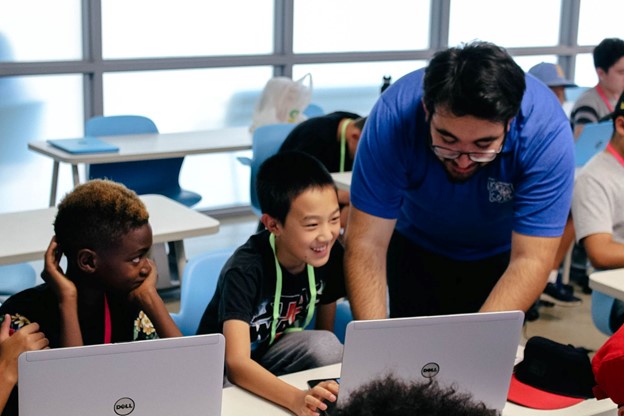
Tech Week has become a working demonstration of what Greater Grand Rapids is trying to build — a regional economy where businesses, educators, entrepreneurs, students, and workers learn alongside one another as technology reshapes nearly every sector of society.
The growth alone is hard to argue with. When Tech Week opened five years ago, it had just 11 events and attracted roughly 3,500 attendees. Fast forward to this year, when about 15,000 people attended some 160 events from Sept. 14-19, with more than 500 businesses and organizations producing the programming, nearly all of it free and open to the public. Locations reflected the diversity of the attendees: sessions were held at tech companies, schools, parks, businesses, and more.
Randy Thelen, president and CEO of The Right Place, says the attendance numbers aren’t the whole story. What’s changed is what’s happening around the event. He points to the region’s increased startup growth, outside investment, and new education initiatives at area universities and colleges.
“There’s a recognition that the future economy is going to be more tech-focused,” Thelen says. “Our business community, our education community, and the community at large are really moving in that direction.”
That direction is intentional. As Rapid Growth reported ahead of this year’s event, Tech Week runs more like an “unconference” than a traditional convention. Instead of The Right Place building and leading every session, area companies, universities, startups, and community organizations have created programming based on what they know and what they want to explore.
This decentralized approach has allowed the event to spread across the community while giving participating organizations real ownership of what Tech Week becomes.
“What makes West Michigan special is its authentic desire to collaborate to do something better than we might be able to do individually,” Thelen says about the open-source-like approach. “Tech Week embodies that question.”
Technology, no ZIP code needed
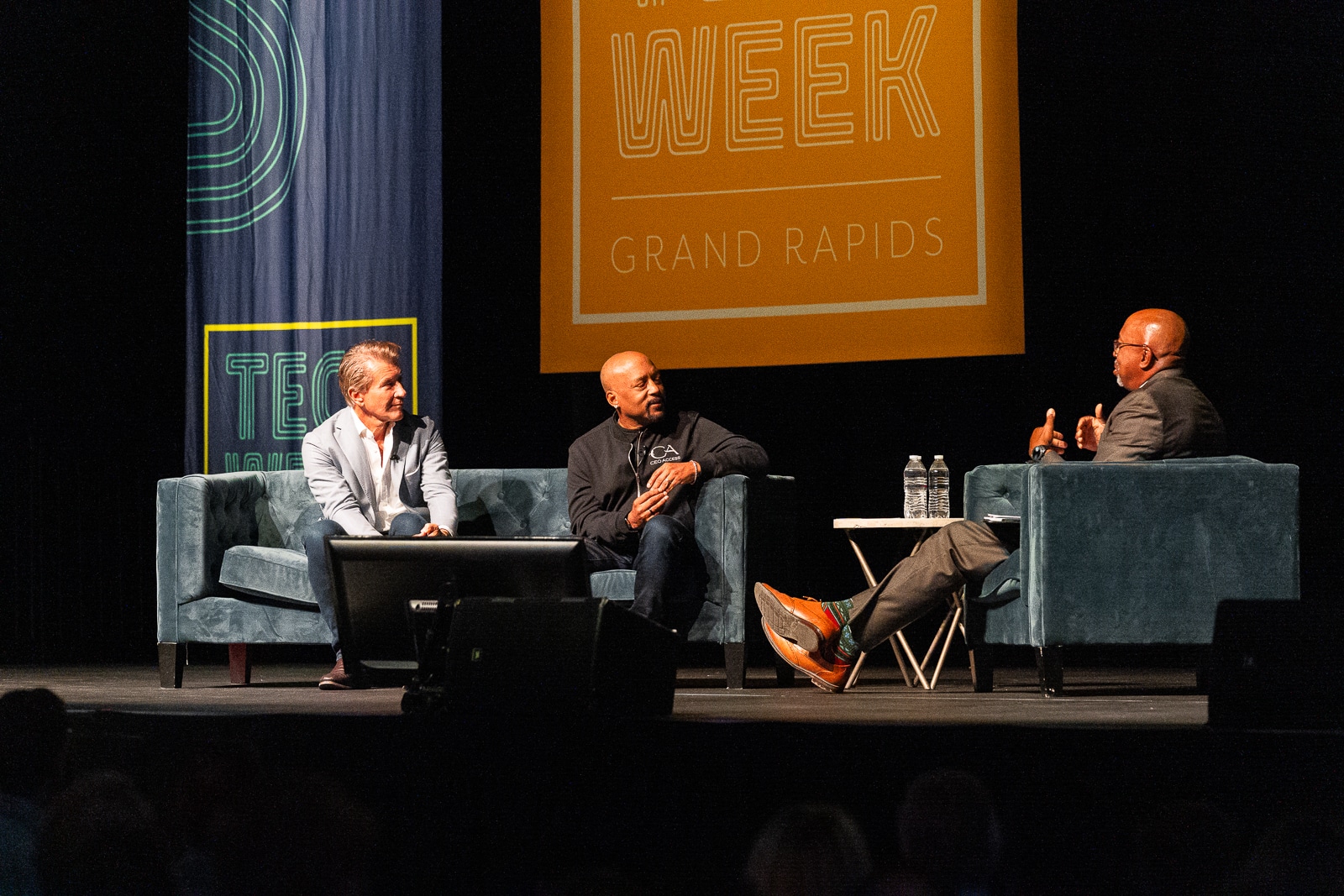
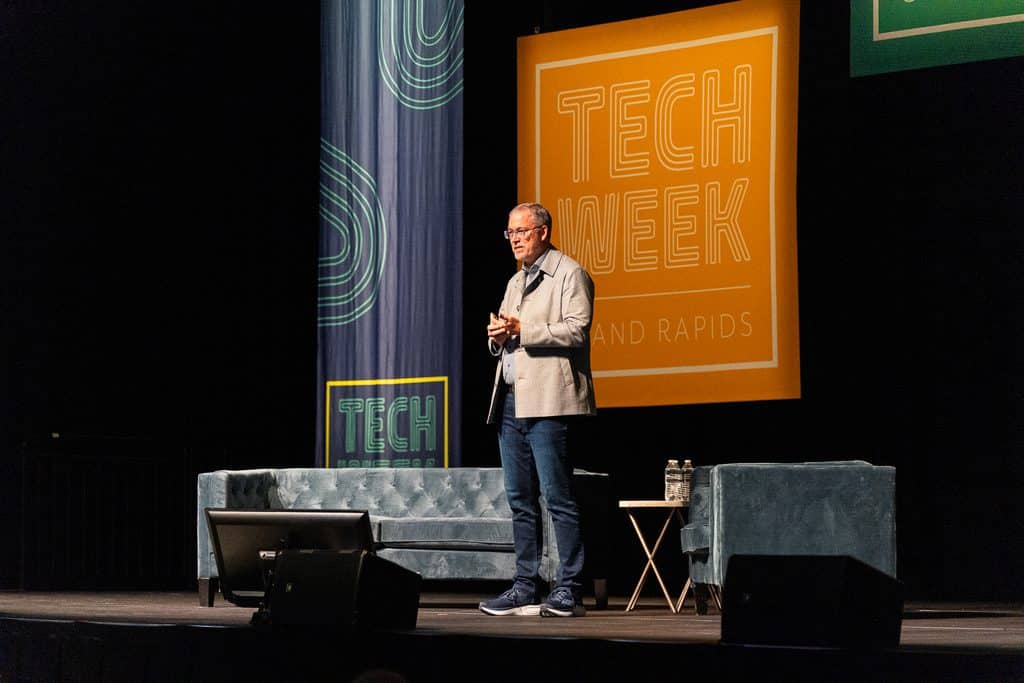
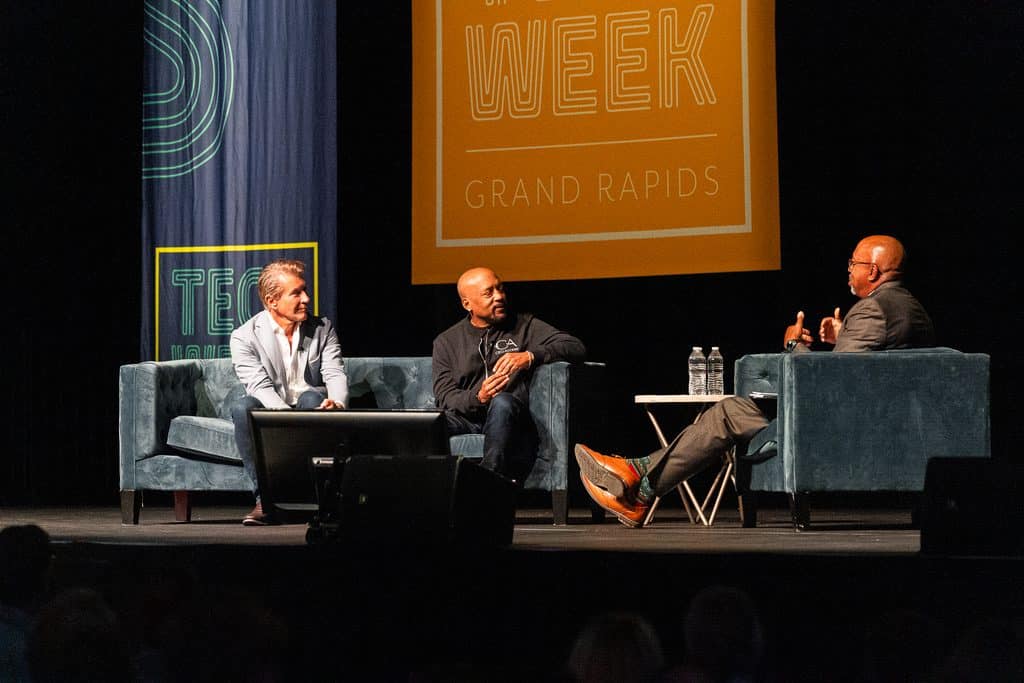
That regional pitch got some outside validation at the Sept. 14 kickoff at GLC Live at 20 Monroe, where Ferris State University President Bill Pink moderated a conversation with entrepreneurs and longtime “Shark Tank” stars Daymond John and Robert Herjavec.
Herjavec, who has built technology and cybersecurity companies of his own, pushed back on a lingering assumption about where innovation has to happen.
“Technology has become such an equalizer,” Herjavec told the audience, noting the exodus from Silicon Valley over the years. “You can create incredible technology hubs, regardless of location.”
John, who’s visited West Michigan before, said that what stood out to him wasn’t so much the growth of technology here as how our community approaches it.
“It’s very intentional here, and that’s what I love about it,” John says.
That may help explain why Tech Week’s value continues to show up beyond the events themselves.
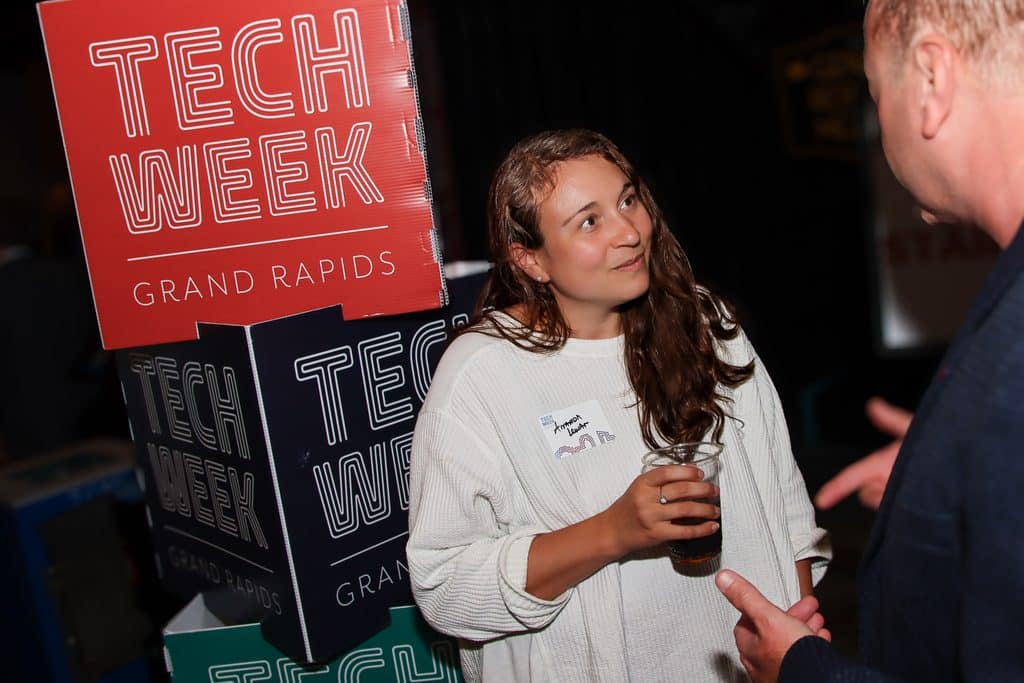
For example, Amanda Lewan, co-founder and CEO of Bamboo, can draw a remarkably straight line between Tech Week and her company’s new presence in Grand Rapids. Lewan came to Tech Week about two years ago, walked into a Start Garden Demo Day, and found herself surrounded by local companies, artists, small businesses, and technology startups.
“We were just blown away,” says Lewan, whose company’s roots are in Detroit.
That visit sent her looking at buildings in the city. This year, not only did Bamboo open its first Grand Rapids location, a multi-floor space at Division Avenue and Fulton Street, but its newest coworking and entrepreneurial hub also hosted free Tech Week events all week long.
Lewan’s company also operates in Detroit and Ann Arbor, which made what she found on this side of the state more surprising.
“I was blown away by the size of the tech community here,” she says. “There’s a lot of talent that people don’t know about.”
She also points to something Grand Rapids had in place long before anyone dreamed up a Tech Week: a rich history of entrepreneurship and a legacy of community collaboration that allowed a growing startup ecosystem to emerge and become a foundation to build on.
Building more than an event
Mike Marsiglia, co-CEO of Grand Rapids-based software consultancy Atomic Object, sees the same shift. Over the past five years, he says, the startup community has continued to strengthen, with accelerator programs and investment funds growing alongside it. Tech Week isn’t creating those pieces — it’s giving them a reason to sit in the same room.
“What I see happening during this week is I see a lot of people coming together for a lot of different events, and I see a lot of community being built,” Marsiglia says. He’d like to see those conversations keep going the other 51 weeks of the year.
That matters because technology doesn’t arrive neatly labeled “tech.” It’s embedded in manufacturing, healthcare, finance, retail, transportation, and education, and this year’s programming reflected that breadth, even as AI understandably dominated much of the conversation.
Thelen says the region’s real task isn’t just figuring out what AI can do, but how to make it work for West Michigan. This includes connecting AI and automation to the region’s manufacturing strength, something the region has understood since its first manufacturer opened a sawmill on Indian Mill Creek in 1832, which, interestingly enough, supplied the lumber to build the area’s first schoolhouse.
“We need to understand AI,” Thelen says, hinting at education’s important role. “We need to explore how to make it work for us as a region. How do we make it work for you in your career?”
That last “you” may be one of Tech Week’s most important challenges because, like it or not, tech is everywhere, and you’ll encounter it soon if you haven’t already.
Education for the people, not just companies
For Grand Valley State University President Philomena V. Mantella, Tech Week offers educators a window into what employers and communities will need next.
“One of my obligations and Grand Valley’s obligations is to foreshadow the talent needed in our community,” Mantella says. “What do we need? What is emerging? How do we think about it together?”
That work, she says, goes beyond preparing students for any one employer. Rather, it’s about building and sustaining talent for the whole community.
At Grand Rapids Community College, President Kathryn A. Rogalski lifts up another piece of that puzzle: Are we preparing people for technological change throughout their working lives, not just at the start of a career?
Rogalski says technology education can’t stand on its own without the “soft, durable skills” that come from broader learning, and GRCC is working with The Right Place and the manufacturing sector to offer an AI certificate — also available in Spanish — that can lead into further credentials and degrees as the sector grows and matures.
She shared a real-life example of why that matters, pointing to an adult GRCC student already working in the information technology sector who’s pursuing the AI certificate to stay current in his field. It’s a reminder that the region’s future tech workforce isn’t only teenagers now picking a college major. It’s also people already on factory floors, in offices, running small businesses or mid-career in jobs being transformed around them.
Rogalski says West Michigan’s advantage is that economic developers, workforce organizations, colleges, universities, K-12 schools, employers and communities are increasingly doing that work together.
“We’re working with our employers and with our communities in the region to make sure that it’s the right work,” she says.
The work after Tech Week
That may be the most meaningful measure as Tech Week wraps its fifth year.
Does the growing attendance matter? Yes, and so does welcoming nationally recognized speakers to an event wedded to a calendar dense enough over just a week to overwhelm even the most determined attendee.
But an ecosystem can’t run for six days and then go quiet. Its real success is what outlasts the week: a student who discovers a career they didn’t know existed. An entrepreneur who finally meets someone willing to bet on their idea. A worker who finds a real path to a new skill. A business that starts treating the company down the street as a partner rather than a stranger.
Marsiglia sees these connections when he looks at the organizations volunteering their spaces, expertise, and time to pull off Tech Week’s 160 events. He doesn’t think they’re doing it hoping a session will hand them a windfall.
“I think people are doing it because they care about the city,” Marsiglia says, “and they care about raising the city as a whole.”
Five years into Tech Week, as we look to the future of this annual event, humans, as much as technology, might be the best investment to keep making… and what might set us apart from the herd, too.
Photos by Tommy Allen and courtesy of The Right Place
This series, West Michigan Tech, aims to spotlight tech organizations and employers in the Greater Grand Rapids area that are delivering innovative programs, addressing talent pipeline challenges, and striving to develop, attract, and retain top talent in West Michigan. This series is underwritten by The Right Place.
Source link