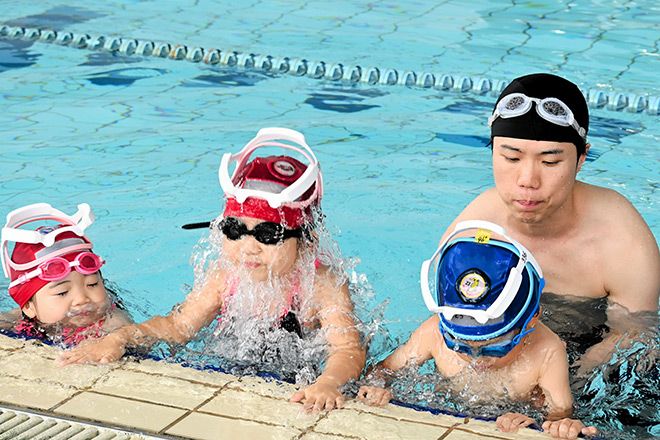
On a recent day in mid-August, about 15 young children took a swimming lesson at the Narita branch of the Aeon Sports Club 3Fit fitness club chain in Narita, Chiba Prefecture.
As the children, aged between 3 and 6, gathered at the poolside, a coach and lifeguards put on a white headgear called Tiara over their swimming cap.
The device notifies lifeguards and other personnel when it detects submersion.
Although the coach told the children not to go underwater, some put their faces in the water while waiting for their turn to wear the headgear.
Luckily, no alert was activated on that day.
Following a spate of drowning deaths of children in swimming pools, PrimeSense Co. startup came up with the Meel safety monitoring system in the Tiara, which utilizes information technology.
“Swimming lessons have relied on lifeguards for many years, but there is a limit in what they can do,” said PrimeSense President Jun Takagi. “We hope we can make full-time monitoring a reality with the help of the electronic eye.”
Many people feel uncomfortable being watched by cameras while wearing swimwear even if it is for safety purposes.
But the Meel system is camera free.
Instead, it opts for a technology commonly seen in daily life: integrated circuit (IC) tags.
Nationwide, there have been drowning-related deaths reported in pools in recent years.
In 2024, a grade-schooler died during a swimming class in Kochi. Another drowned in a sports club pool during an afterschool activity in the western Tokyo city of Koganei in 2025.
The Aeon Sports Club chain introduced the Meel system at seven outlets in July.
“Children find it less uncomfortable to wear than we expected,” a representative said. “In fact, many of them say, ‘it’s cool,’ or, ‘I feel like a princess.’”
The sports club operator also receives favorable responses from their guardians, who say they can feel safe to entrust their children to the operator, the representative added.
PrimeSense, based in Tokyo’s Shibuya Ward, placed particular importance on privacy.
It is said people drown quietly and without splashing, and there is a limit in what lifeguards can do with their eyes watching the water.
In recent years, however, there are concerns over the introduction of cameras in the wake of voyeurism incidents involving teachers.
The company turned to radio-frequency identification (RFID) technology, which makes it possible to read information of IC tags from a remote place without contact through radio signals.
Requiring no battery, IC tags are used for many applications, such as mobile transportation cards and fashion brand Uniqlo owner Fast Retailing Co.’s inventory management system and shoplifting prevention tags.
The Tiara has three IC tags inside: one each on the right and left sides and one on the back of the head.
When the headgear goes underwater, communication between the IC tags and antennas installed on surrounding walls in the pool is lost, enabling it to detect submersion.
When communication is lost for a certain period of time, the headgear notifies lifeguards wearing vibrating alarms and send alert signals to monitors set up on the poolside.
The Meel system also provides the rough location of a drowning victim.
The number of seconds to activate the alert can be adjusted depending on the swimming skills of users and other factors.
The company said it is improving the Tiara to fit better and be more comfortable for swimmers.