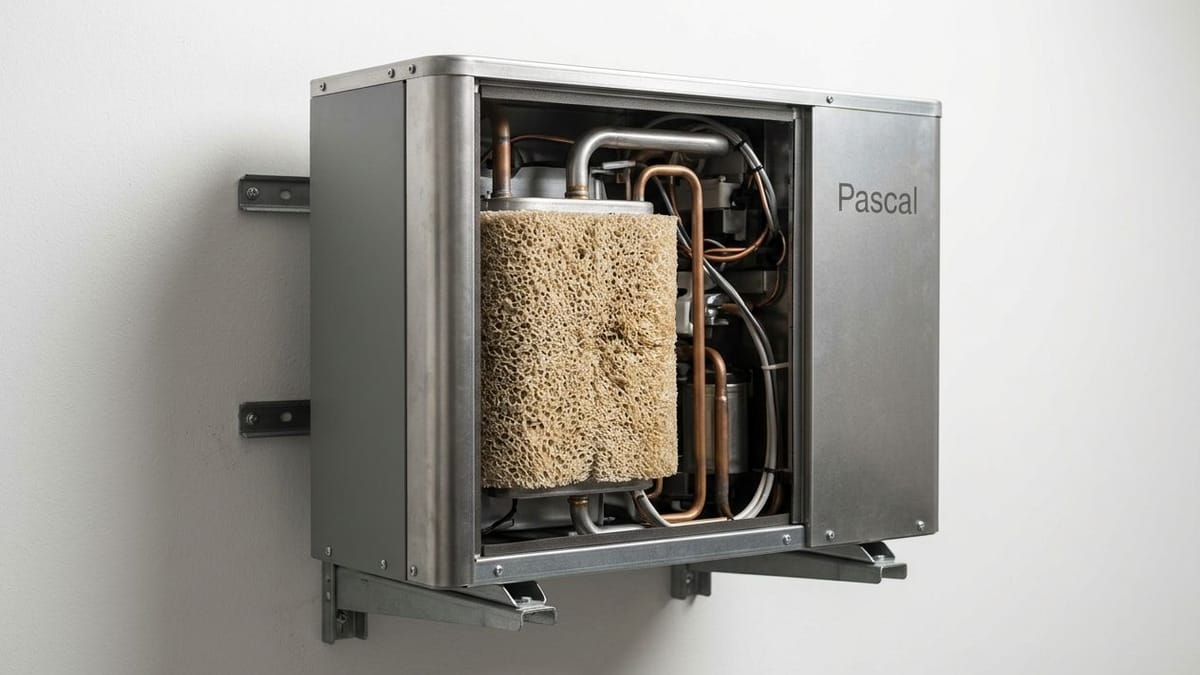
Heat pump technology hasn’t changed much since the 1850s, but climate tech startup Pascal thinks it’s cracked the code. The company just unveiled a novel approach using a sponge-like material that promises to deliver 20% efficiency gains over conventional refrigerant systems. With buildings accounting for nearly 40% of global energy consumption, Pascal’s innovation couldn’t come at a more critical time for the climate tech sector.
Pascal is taking aim at one of the most overlooked pieces of climate infrastructure: the humble heat pump. While the technology has been around since the mid-1800s, it’s remained largely unchanged, relying on vapor-compression cycles and chemical refrigerants that haven’t evolved much beyond incremental improvements.
The startup’s breakthrough centers on a proprietary sponge-like material that replaces traditional refrigerants in heating and cooling systems. According to TechCrunch, this approach delivers 20% better efficiency compared to conventional heat pumps, a significant jump in an industry where single-digit improvements are considered victories.
That efficiency gain matters more than it might seem. Heat pumps are already three to four times more efficient than traditional furnaces, but they still account for massive energy draws in residential and commercial buildings. The International Energy Agency estimates that heating and cooling represent about half of global energy consumption in buildings, which themselves use nearly 40% of all energy produced worldwide.
Pascal’s timing aligns with a broader push to electrify everything. Governments across Europe and North America are phasing out gas heating, while heat pump sales have surged 40% year-over-year in some markets. But the technology’s Achilles heel has always been efficiency in extreme cold, where traditional systems struggle and energy bills spike.
The sponge-like material appears to address this through a fundamentally different thermodynamic process. Instead of compressing and expanding gases, the material absorbs and releases thermal energy through its porous structure. Think of it like a thermal battery that can be charged and discharged rapidly, without the mechanical complexity of compressors and the environmental baggage of hydrofluorocarbon refrigerants.
Traditional refrigerants have become a climate problem in their own right. HFCs can be thousands of times more potent than CO2 as greenhouse gases when they leak, which happens regularly in aging HVAC systems. The Kigali Amendment to the Montreal Protocol is already forcing a global phasedown of these chemicals, creating an opening for alternative approaches.
Pascal isn’t the only company chasing this opportunity. Startups like Blue Frontier and Gradient are developing their own takes on next-generation cooling, while established players like Carrier and Daikin are investing heavily in heat pump R&D. But most are still working within the vapor-compression paradigm, tweaking refrigerant chemistry rather than reimagining the entire system.
The commercial potential is enormous. The global HVAC market topped $150 billion in 2025, with heat pumps representing the fastest-growing segment. As building codes tighten and carbon pricing spreads, the premium for efficiency keeps climbing. A 20% improvement could translate to thousands of dollars in lifetime energy savings for a typical home installation.
What remains unclear is how Pascal’s technology scales to mass production. Novel materials often look great in the lab but stumble when manufacturers try to produce them at HVAC-industry volumes. The company will need to prove it can hit aggressive cost targets while maintaining performance, especially if it wants to compete with entrenched players who’ve spent decades optimizing their supply chains.
There’s also the question of durability. Heat pumps need to survive decades of daily thermal cycling, often in harsh conditions. Sponge-like materials can degrade over time, losing their absorption capacity or developing structural weaknesses. Pascal will need long-term testing data to convince building owners and HVAC contractors that this isn’t just a science experiment.
Still, the climate math is compelling. If Pascal can deliver on its efficiency claims at scale, it could accelerate the retirement of gas heating infrastructure and make electrification economically irresistible even in cold climates. That’s the kind of breakthrough the building sector desperately needs as it races to decarbonize by mid-century.
Pascal’s sponge-based heat pump technology represents the kind of fundamental rethink the HVAC industry hasn’t seen in generations. A 20% efficiency gain isn’t just incremental progress, it’s the difference between heat pumps being a nice-to-have and a no-brainer for building owners watching their energy costs. The real test comes next: can Pascal manufacture this at scale, prove it lasts, and convince a conservative industry to bet on something genuinely new? If they pull it off, they won’t just build a successful startup. They’ll help rewrite the economics of building decarbonization.