
A new study by the Fin.Tech Marketing Community, in partnership with digital marketing agency Accuracast, polled 105 marketing leaders in financial services and fintech about the state of their digital marketing.
The findings reveal several trends, highlighting consistent positive results from digital marketing, a rising emphasis on answer engine optimization (AEO), and artificial intelligence (AI) acting as a marketing tool despite governance gaps.
Digital marketing performance meets expectations
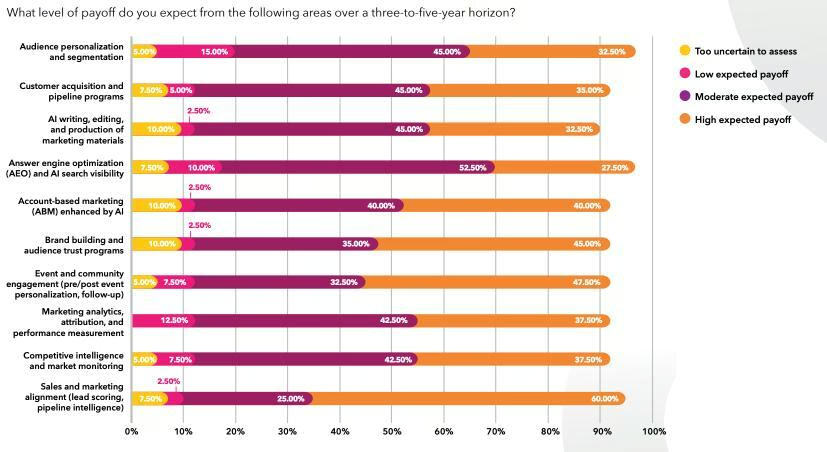
The study found that digital marketing performance consistently meets baseline expectations. Most respondents reported results at or above initial levels, with early positive or strong measurable gains across marketing areas cited by between 17.5% to 52.5% of respondents for each function.
In particular, audience personalization, and marketing analytics witnessed the strongest measurable results today, with approximately one-third of respondents seeing a significant impact.

Meanwhile, sales and marketing alignment holds the highest future expectations, with 60% of respondents expecting high returns, despite only 25% reporting a strong impact.
Planning aligns payoff expectations. AEO and AI search visibility drew the most targeted new investment for 2026, cited by 32.5% of respondents, despite limited early return on investment (ROI) data, with just 27.5% reporting positive improvements, and 22.5% reporting no measurable results yet.
AEO refers to the practice of structuring, writing, and marking up web content so that AI-powered answer engines, large language models (LLMs), voice assistants, and featured snippets can easily extract, summarize and cite it as a direct answer.
Impact concentrates at the top of the funnel
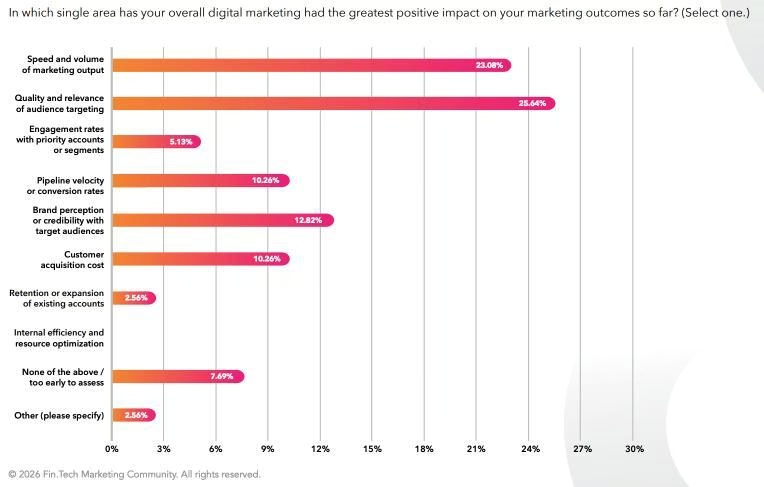
The study also found that the impact of digital marketing is concentrated at the top of the funnel, especially awareness and the attraction of potential customers. Among respondents, 25.64% identified audience targeting quality and relevance as the single area of digital marketing with the greatest positive effect on outcomes, while 23.08% named speed and volume of output.
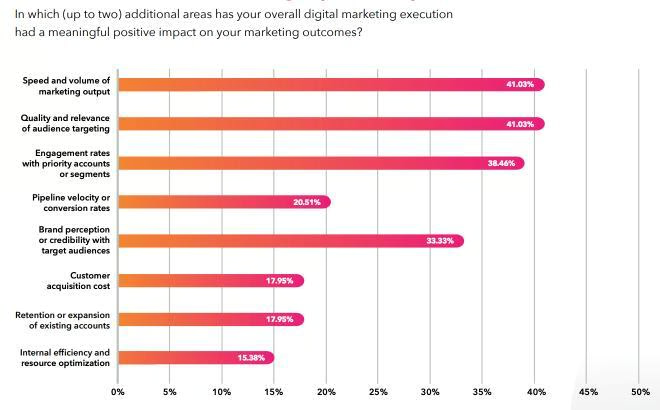
A further 38.46% of respondents noted engagement rates with priority accounts or segments as an additional area of meaningful positive impact, and 33.33% cited brand perception or credibility with target audiences.
By contrast, bottom-of-funnel metrics, including customer acquisition cost (CAC), and customer retention, show considerably less improvement, each cited by 17.95% of respondents. No respondents listed internal efficiency as a primary benefit, and only 15% cited it as a secondary benefit.
Paid search, organic, email lead as top channels
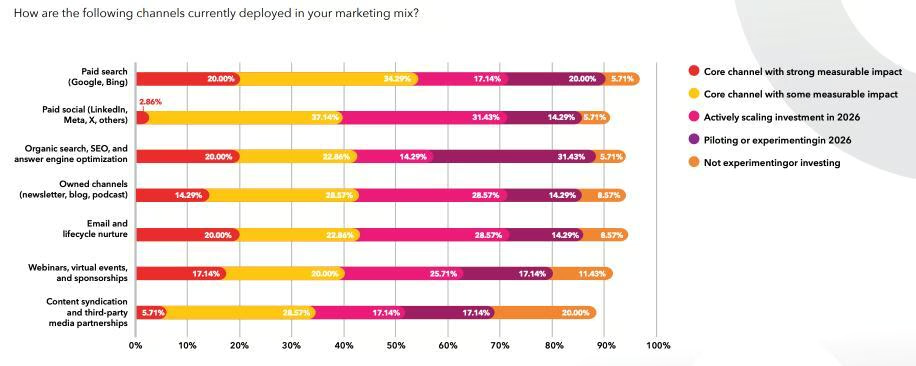
Paid search, organic search and email continue as core channels, with 20% reporting strong and measurable ROI. Organic search also leads pilot activity in 2026 at 31.43% as teams experiment with AEO.
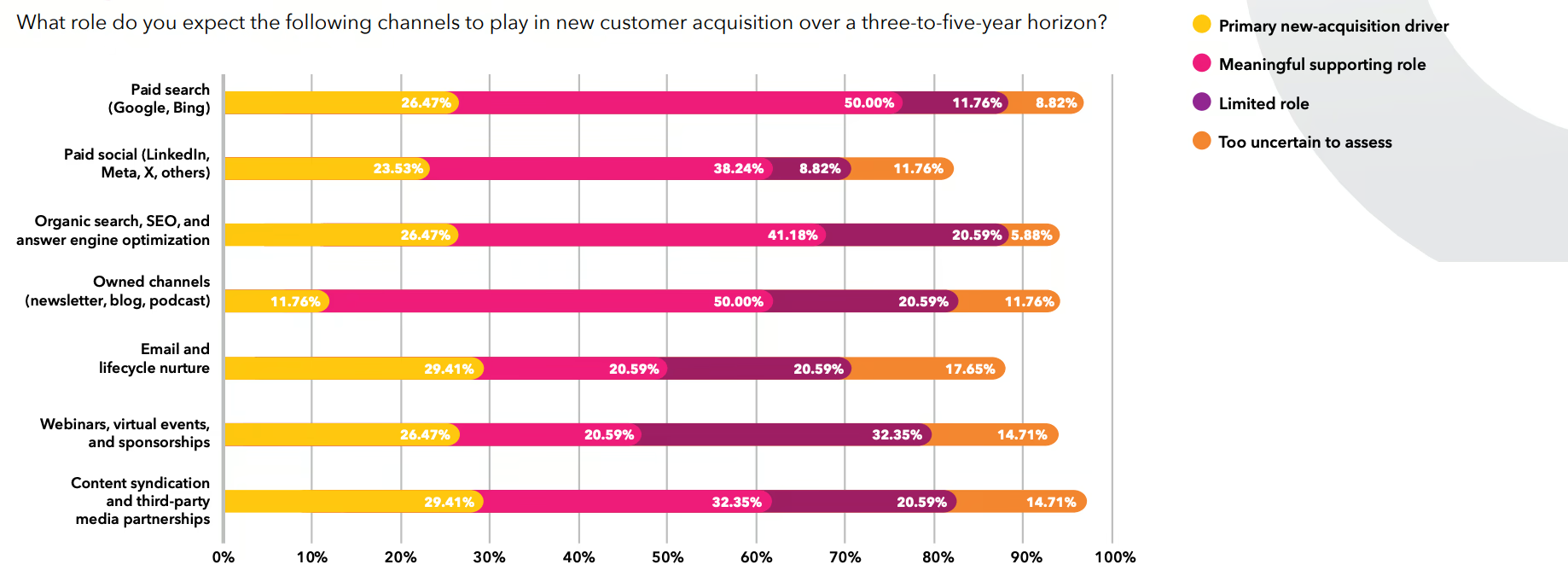
Looking ahead, expectations and investment plans are fragmented across channels, with no single option standing out as a consensus growth driver. Content syndication, which refers to the republishing or distributing of existing content on third-party websites or external platforms, recorded the most variance, with 20% planning no investment, but 29.41% expecting it to become a primary acquisition channels over the next three to five years.
Meanwhile, owned media ranked lowest among primary growth drivers, cited by 11.76% of respondents while half placed these channels in a supporting role behind paid and third-party media.
Few firms have a formal AI integration strategy
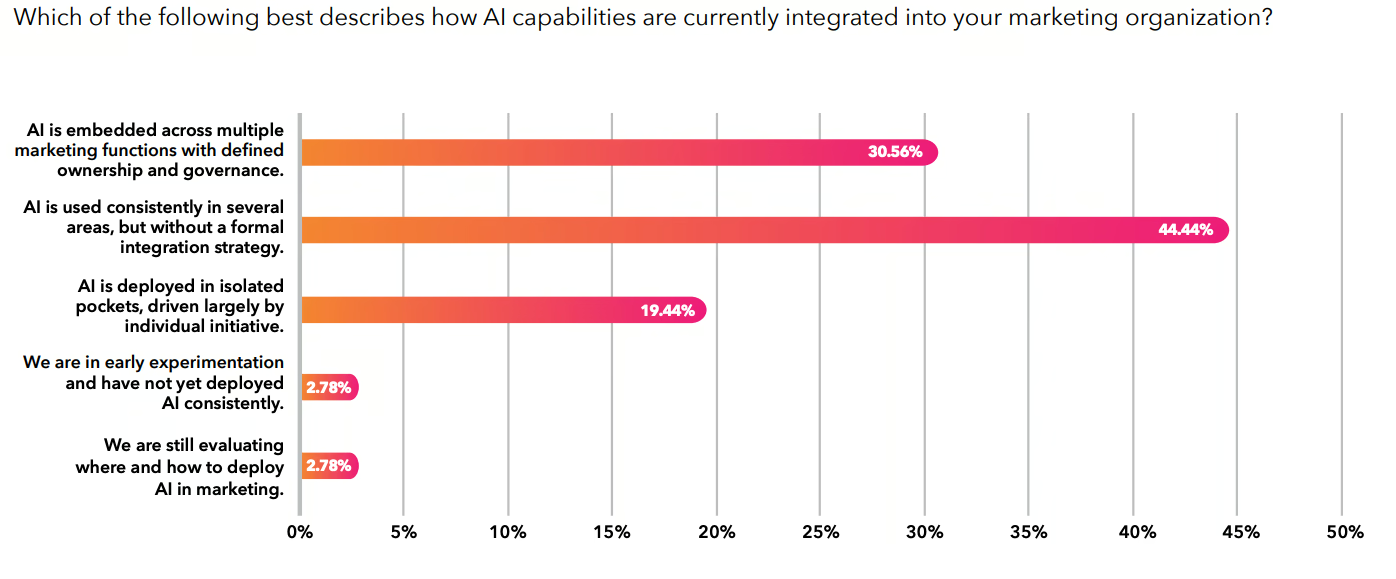
The survey found that AI adoption is widespread across marketing functions. 75% of respondents utilize AI capabilities across multiple areas. An additional 19.44% has deployed AI in isolated pockets, driven largely by individual initiative.
However, formal strategy lags, with 44.44% using AI consistently in various functions but without a formal overarching integration strategy. This points to gaps in governance, alignment, scalability, and the realization of AI’s full organizational value.
Performance measurement displays a similar divide. 34.38% of respondents track defined KPIs on a regular schedule, while 34.38% rely on informal indicators. The remainder use directional judgment, have no standardized metrics, or are too early in AI use to assess results.
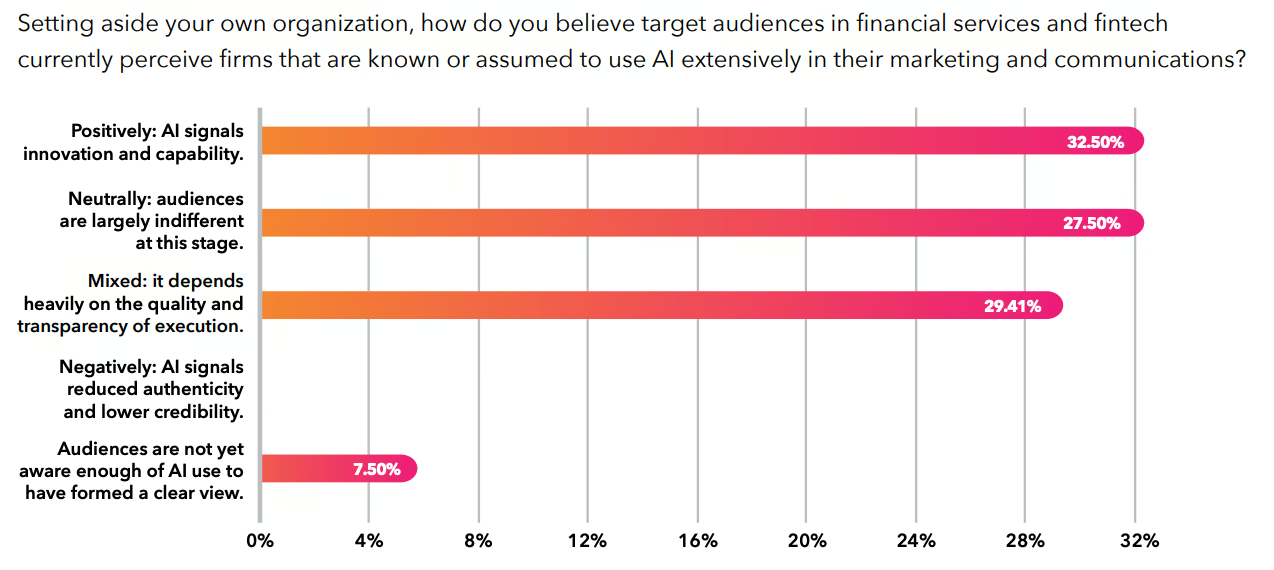
Overall, finance marketers see AI adoption as neutral or positive. 32.5% regard AI use as an indicator of innovation, and 27.5% are indifferent.
AI has emerged as a major influence on how customers discover and evaluate financial services as soaring consumer adoption of conversational AI platforms like ChatGPT transforms these chatbots into key sources of information and, effectively, new channels for marketing outreach.
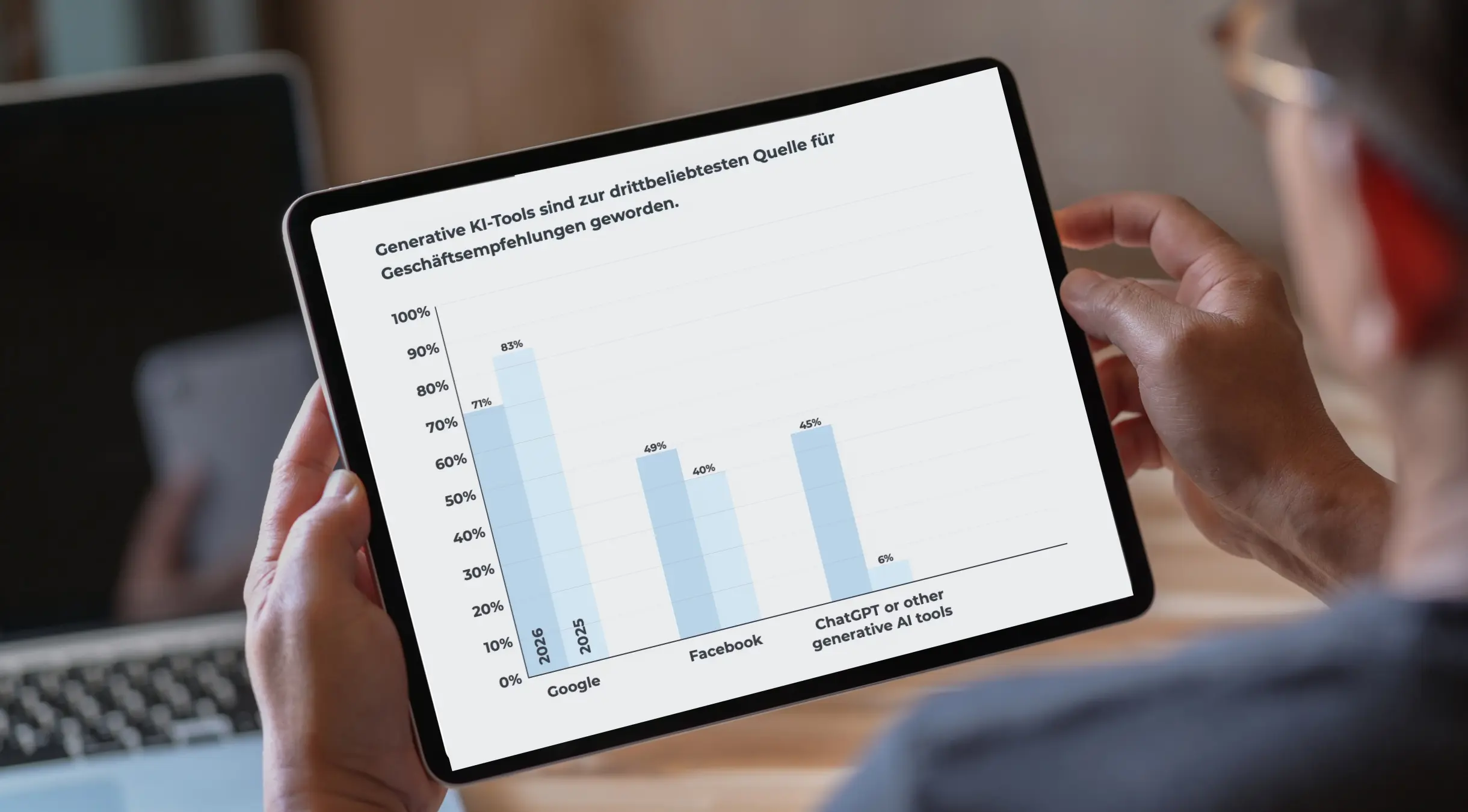
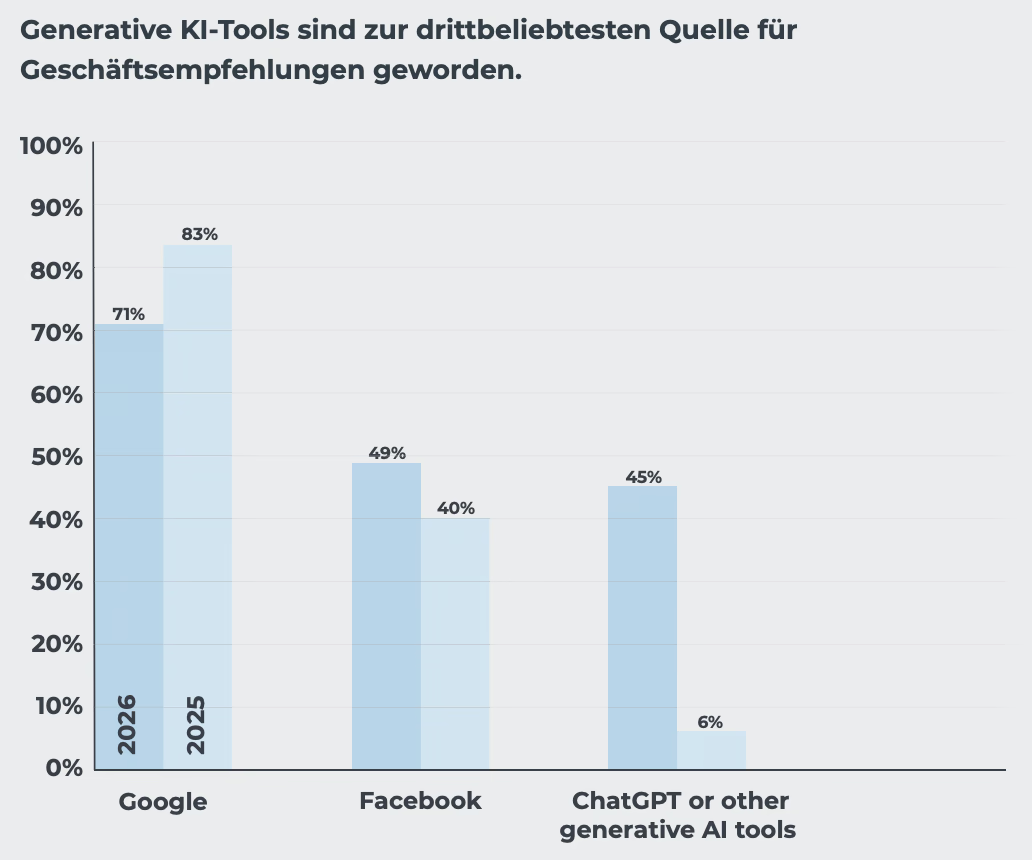
According to a 2026 report by Swiss software company hypt, usage of LLMs for search surged dramatically from just 6% in 2025 to 45% 2026. During the same period, traditional search engines for local recommendations declined from 83% in 2025 to 71% in 2026.
The shift from search engines to AI chatbots is expected to continue moving forward, with Gartner forecasts a 25% decline in search engine volume by 2026 due to AI chatbots and other virtual agents.
Featured image: Edited by Fintech News Switzerland, based on image by thanyakij-12 via Magnific
Source link