
Before participating in the startup accelerator programs offered through the Indiana University Launch Accelerator for Biosciences, Deron Herr tended to talk about his work on new peripheral nerve pain treatments as a scientific challenge.

But after meeting with mentors, investors and other startup founders through the programs, the IU School of Medicine-Terre Haute researcher said he has also grown comfortable discussing the work as a healthcare challenge and investment opportunity.
“My presentations were always 80% science,” said Herr, a professor of pharmacology and toxicology. “But after you see so many other people take that same approach, it becomes obvious how that message can be lost on your audience. The science is important, but no one’s going to listen to it without first understanding why the problem is also important, whether the solution makes sense, and if you have a plan.”
Herr is the cofounder of Bahto Biosciences, a bioscience startup based on his research to develop a non-addictive therapy to reduce the pain of peripheral neuropathy without the risks of opioid-based treatments.
Two accelerators, one mission
The company is one of two IU-affiliated startup companies that participated in the third cohort of the IU LAB Lifetech Accelerator Powered by Plug and Play, along with 10 other life-sciences companies from across the U.S. and abroad. The 12-week program accelerates bioscience companies’ path toward commercialization through mentorship and connections with industry experts, corporate partners and investors.
The other IU-affiliated startup that participated in the accelerator was GoldiloxBio, which aims to improve preclinical cardiac drug testing.
Bahto also previously participated in the IU Health Incubator at IU LAB Pre-Accelerator powered by gener8tor, a seven-week accelerator program that helps early-stage founders develop business models and prepare to reach out to investors. The third cohort of the accelerator powered by gener8tor included IU-affiliated startups NeuroCoolX, Resolet and Vicentrix, along with two other startups, ResperCare and VitaWave Tech.
Advancing bioscience for Indiana
Launched in 2024 with a $138 million grant from Lilly Endowment, the IU Launch Accelerator for Biosciences, or IU LAB, is a university-wide initiative to transform life science discoveries into companies, products and technologies through startup support, industry partnerships and accelerator programs.

IU LAB recently marked a milestone in the construction of its five-story, 150,000-square-foot location adjacent to the Herron School of Art and Design’s Sidney and Lois Eskenazi Fine Arts Center on Indiana Avenue, in the heart of Indianapolis’ 16 Tech innovation district.
In addition to startups founded by IU faculty, IU LAB’s accelerators also welcome life science companies whose work aligns with the state’s bioscience strengths and healthcare needs, such as medical devices and metabolic diseases.
“By bringing companies from across the U.S. and beyond into our ecosystem alongside IU-affiliated innovators, we’re creating more opportunities for collaboration, investment and commercialization at all stages of the process, while also addressing some of the most important health challenges in our state,” said David Rosenberg, president and CEO of IU LAB and IU Inc.
Reducing pain without addiction
Herr’s startup leverages his research on a key receptor in the sphingosine-1-phosphate signaling pathway – a chemical system that coordinates cellular responses to various types of stimuli – as a non-addictive therapeutic target for neuropathic pain.
“I was very pleased by the programs offered through IU, and by the quality of experience,” said Herr, who joined IU in 2025 after a career spent abroad and in California, where he also gained experience with a San Diego biotechnology startup.
“I had been through this process before in California and thought I knew what to expect,” he said. “You can attend lectures or workshops, but being able to sit across from somebody who has actually raised money, built a company and gone through the process is a completely different experience. The mentors available through IU’s programs were outstanding.”
Treating neurological injury without complications
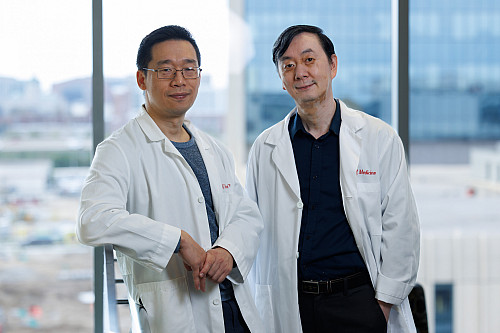
NeuroCoolX cofounders Lingxiao Deng and Xiang Gao, assistant professors of neurological surgery at the IU School of Medicine, also learned how to shift their approach to research commercialization through their experience in the accelerator program powered by gener8tor.

“We are not businesspeople, so some of the terminology is unfamiliar to us,” Deng said. “We got some very good guidance from some very experienced mentors. They helped us understand how to do market exploration and how to develop a business plan. You need to understand your market before you can attract investment.”
NeuroCoolX aims to develop a therapeutic platform using hypothermia to improve patient outcomes after spinal cord injury and traumatic brain injury. Because of its complexity, hypothermia is currently applied only in rare circumstances to slow tissue damage in critical hours after injury.
Deng and Gao’s approach hinges on their research into using a previously FDA-approved drug to lower body temperature, for which they are pursuing intellectual property protection through the IU Innovation and Commercialization Office. The compound, dexmedetomidine, is widely used in hospitals as a sedative.
Their proposed technology, which would combine the drug with a system to safely administer and automate its delivery, could make the method easier for surgeons to access, potentially making hypothermia therapy more common in emergency departments across the country.
Inspired to move forward
Deng was inspired to pursue his work in part by his experience as a surgeon in his native China, where he saw firsthand the long-term consequences of neurological injury in his patients. The experience convinced him to shift his career toward research to advance new treatments to reduce the secondary tissue damage that often occurs after neurological injury. These long-term complications can often prove fatal over time.
The researchers have already demonstrated the effectiveness of their approach in preclinical and animal models. They are now focused on refining the technology, strengthening intellectual property protections and pursuing regulatory approvals to advance toward human clinical trials. These goals all require external investment, Deng said.
He added the skills acquired through IU’s accelerator program will bring him another step closer to the ultimate goal: getting better treatments into the hands of doctors and the patients who need them.
Source link