Image Credit – Gemini
The Autopsy of the Linear Broadcast
Let’s be real about the current architecture of sports media. The bankruptcy of Diamond Sports Group wasn’t just a localized corporate misstep; it signaled the permanent collapse of the regional sports network model. Younger demographics completely refuse to stare at a passive, linear television screen for three hours. Mobile devices have swallowed the viewing experience whole. The reality is that traditional broadcast feeds now serve as mere contextual wallpaper for the actual action occurring inside group chats and social feeds. Media giants operating in 2026 finally realize that isolating video from the community is a catastrophic strategic failure. Their objective today is brutally simple. Silicon Valley wants to collapse the exact distance between seeing a pivotal play and swiping a credit card.
Beating the Latency Tax with MoQ
Old-school internet plumbing practically suffocated this vision on arrival. Legacy HTTP protocols sliced live broadcasts into awkward, discrete chunks; this fundamentally baked 30-second delays directly into the feed. You simply cannot execute a live sneaker drop—or cash out a volatile in-game wager—when your audience is stuck living half a minute in the past. Network architects initially tried shoving live feeds through WebRTC to achieve sub-500 millisecond speeds. The catch? WebRTC requires a dedicated, stateful connection for every single viewer. Compute costs associated with scaling WebRTC clusters for millions of concurrent users quickly became a financial bloodbath for tier-one sporting events.
Relief finally arrived in March 2026. Apple’s Safari natively integrated WebTransport, quietly opening the floodgates for Media over QUIC technology to take over the industry. MoQ elegantly combines the raw speed of UDP transport with the cheap, stateless scalability of standard CDNs. Edge relays deployed globally by Cloudflare or Akamai fan out media tracks instantly without needing to decode the underlying video. Glass-to-glass latency reliably sits under 500 milliseconds today. This temporal precision is the exact structural foundation required for every interactive overlay currently dominating the market.
The Zero-Party Data Heist
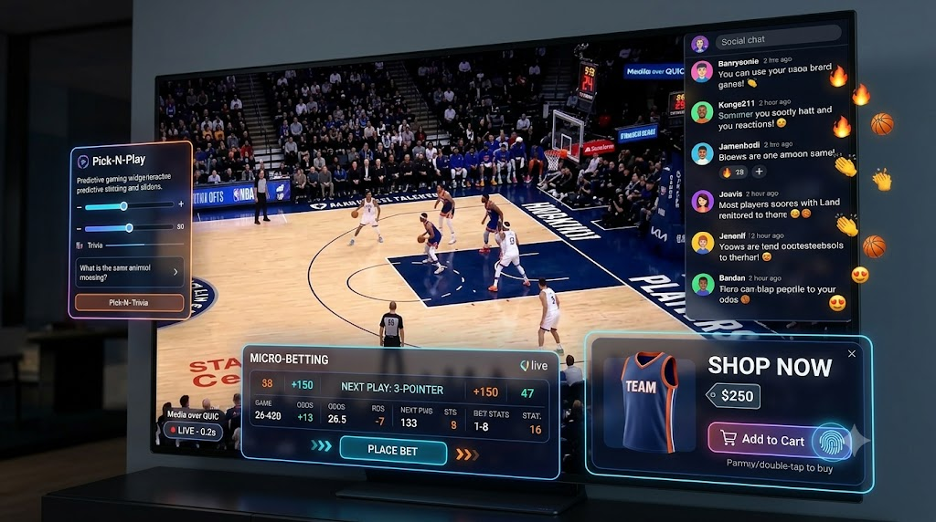
Latency is no longer a viable excuse for passive platforms. Startups like LiveLike embed software development kits directly into broadcaster apps to weaponize this new network speed. These companies arm regional and national platforms with prediction sliders, influencer chats, and cheer meters. Frankly, this goes far beyond making a game entertaining. Gamified viewers consistently watch 33% longer, but the true corporate prize is the underlying telemetry.
A fan mashes a sentiment poll after a bad referee call, willingly handing over highly accurate psychographic data. Broadcasters feed this zero-party data straight into Customer Data Platforms. The software then dynamically swaps camera angles or serves hyper-targeted ads based on real-time frustration or joy. Executives at the YES Network saw active participation jump 50% on their Gotham Sports App just by utilizing these exact behavioral loops.
Frictionless Commerce and the Tap-to-Buy Cartel
Consumer attention always dictates where retail architecture inevitably follows. Impulse buying on the web has historically been a total friction trap. Analytics prove nearly 70% of viewers will instantly abandon the cart if you force them to open a new tab and stumble through a bloated checkout form. Startups like Sprii and Firework bypass this entire catastrophe completely. Their tech superimposes a secure, invisible shopping layer right on top of the live stream so fans never have to leave the action. A viewer spots a pair of limited-edition sneakers on their favorite point guard. They tap the screen, select a size, and authenticate the purchase via Apple Pay before the broadcast ever cuts to commercial.
The financial reality of this integration is staggering. Standard web stores crawl along at a dismal 2% conversion rate. These shoppable broadcasts, conversely, routinely convert between 8.7% and 30%. High-definition video allows consumers to watch fabric move and equipment flex in real-time, drastically dropping the dreaded apparel return rate below 10%. We are also seeing the Universal Sports Graph protocol unbundle digital rights entirely. TAPPP uses this machine-readable data architecture to sell $4.99 micro-access day passes with a single click, completely bypassing the friction of bloated seasonal subscriptions.
Dopamine, Algorithms, and the Micro-Betting Engine
Nothing moves capital faster than high-frequency risk. The growth engine of the modern sportsbook has pivoted violently away from the pre-game moneyline. Kero Sports and nVenue feed massive amounts of historical telemetry into AI trading engines to generate play-by-play probabilities. Bettors can pull up a stream, check live NBA odds seamlessly on the sidebar, and immediately wager on whether the next possession will end in a three-pointer.
Genius Sports’ BetVision interface bakes this entire loop directly into the stream for operators like DraftKings and FanDuel. In-play wagering now accounts for a massive 76% of the betting handle on these integrated platforms. The company literally raised its 2026 revenue guidance to over a billion dollars off the back of this relentless transaction velocity.
The Psychological Toll and the Class-Action Wave
The reality is that the neurobiology powering these platforms perfectly mimics a digital slot machine. Traditional sports betting required actual patience; micro-wagering completely annihilates that delay by injecting users with vicious, 45-second dopamine hits. Clinical data is currently flashing red, indicating that one in ten young American men now exhibit serious gambling disorders. The legal fallout from this is absolutely brutal. Plaintiff lawyers are actively aggregating massive class-action claims, arguing that sportsbooks literally deploy machine learning models to hunt down and exploit compulsive losers. Cases like Vest v. DraftKings argue that so-called VIP hosts bombard distressed players with free bets the exact moment they attempt to delete the app.
The frictionless nature of these bets has also deeply compromised the physical safety of the athletes. Charlie Baker and the NCAA successfully lobbied to ban college player prop bets after students faced endless social media death threats over blown parlays. Professional leagues deal with identical nightmares. Adam Silver banned certain micro-bets entirely following scandals involving Jontay Porter and Terry Rozier, realizing that granular wagers are incredibly easy for bad actors to manipulate on the floor.
The Prediction Market Pivot and the CFTC War
Traditional sportsbooks are rapidly bleeding public goodwill. A new faction of prediction markets has stepped into the void to absorb the demand for speculative trading. Platforms like Polymarket and Kalshi let users trade binary shares on real-world outcomes against each other rather than betting against a house with a built-in mathematical edge. The Commodity Futures Trading Commission absolutely hated this development. Regulators initially tried to crush startups like Novig and ProphetX for offering micro-contracts on specific sports outcomes, categorizing them as illegal, unregulated swaps. The agency aggressively paused trades on granular events like NFL “scorigami” (or the first points scored in a basketball game) by citing severe market integrity risks.
Prediction startups fought back relentlessly in federal court. Kalshi specifically leveraged massive legal resources to argue that sports event contracts are just another form of information discovery, not illicit gambling. Major professional leagues decided to read the room instead of fighting the tide alongside the regulators. The NBA and MLB signed unprecedented memorandums of understanding with the CFTC to establish a massive information-sharing framework. The NBA simultaneously designated Kalshi and Polymarket as preferred prediction market exchanges. This commercial arrangement grants the league the right to veto specific markets and scrape trading data to catch potential fixers. Everyone gets a piece of the action while insulating themselves from the legal blast radius of the traditional sportsbooks.
The Regulatory Reckoning of the High-Frequency App
We are no longer building sports broadcasting infrastructure. Media executives are engineering highly efficient extraction engines. The digital stadium of 2026 operates flawlessly to convert a fan’s baseline emotional investment into high-frequency micro-revenue. Wall Street mechanics have officially consumed the user interface, and the isolated viewer is the most valuable commodity on the floor. Tomorrow’s existential threat isn’t network latency or user acquisition costs. The real danger lies in the inevitable moment federal intervention arrives. Federal judges will soon realize that a modern sports app is just a high-frequency trading terminal with a basketball game playing in the background. That exact realization will trigger a regulatory crackdown that makes the regional sports network bankruptcy wave look like a minor administrative error.