



Pay-later loans are increasingly available for monthly housing payments as financial technology companies seek growth by responding to consumers’ affordability struggles.
While the buy now, pay later market has traditionally focused on providing consumers with financing at retail merchants for discretionary items, a newer batch of companies sees profit potential in tailoring loans to rental payments and other monthly bills such as utilities, medical care and telephone service.
A variety of players have moved into the pay-later rental arena in recent years, aiming to fill financial gaps between consumers’ monthly rents and their incomes, as the increases in the former outpace the latter.
Ariel Nelson
Permission granted by National Consumer Law Center
The rise of these businesses is “really revealing in what they say about the state of affordability around life essentials,” said Ariel Nelson, a senior attorney with the National Consumer Law Center. “These products are really appealing because people are desperate.”
Companies seeking to develop a market in the rental area include RealPage, an apartment management software firm, which last year bought Livble, a startup that offers renters flexible payment options. Another is New York-based Flexible Finance, known as Flex, which lets consumers split their rent, mortgage or other monthly bill payments.
A third rent-focused fintech is Bilt Technologies, which offers a payments and loyalty program aimed at attracting rent and mortgage payments to its co-branded credit cards. In addition to points for rent and everyday spending on its cards, New York-based Bilt issues points for homeowners’ association and condominium fee payments.
Bilt cardholders can transfer the points to 18 airline and seven hotel loyalty partner programs to redeem for flights and hotel stays. The points can also be redeemed at merchants such as Amazon.com and Lyft.
Consumer advocates contend that pay-later products aimed at rent and medical care can exacerbate financial strains for economically vulnerable people and lead to a stacking of their debt.
“As the price of shelter has shot up, a new breed of predatory creditors has emerged aiming to turn this emergency into profit,” advocacy group Protect Borrowers said in a February report on the rent now, pay later industry. “Beneath the surface, these products are united in being little more than a repackaging of an age-old debt trap: payday loans.”
About 109 million Americans have a monthly rental payment, according to Protect Borrowers, a Washington-based nonprofit that lobbies and litigates on consumer debt issues. The group was formed in 2018 as the Student Borrower Protection Center by former officials of the Consumer Financial Protection Bureau.
Pay-later options allow renters to avoid being late on their rent, avoiding landlords’ late fees and revolving credit card interest rates that can reach 30% or more, Zahir Khoja, RealPage’s chief fintech officer, said in an interview last month. The average late fee is $85, he said.
“It’s not that you can’t pay your rent,” he said of tenant customers that select pay-later plans. “You may not be able to pay your rent on January 1st, and so you need some time in the month of January to be able to do it. It’s much better than paying a late fee or revolving at 29.9 (percent) on credit.”
Another BNPL provider, Sydney-based Zip, offers a bill-payment service to split monthly bills such as insurance, utilities and mobile phone. The company is also exploring a new rent-focused service for the U.S. market.
Many “everyday Americans” are challenged by a misalignment between the timing of their income and bills, Zip’s U.S. CEO, Joe Heck, told analysts on the BNPL provider’s August earnings call.
“Most consumers are paid every two weeks, while bills like rent are generally due monthly,” Heck said. “That mismatch in timing of income and expenses creates large opportunities beyond BNPL,” he said, pointing to bill payments and the need for “income-smoothing” as other ways the services could be used.
Shragie Lichtenstein
Permission granted by Flex
The U.S. monthly rent and bill market is a $2 trillion addressable opportunity, compared to $160 billion for the retail BNPL market, Zip said in its investor presentation.
“I do think that this is a trend, both for rent and in general consumer essentials, that’s likely to continue,” Flex co-founder and CEO Shragie Lichtenstein said in an interview Oct. 8.
Competing payment plans
RealPage, which is based in suburban Dallas, sells property-management software and rent payment financing services. The company offers both Livble and Flex via its app for residents and property managers or owners.
Despite its Livble ownership, RealPage promotes both brands with its property owner customers, Khoja said. “We tell them ‘Hey, it’s Pepsi (or) Coke. Let the customer decide which one works for them.’”
Flex is a subscription service for tenants that collects a percentage of the rent as a payment for the service, he said Oct. 18, during an interview at the Money20/20 financial technology conference in Las Vegas. “Whereas ours (Livble) is just a flat fee, so it’s different – whatever works for you better as the resident.”
Another difference is that Flex offers credit cards as a payment method, while Livble accepts only ACH, said Khoja, who joined RealPage in March.
Livble charges customers a fee for each payment they make, eschewing recurring monthly membership or subscription fees. Livble’s typical payment fee is $30 to $35 but are “nuanced by state,” which is why they’re not posted on the company’s website, a RealPage spokesperson said last week in an email. A resident using Livble, “will always know the fee before it’s final,” the spokesperson said. The company didn’t immediately respond to a question about how it presents its fees to customers.
“We don’t want you to get into perpetual debt,” Khoja said. “Our goal is to actually help you go up the financial-inclusion ladder, where you’re now able to stand on your own two feet and do things without revolving credit at such high rates or taking third-party loans that you can’t repay.”
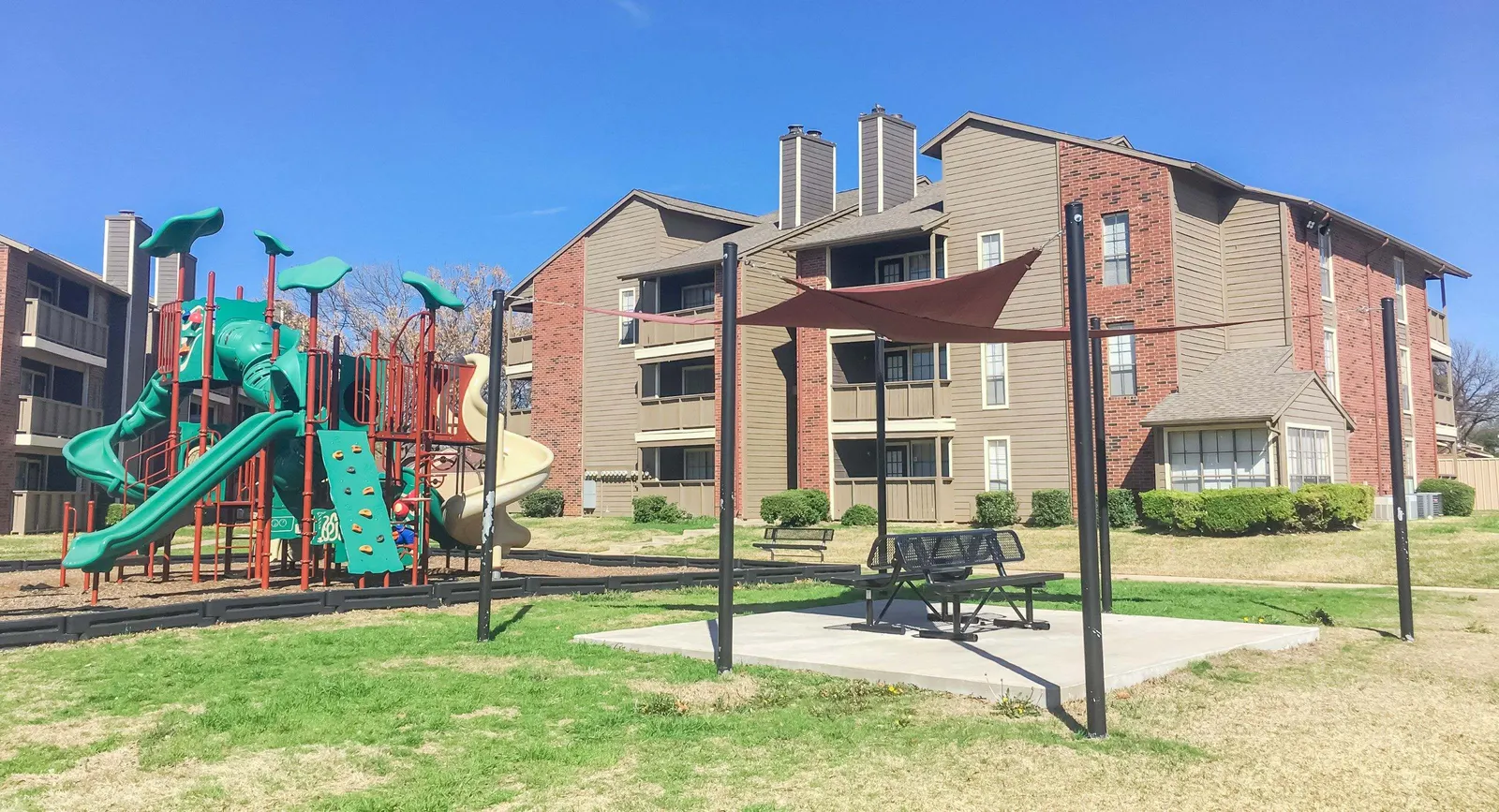
A playground at an apartment complex in Irving, Texas, near Dallas.
Getty Images
Two years ago, the Justice Department and eight states filed an antitrust lawsuit alleging that RealPage helped apartment owners collude to fix rental prices. The lawsuit said that the company’s pricing software used nonpublic, sensitive data collected from apartment owners to develop rental rate recommendations in various markets and keep rents higher than they would have been in a competitive market.
The company and government settled the case last year, with RealPage agreeing to stop using sensitive information from landlords to determine the rental prices that it suggested through its software. The company did not admit or deny wrongdoing or face a financial penalty as part of the agreement. Several antitrust lawsuits filed by states and private plaintiffs continue. Private equity firm Thoma Bravo acquired RealPage in 2021.
Another rent-payment focused startup, New York-based Esusu, has partnered with BNPL provider Affirm Holdings to allow renters to split their rent into two equal payments. The Esusu program remains an “early-stage pilot” in testing and consists only of evenly split rent payments, with no fees or interest, an Affirm spokesperson said last month in an email.
Esusu charges a $59 membership fee, paid monthly or annually, depending on whether a tenant’s apartment property is part of the company’s network. The company also has a “split pay” program allowing renters to pay 60% of their rent upfront and divide the remainder into two or three payments. Esusu did not respond to a message seeking comment on its business model.
Determining the costs of these rent-payment programs “can be confusing,” said Nelson, the NCLC attorney, noting that such information is often buried deep within user terms and conditions.
“I cannot for the life of me figure out how much they cost,” she said of having looked around different pay-later providers’ websites for pricing information. “And that’s also a problem.”
Scattered regulatory oversight
Pay-later lending has had little oversight at the federal level. Several states – including Illinois, New York and Oregon – have formulated rules to regulate the industry as the Consumer Financial Protection Bureau has contracted during the Trump administration.
In June, U.S. Rep. Daniel Goldman, a Democrat from New York City, introduced a bill to apply the federal Truth in Lending Act to BNPL loans, effectively regulating them as credit cards. The measure hasn’t moved beyond the House Financial Services Committee, according to Congress’ website.
BNPL “users have been left with no federal protections,” Goldman said in a press release announcing his bill, referring to the CFPB’s decision to retreat last year from a 2024 decision to regulate pay-later loans much like credit cards.
Another bill, filed by Sen. Jack Reed, a Rhode Island Democrat, would amend the Truth in Lending law, which dates to the late 1960s, and the 2010 Consumer Financial Protection Act to apply new oversight and consumer protections. Reed’s legislation, filed late last year, has attracted four Democratic co-sponsors and a companion bill in the House, but no Republican sponsors, according to Congress.gov.
Lichtenstein, the Flex CEO, said that one challenge facing the RNPL industry is that these products “don’t fit into a clean box” neatly for regulators to evaluate what they are and how they work.
“The more you don’t fit into a clean box, the more regulatory scrutiny it draws,” he said. “We have tried our best to fit into a relatively clean box,” he said, adding that the company has “internal guardrails” to help it evaluate “the many, many gray areas that can exist for consumer fintech.”
However, he added, pay-later services for rent differ from other financial services, often “embedded” with the rent payment and with different pricing models.
The RNPL industry doesn’t currently have a “uniform set of standards” from regulators under which to operate, Lichtenstein said, which can lead to different practices among the various players. “Continued clarity on the right way to do things would be welcome by us,” he said.
Risks for renters?
Beyond high fees and the potential for debt accumulation, rent-payment services pose “a significant risk” to borrowers because lenders often link directly to consumers’ bank accounts and offer “disastrously poor customer service” in addressing errors or other account issues, according to the Protect Borrowers report.
Their growth is also likely to lead to further regulatory scrutiny, with at least one state, New York, being encouraged by the New York City Department of Consumer and Worker Protection to apply its BNPL rules expansively to other providers in adjacent verticals.
Pay-later services are marketed by lenders “who claim that these loans can ease the housing affordability or healthcare accessibility crisis,” Commissioner Samuel A.A. Levine of the New York City DCWP wrote in September in a letter to New York state financial regulators. “However, in both cases, these products fail to address the underlying problems and result only in consumers facing new and compounding risks.”
Among various recommendations to the state’s Department of Financial Services, Levine urged regulators to include “all forms of BNPL products” in its pending rules for such lenders, including those that offer rent payment services.
“The stakes are really high, so I think we need to be extremely cautious about how we handle products in this space.”
Ariel Nelson
National Consumer Law Center
Esusu raised $50 million last December. Its platform covers about 5 million rental units, with 12 million people, according to the company’s press release. The company also offers a rent-payment reporting service to help renters build their credit scores.
Esusu says on its website that its credit services are needed because two-thirds of Americans “live paycheck to paycheck” and that about “30% of lower-income households spend 95% or more of their income on basic necessities like housing, food and utilities.”
Affirm doesn’t allow a consumer to borrow further if they have an outstanding balance from the prior month, Affirm’s vice president of government relations, John Pitts, wrote in a February blog post in response to the Protect Borrowers report, seeking to highlight differences between Affirm and others in the rent market.
“Being financially blindsided by hidden fees and/or still paying January’s rent in March is not solving affordability, it’s stacking debt,” Pitts wrote. “That’s why our products are structurally different.”
Regulators are beginning to “get educated in this space, and they’re asking the right questions to provide the consumer protection around it,” said RealPage’s Khoja. Officials in states with the largest numbers of renters – California, Florida, New York and Texas – are among those gathering information about how RNPL firms work, he said.
However, the field of pay later for rent is nascent and state officials are still “catching up” with its growth, said Nelson, the consumer attorney.
“You’re talking about people who are doing whatever it takes to keep a roof over their head,” she said. “This isn’t like I couldn’t pay for an expensive pair of shoes – you could literally be homeless. The stakes are really high, so I think we need to be extremely cautious about how we handle products in this space.”
Source link