




Plus: Real-time rail’s first phase is finally here.
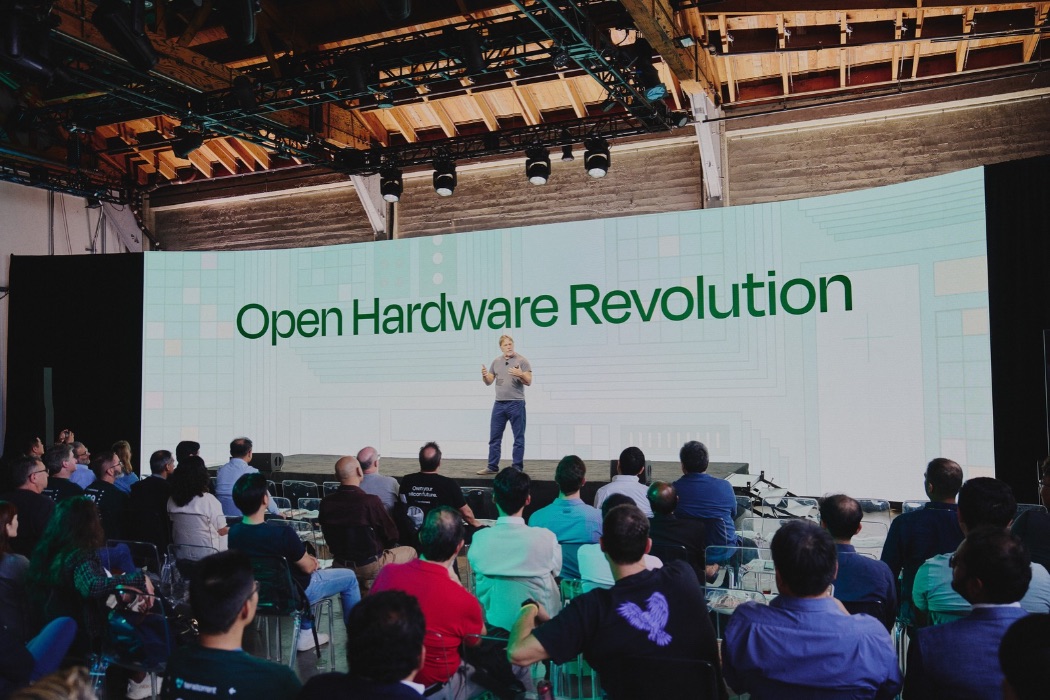
Last month, Toronto-founded AI chip maker Tenstorrent announced a whopping $1.5-billion USD Series E round. I say Toronto-founded because the company quietly relocated to the US in 2023 to support its fundraising and IPO goals. With over $2 billion USD in funding announced since, the move appears to have paid off.
Tenstorrent still has some 200 employees in Toronto, and hasn’t forgotten its Canadian roots. The Logic reported this week that the company has lobbied the federal government for sovereign AI contracts and funding for large-scale data centre buildouts.
Every company should be expected to make decisions in its own best interests. But Tenstorrent’s gentle tap dance back and forth across our southernmost border when it benefits them shines a light on a murky question: what makes a company Canadian?
Noting that the feds’ Buy Canadian Policy currently allows for, say, Walmart Canada, the policy wonks at The Canadian Shield Institute have argued for a revised definition in BetaKit. The think tank also recently asserted the perils of considering companies like Tenstorrent Canadian enough: “If any company, headquartered anywhere on earth, can qualify for funding because its lobbyists point to some operations here or some historic association with Canada, then economic development policy will become meaningless.”
This week, I interviewed AI Minister Evan Solomon about the federal government’s investment in Cohere. The interview will be released soon, but Tenstorrent came up. The minister said his job was to give tech companies reasons not to leave, using levers like compute, customers, and capital (i.e., why Tenstorrent said it left). But he also seemed OK with now-foreign entities continuing to hire and do business in Canada. “We want that,” he said. “They’re investing in Canadian talent.”
Successful economic development policy requires striking the tricky balance between short-term realities and long-term priorities. In the midst of Nvidia’s historic, shareholder-value-destroying self-own, it seems possible that Tenstorrent (or Untether AI or Taalas—both sold to AMD) could have been federally anointed an AI champion like Cohere had they stayed. The feds still might, but would Tenstorrent really be a sovereign selection? And if not, would it matter?
Douglas Soltys,
Editor-in-Chief
One place for every payment your business makes.
More than 10,000 Canadian businesses use Float to issue CAD and USD corporate cards, pay bills and send money in 21 currencies, with no bank portal or second login. EFT, ACH and SEPA payments are free, and eligible bills paid by Float card earn up to 1% cashback on card spend over $25K a month.
Float Intelligence reads the GST, HST, PST and QST split off every invoice, helping finance teams close their books up to 8x faster.
Top stories from BetaKit
Real-time rail is here
After more than a decade of development and many delays, eight financial institutions, including Wealthsimple and Koho, have joined the first phase of Canada’s Real-Time Rail payments system. BetaKit sat down with Fintechs Canada executive director Adriana Vega to better understand what a successful execution of the system would look like and why it needs the as-of-yet absent Big Six banks to succeed.
Blue J takes flight
AI tax research platform Blue J raised a $176-million USD Series E round this week after more than doubling its annual recurring revenue in just over a year. Blue J CEO Ben Alarie told BetaKit the company plans to expand its agentic offerings to take more off accountants’ plates and build “Canada’s next great tech company right here from Toronto.”
Boson treasures Toronto
Well-funded US AI research lab Boson AI started quietly building a Toronto office in 2023 as a prudent “Plan B.” Now it houses around half of its 40 staff and has proven a valuable location for its compute, talent, and predictability, Boson co-founder and CEO Alex Smola told BetaKit.
Acquisitions ramp up
While Canadian venture capital activity is broadly on par with last year, disclosed exit proceeds have already more than doubled compared to 2025, according to CVCA’s Q3 report. Exit proceeds totalled $744 million CAD across 10 disclosed transactions, which is more than double the $355 million in disclosed exit value for all of 2025.
Why the feds reserved sovereign compute
The recent federal budget committed to making 500 megawatts of sovereign AI compute available for domestic companies. As smaller AI startups get crowded out by hyperscalers in the compute race, Canadian tech sees promise in the feds’ pledge to save them a seat at the table.
Sponsored stories
CIBC’s security chief on how AI is changing cybersecurity
As AI supercharges the speed and sophistication of cyber threats, CIBC is shifting toward earlier security integration and rapid vulnerability remediation while outlining how tech startups can win long-term enterprise partnerships through seamless workflow integration.
Coraltalk wants universities to stop chasing AI cheaters and start measuring learning
Backed by York University’s YSpace, EdTech startup Coraltalk is helping universities move beyond unreliable AI-cheating detectors by using conversational AI to scale individualized oral exams that evaluate students’ true reasoning and comprehension.
Fall applications are now open: hire a student with up to $5,000 in wage support
TECHNATION’s Career Ready Program, funded by the Government of Canada’s Student Work Placement Program, covers up to 50% of a student’s wage, to a maximum of $5,000, for a work term with your company. Whether you need extra hands this fall or want to meet your future hires early, it’s a simple way to add fresh tech talent and keep costs down.
Up to $5,000 per student | Applications close November 30
Apply now to secure your wage support!
Deals and dollars
Who’s cashing in, or out, this week:
- Indigenous business accelerator EntrepreNorth secured an $8-million initial close to help fill Northern Canada’s risk-capital gap. (Yellowknife)
- Lithium extraction company Summit Lithium Technologies is evaluating strategic options that could result in a sale to a foreign buyer. (Calgary)
- Conexus Venture Capital raised an additional $5 million for its second fund. (Regina)
- US-based payments company Shift4 agreed to acquire Paramount Commerce for up to $317 million USD. (Toronto)
- Northside Ventures launched its second venture capital fund, targeting $30 million USD to support companies at the earliest stages. (Toronto)
- Blackletter, a tech-forward business law firm founded by former Cohere and Blue J leaders, raised $6 million USD. (Toronto)
- Energy grid management startup BluWave-ai secured $8.1 million in equity and debt in anticipation of a data centre-fuelled surge in demand. (Ottawa)
- Qvyon Technologies emerged from stealth with $8 million USD to prepare physical AI for dangerous edge cases. (Montréal)
- OpenAI acquired Sonder co-founder Francis Davidson’s new travel tech company Odessia, less than a year after he started it. (Montréal)
Main character
Read more on BetaKit.
The refresh
Computer chips are the most magnificent things humanity has ever made
Amid all of the focus on Nvidia this week for, err, reasons, it’s worth taking a step back to talk about its core product. This piece from The New Yorker will help you appreciate the miracle of computer chips, the sheer scale of the semiconductor supply chain, and why it anchors geopolitical rivalries.
BetaKit Podcast · Nov 9
“It’s pretty clear the government has gone down a lot of the laundry lists from businesses and entrepreneurs and just said, ‘OK, well, what if we do all of the above?’”
Budget 2026 shows a federal government trying to do everything, everywhere, all at once. How is that going to work out? BetaKit‘s Policy Power Panel once again assembles to talk prioritization, efficacy, and sweat the details. Featuring, in clockwise order: Vass Bednar (Canadian Shield Institute), Jaxson Khan (Munk School of Global Affairs & Public Policy, and Laurent Carbonneau (Council of Canadian Innovators). Watch and listen now ›
Contributors: Alex Riehl (Ottawa staff writer), Trevor Nichols (web editor), Sarah Rieger (managing editor), Douglas Soltys (editor in chief).
Feature image courtesy Tenstorrent.
Source link