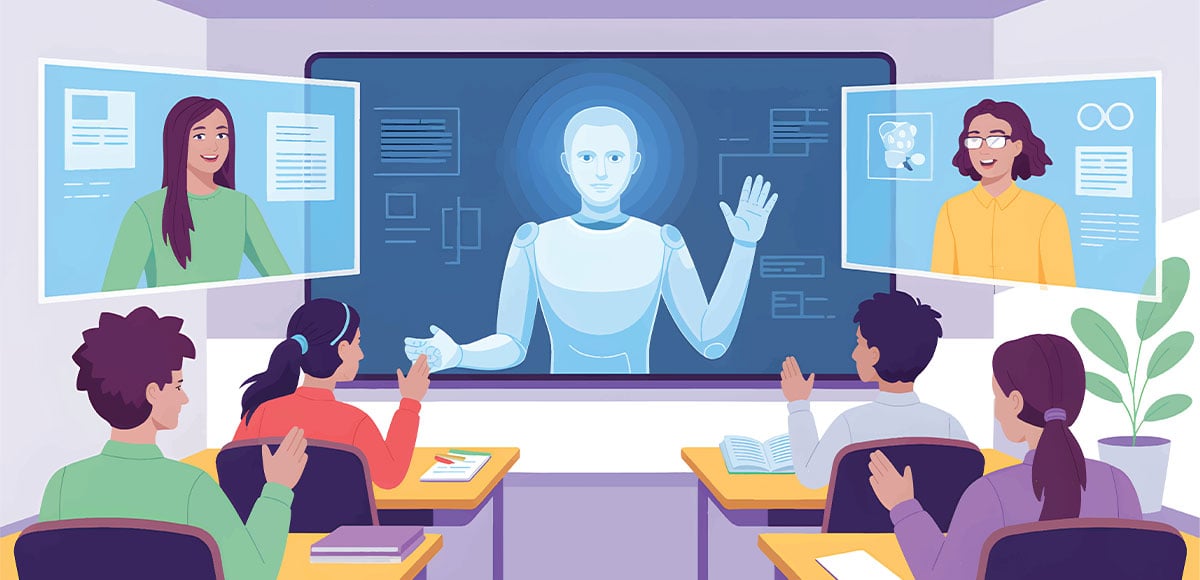
Edtech has largely centred on learners rather than educators: better curriculum, richer content, personalised learning. Early AI in education followed the same pattern, prioritising tutoring, adaptive learning, and automated feedback for students. But the deeper we’ve gone into AI-native product development, the clearer it’s become that the real transformation isn’t just on the student side. AI is uniquely positioned to empower educators – the people who guide learning – as much as the students themselves. Between 60% to 84% of teachers report that AI tools save them time but it’s capable of even more.
AI tools for educators and faculty have become a new frontier for edtech startups, shifting the focus from delivering content to supporting the people who teach and mentor students. Educators face constant pressure to do more with less time: personalising instruction, managing administrative work, supporting diverse learners, and engaging students across a wide range of contexts. Edtech startups can meaningfully address these challenges by building AI grounded in real classroom needs. Rather than asking what AI can automate, startups should ask how it can help educators spend more time connecting with students.
The goal is to design tools that educators can integrate naturally into existing workflows with minimal learning effort and immediate, scalable value. At the heart of it, it’s about empathy: using the best available technology to amplify human impact. When we get that balance right – human-centred design powered by intelligent systems – we can unlock enormous potential in education.
How can edtech startups truly empower educators with AI
We already know it very well – AI can take a lot of the invisible workload off educators’ plates, the admin tasks, data crunching, and prep work that quietly eat up hours. Beyond time savings, there’s even more hidden opportunities: AI in edtech makes data more useful than ever. For years, administrators have had access to dashboards filled with information on their campuses. The challenge has not been access, but clarity. AI can help interpret patterns, surface what matters most, and provide concise, actionable insights.
For example, edtech startups can build AI that supports planning and coordination by automatically gathering relevant information, organising context, and surfacing key insights before instructional or advising moments. Instead of spending time assembling materials or navigating multiple systems, educators can focus their attention on students and learning outcomes.
Instead of digging around to find answers, with the help of AI, educators can easily identify:
- Which students are struggling with specific concepts or disengaging with the course?
- What patterns emerge from student feedback and data across multiple terms?
- Which advising actions correlate with improved completion?
The AI combines the relevant data, analyses it, and offers practical next steps. The result? In a few seconds an educator gets clear and well-structured information without being overwhelmed with excessive details. This shift changes more than the workflow; it lightens the cognitive load and frees them to focus on the work where their expertise and nuance can make a difference.
Another thing that feels relevant is the way AI can personalise support for educators themselves. We often talk about personalised learning for students, but teachers also need tools that adapt to their workflow, their requirements, or their style. When AI can instantly generate differentiated materials, suggest methodologies that have worked for similar students, or just meet instructors where they are in their daily tasks, that’s a real game changer.
Beyond efficiency, AI is also democratising expertise, making high-quality guidance accessible to those early in their career who’ve never had that kind of resource. And it also gives teachers room to become designers, not just deliverers. Educators can now have space to experiment, to be creative, to truly shape learning experiences in their style and for all their students.
There is so much innovation happening right now and edtech startups building on AI certainly play a big role in all those developments. Designing with educators rather than around them ensures that AI functions as an enabler, reducing friction, creating clarity, and supporting scale in ways that feel natural.
Co-intelligence as a competitive advantage for edtech startups
How can an edtech startup decide when to use AI and when to keep things natural? It always starts with the question: what’s the human problem we’re actually trying to solve, and where does human judgment remain irreplaceable? AI in education works well when a startup designs it to remove friction or scale work that is difficult to do manually, while keeping educators firmly at the centre.
In practice, AI tends to add the most value, across both schools and colleges, in two areas:

- Early signal detection and decision support: continuously monitoring patterns across learning and engagement to surface risks that are easy for humans to miss at scale like academic gaps, disengagement, attendance issues, or wellbeing concerns. Crucially, these systems help educators, counsellors, and faculty intervene earlier, and with better context and greater confidence
- Instructional and operational acceleration: helping educators personalizing materials in their style with their insights, across grades, courses, and learner abilities; aligning content to standards or outcomes; and surfacing relevant instructional or advising strategies in context
When it’s done right, this AI assistance feels invisible. Strong edtech founders know: the goal is not to replace human teachers with AI, but to connect AI with educators – designing for co-intelligence and moving educational capabilities forward. The most meaningful use of AI is when it helps educators and mentors show up as 10x versions of themselves, focusing their energy on the creative, relational, and judgment-driven parts of learner support.
Tips for startups building AI tools in edtech
Education as a space tends to be a complex, multi-stakeholder environment, shaped by limited budgets, long decision cycles, and competing incentives across institutions, educators, and learners. In order to succeed, edtech products, especially those using AI, need to be designed not just for individual users, but for the operational realities of the system as a whole.
Today’s students, Gen Z and Gen A, are very different from millennials with their own struggles around professional skills, job readiness, communication and collaboration. Learning their struggle points can reveal opportunities for creating a product that would really stand out.
Institutional context matters just as much. Schools, colleges, and universities vary widely in infrastructure, staffing models, governance, and available resources. Successful startups might have to make an explicit strategic choice. Either invest in the ability to support multiple institutional models, accepting the complexity and cost of customisation or focus narrowly, designing deeply for a specific segment of institutions they can serve exceptionally well. What tends to fail is the middle ground: products built for everyone in theory, but truly loved by no one in practice.
Ultimately, as foundation models advance at a relentless pace, surface-level AI features are quickly becoming table stakes. The real differentiator for edtech products will not be what the model can do, but what the product deliberately takes off teachers’ plates and what it leaves firmly in their hands. Educators are pragmatic, time-scarce, and fiercely protective of their classroom autonomy. For founders, this means winning AI tools will absorb cognitive and administrative burden while sharpening, not diluting, the professional judgment that experienced teachers bring. The most delightful products will evolve continuously, yet feel stable to use, improving quietly in the background without forcing educators to constantly relearn workflows or renegotiate their role in the classroom.
For more startup news, check out the other articles on the website, and subscribe to the magazine for free. Listen to The Cereal Entrepreneur podcast for more interviews with entrepreneurs and big-hitters in the startup ecosystem.