Global FinTech firms raised $955m across 26 deals this week, marking a near 70% increase in funding from the figure raised seven days ago.
While deal volume remained unchanged week-on-week, total capital deployed climbed by a shade under 68% from the $570m last week, reflecting growing investor appetite for AI-driven cybersecurity and financial infrastructure platforms.
Four deals surpassed the vaunted $100m mark this week. The largest was secured by cybersecurity startup Armadin, which raised $189.9m in a combined Seed and Series A funding round led by Accel to develop its AI-driven cyber defence platform.
The second-largest deal came from Uzbekistan-based digital ecosystem Uzum, which secured more than $130m in strategic investment from sovereign entities in the Sultanate of Oman to expand its digital banking, payments and consumer finance ecosystem.
Another major round was announced by AI cybersecurity firm Kai, which emerged from stealth with $125m in funding, while Paris-based InsurTech Alan also broke the nine-figure mark, pushing its valuation to €5bn.
RegTech-related companies dominated activity this week, accounting for 12 of the 26 deals announced, the highest share of any subsector. Infrastructure and enterprise software providers followed with seven deals, while three funding rounds were recorded in both the FinTech and InsurTech sectors. In contrast, only one WealthTech deal was announced this week, indicating a short-term slowdown in activity within the segment.
However, recent research from FinTech Global suggests investor confidence in the WealthTech sector remains strong.
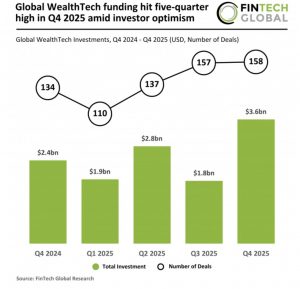
In Q4 2025, the sector recorded 158 deals globally, an 18% increase year-on-year, while total funding reached $3.6bn, up 49% from $2.4bn in Q4 2024, marking the highest funding levels in five quarters.
The United States remained the most active FinTech funding hub this week, accounting for 13 of the 26 deals announced.
The UK continued its position as the perennial bridesmaid of the funding world, landing three deals, while France, Israel and the Netherlands each secured two deals.
Other countries represented this week include Italy, Uzbekistan, Ireland and South Africa, highlighting the continued global spread of FinTech investment activity.
This trend broadly reflects wider market dynamics. According to FinTech Global data, the US dominated global FinTech investment in Q4 2025, accounting for 525 deals and a 44% share of the global market, up from 421 deals in Q4 2024. The UK ranked second with 82 deals, while India placed third with 75 deals

Here are this week’s FinTech funding rounds:
Armadin lands $189.9m for AI-driven cyber defence
Armadin has announced a record-breaking $189.9m combined Seed and Series A funding round aimed at helping organisations defend against increasingly sophisticated AI-driven attacks.
The investment was led by Accel, with participation from Google Ventures, Kleiner Perkins, Menlo Ventures and In-Q-Tel. Existing investors 8VC and Ballistic Ventures also joined the round with follow-on backing. According to the company, the deal represents the largest combined Seed and Series A funding round ever recorded in the cybersecurity sector.
Armadin is developing a platform designed to help organisations identify and respond to security risks at machine speed.
As cyber threats evolve through the use of artificial intelligence, the company argues that traditional human-led defences are struggling to keep pace. Its platform aims to bridge this gap by using autonomous systems capable of detecting vulnerabilities, validating potential exploits and supporting remediation before attackers can act.
The technology centres around what the firm describes as an “agentic attacker swarm”, a network of specialised AI agents that emulate the behaviour of advanced human threat actors. Instead of simply scanning for weaknesses, the system continuously analyses and adapts to an organisation’s infrastructure, identifying real-world exploit paths and presenting decision-ready intelligence to executives and security leaders.
Uzbekistan FinTech Uzum lands $130m strategic investment
Uzbekistan’s leading digital ecosystem, Uzum, has secured a strategic investment exceeding $130m in a deal that underscores growing international confidence in the country’s rapidly expanding digital economy.
The company operates a broad digital platform that combines e-commerce, digital banking, payments and consumer finance services for millions of users across the country.
The funding round was anchored by sovereign entities from the Sultanate of Oman, which led the strategic investment.
The transaction combines primary equity and structured capital and establishes a $2.3bn pre-money valuation reference point for the company. Conversion terms for the structured capital are linked to Uzum’s next qualified financing round. The investment also attracted participation from existing international shareholders VR Capital, Tencent and FinSight Ventures, signalling continued support from global investors.
Uzum has developed a fully integrated ecosystem that blends commerce and financial services on a national scale. Its portfolio of platforms includes Uzum Market, an online marketplace, Uzum Tezkor, a rapid delivery service, Uzum Bank, a digital banking platform, and Uzum Nasiya, which offers consumer lending solutions.
Together, these services are used by more than 20 million people, representing over half of Uzbekistan’s population, positioning the company as one of the most influential players in the region’s digital transformation.
The newly secured capital will be used to accelerate the next stage of the company’s expansion across its core verticals, including e-commerce, digital banking, payments and lending. Uzum intends to deepen its product offerings, enhance its infrastructure and broaden nationwide access to digital financial services.
Cybersecurity firm Kai secures $125m for AI defence
Alan valued at €5bn after €100m funding round
Digital asset data platform Cryptio lands $45m round
Cybersecurity company Bold bags $40m funding round
Bold, an enterprise cybersecurity company focused on preventing user-based threats at the endpoint, has emerged from stealth after securing a $40m funding round to support the launch of its AI-powered security platform.
The funding round brought in $40m from investors including Bessemer Venture Partners, Picture Capital and Red Dot Capital Partners, providing the company with fresh capital as it introduces its technology to the market.
Bold develops endpoint security technology designed to reduce user-related risks across enterprise systems. The company focuses on protecting what it describes as the “last mile” of the enterprise — employee devices that connect internal systems with the outside world. Traditionally, organisations have relied on a mix of legacy tools such as data loss prevention (DLP), insider risk monitoring and application oversight to address these risks. However, many of these systems operate in isolation and struggle to detect threats in real time, particularly as enterprise workflows become increasingly decentralised and AI-driven.
The company’s platform aims to address this challenge by transforming endpoints into active security layers rather than passive risk points. Bold’s technology runs AI models locally on each device, allowing enterprises to monitor behaviour, classify sensitive data and enforce security controls directly on the endpoint. By analysing user actions and contextual information in real time, the platform can identify and intervene when risky activity occurs, such as unauthorised data transfers or attempts to move sensitive information outside the organisation.
Bold plans to use the newly secured funding to accelerate its go-to-market strategy and further develop its edge AI platform.
Cybersecurity FinTech Onyx Security secures $40m funding
Onyx Security has launched with $40m in funding as it seeks to address emerging risks tied to the rapid adoption of agentic artificial intelligence across organisations.
The company confirmed it raised $40m from investors including Conviction Partners and Cyberstarts. The funding accompanies the firm’s public launch and positions the business to capitalise on growing enterprise demand for tools capable of monitoring and controlling increasingly autonomous AI systems.
Onyx Security is developing what it describes as a secure AI control plane designed to oversee the deployment and operation of AI agents within enterprises. As organisations integrate AI agents into workflows spanning engineering, customer service and internal operations, these systems are gaining access to critical infrastructure and sensitive information. However, their ability to operate autonomously introduces new operational and cybersecurity risks, including reasoning errors, hallucinations and potential manipulation through malicious prompts.
To address these challenges, the company’s platform is designed to continuously discover AI agents operating within an organisation, monitor each stage of their reasoning processes and approve, modify or block actions when necessary. By doing so, the system aims to ensure enterprises can enforce governance and security policies while still enabling rapid adoption of AI-driven automation.
Qevlar AI secures $30m to build autonomous AI SOC platform
Qevlar AI, an autonomous AI security operations centre (SOC) platform, has raised $30m to push its technology beyond alert investigations and towards organisation-wide security insights.
The round was co-led by Partech and Forgepoint Capital International, the latter having also backed the company in its previous 2025 funding round, with EQT Ventures participating.
The capital will fund further development of the platform’s ability to surface intelligence about the root causes of recurring security issues, enabling teams to address problems at source. Qevlar AI has built a global customer base that includes enterprise names such as Mercedes-Benz and Sodexo, as well as MSSPs including Orange Cyberdefense, ECI and Atos.
PactFi raises $25m Series A to modernise private credit
PactFi, a secure end-to-end operational platform for private credit, has raised $25m in a Series A funding round led by 7RIDGE Ecosystem Impact Fund (EIF), with participation from Vestigo Ventures.
The round will be used to accelerate PactFi’s position as core infrastructure for the private credit ecosystem across four key areas: product expansion, go-to-market growth, continued research and development alongside artificial intelligence integration, and team expansion. The company is actively hiring across product, engineering, and client-facing roles.
PactFi was founded by industry practitioners who experienced firsthand how disconnected tools introduced risk, inefficiency, and control gaps across the transaction lifecycle.
The platform provides cross-counterparty workflows within a shared operating environment, capturing and structuring data across the private credit lifecycle and enabling straight-through processing with centralised visibility. It holds ISO 27001 certification and SOC 2 Type II attestation, underscoring its commitment to enterprise-grade security and governance infrastructure.
Since launching in 2023, PactFi has processed more than $300bn in deal volume across more than 250 counterparties. It has more than 2,600 users representing 3,000 fund entities, and already supports eight of the top 20 credit asset managers, representing a combined $3.4tn in assets under management. All of the top 20 have participated on the platform as lenders.
Security data platform Scanner secures $22m funding
Scanner, a cybersecurity company building a data platform designed for modern security operations, has announced new funding of $22m.
The company has raised $22m in a Series A funding round led by Sequoia Capital, with additional participation from CRV and Mantis VC. The investment is intended to accelerate the company’s mission to deliver faster and more scalable security data infrastructure for enterprise security teams.
Scanner develops a platform that allows organisations to search and analyse large volumes of security log data quickly, even when that information is stored in cost-efficient object storage systems. Traditionally, security teams have faced a trade-off: they can store data in security information and event management (SIEM) tools where it can be searched rapidly but only retained for short periods, or keep it cheaply in object storage where searching the data can take hours or even days. Scanner aims to bridge this gap by enabling teams to analyse years of log data at high speed without incurring the costs associated with traditional SIEM ingestion.
The company’s platform is built around a specialised indexing system designed specifically for object storage. When a query is initiated, the system temporarily scales its computing resources to retrieve results quickly before scaling back down when the task is complete. According to the company, this approach allows security teams to run investigations across months or years of logs and numerous data sources while only paying for the computing power used during the query.
Scanner said the newly secured capital will be used to expand the platform’s capabilities and bring its technology to a wider range of security teams. The firm is particularly focused on supporting the growing use of AI agents within security operations, where automated systems continuously analyse security data, investigate alerts and hunt for potential threats.
Escape raises $18m Series A for AI offensive security
Escape, an AI-native offensive security engineering platform trusted by more than 2,000 security teams globally, has raised $18m in a Series A funding round led by Balderton Capital.
Uncorrelated Ventures joined the round alongside existing investors IRIS and Y Combinator.
The funding will be used to deepen the platform’s AI agent capabilities, expand agentic pentesting functionality, and grow the team across engineering, research, and go-to-market in the US and Europe. The announcement coincides with a new brand identity for the company.
Escape’s platform delivers three products: Attack Surface Management, which provides continuous visibility across code and cloud environments; Business-Logic-Aware DAST, which replaces legacy scanning with continuously improving, context-aware testing; and AI Pentesting, which offers the depth of a senior pentester running continuously at scale.
The company counts BetterHelp, PandaDoc, CyberCube, and Arkose Labs among its customers. One customer reported a 393% ROI after reducing its security testing cycle from five days to five hours.
Outpost raises $17.5m Series A to simplify global trade
Cleafy raises €12m to fight banking fraud in Europe
Coreworks, an artificial intelligence-powered business reporting platform, has raised $5m in a seed funding round led by Together Fund.
The round will be used to accelerate product development and expand early access to teams looking to overhaul how reporting is produced within their organisations. The company is also opening an early waitlist and inviting companies to help shape the future of reporting.
Coreworks has developed what it calls an AI SuperAnalyst, which connects to data sources including ERPs, CRMs, and spreadsheets to generate structured reports, presentations, and financial models directly from underlying source data. Every metric remains traceable to its original source, allowing numbers to be verified instantly during discussions or decision-making processes.