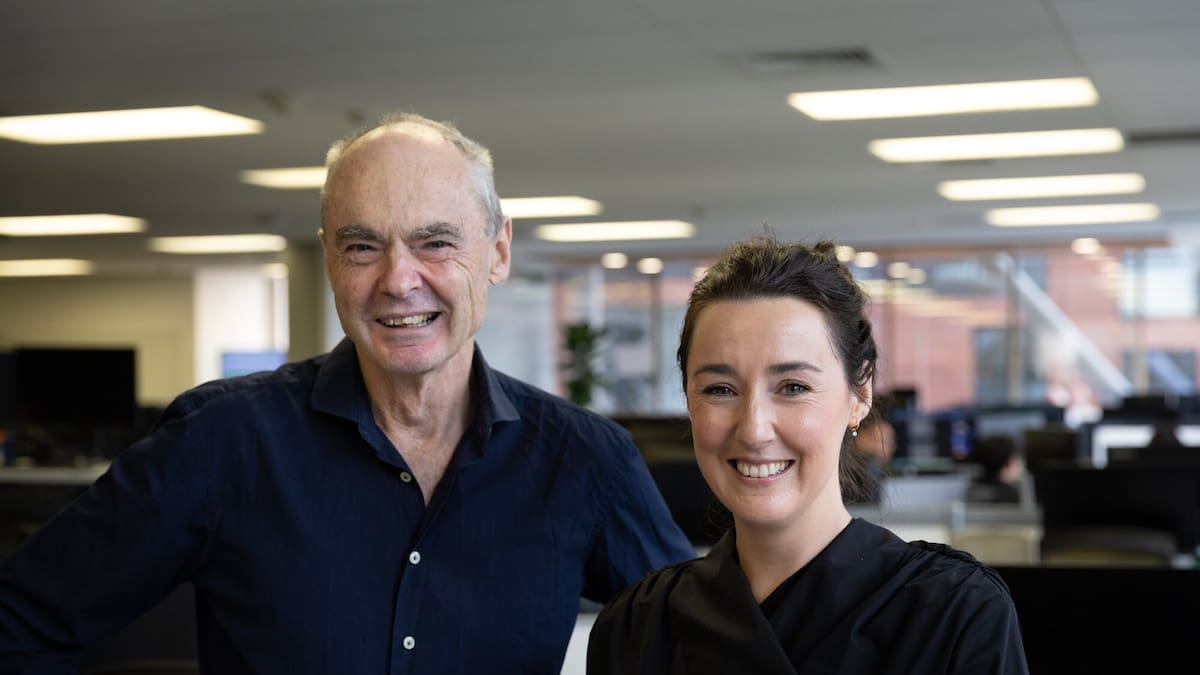


“The family would be at the beach, swimming, and I’d be jammed in the corner, AI’ing,” he says.
McCrae Tech was founded by McCrae with proceeds from the $205m sale of Auckland-based Orion Health to Canada’s Healwell in late 2024.
His daughter Lucy Porter is playing a key executive role.
The Auckland-based firm includes the patient health record system created by Orion and used by every public hospital in the South Island, plus others around the world. It’s now spruced up with new features and rebranded as Amalga.
Then there’s McCrae Tech’s Orchestral platform, based on Orion R&D work, which McCrae also kept rights to in the Healwell deal.
The idea is that Orchestral’s AI scours existing data, sitting across administrative, clinical and community systems, often in complex and fractured fashion, then turns it into “human-digestible” nuggets.
Founder … and guinea pig
McCrae Tech’s 110 staff include Dr Jack Vojack, charged with feeding Ian McCrae’s medical files – several inches thick and pulled from far and wide – into Orchestral systems as the founder doubles as the start-up’s guinea pig.
Vojack’s efforts include pulling real-time data from a patch on McCrae’s left upper arm, which measures his body’s level of ketones, the better to monitor the strict keto diet that forms part of his treatment.
‘Road toll’-level prescription errors
The firm is releasing its first standalone product today: Orchestral for Prescription Safety, which will check for mistakes when medication is prescribed.
“It’s not well known, but there’s over 200 people in New Zealand who die every year due to prescription errors,” Porter says.
“That’s actually more than our road toll.”
Last year, a week-long audit of 68 pharmacists in Health NZ’s Midland region found 1257 problems in prescriptions sent by GPs, specialists, midwives, dentists and other prescribers – with 26% of these mistakes having a high risk of patient harm.
The College of General Practitioners complained none of the software systems available were fit for purpose.
Extrapolating this across the rest of New Zealand means there are probably one million problem scripts per year across 1154 community pharmacies nationwide, with 250,000 having a “high risk of patient harm” – and this is not a problem limited to New Zealand.
Research published by University of Auckland Emeritus Professor in Population Health Dr Peter Davis and colleagues in the New Zealand Medical Journal in March 2006 found 1.3 preventable deaths per 1000 hospital admissions.
Davis said the exact number was hard to quantify. The situation was not black-and-white when patients were old or frail or hard-to-anticipate side effects were in play. But he estimated that around a quarter of the preventable deaths were medication- or therapy-related.
Extrapolating the rate from Davis’ earlier research to contemporary admissions across public and private hospitals would imply around 375 preventable deaths per year from medication errors, which would be higher than last year’s road toll of 272 (the Ministry of Health could not immediately supply any prescription error figures. The Herald was asked to file an Official Information Act request).
‘AI should eliminate mistakes’
A 2023 World Health Organisation survey found medication-related harm also poses a major financial burden on healthcare systems worldwide.
“Globally, the cost associated with medication errors has been estimated at US$42 billion [$72.2b] annually.”
It says in the US alone, 1.3 million people experienced preventable medication-related harm.
Orchestral for Prescription Safety will cross-reference a patient’s age, sex and other characteristics, and what they have already been prescribed.
It will also check The New Zealand Formulary (a national database that includes information on pharmaceuticals and their use), among other safeguards, Porter says.
“AI will make it a lot better,” Davis told the Herald, talking about artificial intelligence in health in general.
The new semi-retired academic says any electronic system is a step-up from the mistakes that used ot be caused by doctors’ handwriting.
By automating multiple cross-checks, “AI should make it impossible” to make a prescription mistake,’ Davis says, if it’s implemented correctly.
Porter says all Orchestral’s AI agents are “governed” or operating within strict rules and builds on decades of data storage engineering, first within Orion and now sput into McCrae Tech. Orchestral has three components:
- Health Information Platform (HIP): Ingests data from any source and delivers trusted, structured, standardised, and compliant health data;
- Health Agent Library (HAL): Provides a governed registry of AI building blocks for the entire health system and
- Health AI Tooling (HAT): Empowers data analysts and scientists to build agentic workflows, business intelligence reports and more.
NZIER sees billions in AI gains
“AI, if used correctly in healthcare, can double, triple or quadruple the throughput in primary care,” McCrae says.
A New Zealand Institute of Economic Research (NZIER) report, commissioned by McCrae Tech, says “AI can lift system-wide productivity by improving the accuracy and timelines of prediction, diagnosis, treatment and surgery, reducing avoidable costs and downstream complications”.
Porter says prescriptions are just one of 50,000 healthcare workflows that could be improved by her firm’s software.
And research indicates possible big gains from those improvements.
“AI adoption could generate substantial fiscal savings, with international evidence indicating a 5% to 10% reduction in health system costs,” NZIER says.
Approximately a third of the gains would stem from reduced administrative expenditure.
Over 10 years, the cost-savings would be $15 billion to $31b, NZIER said.
“This is equivalent to the cost of providing an additional six months to a year of health system services.”
NZIER also says AI productivity gains could address barriers to healthcare access at a time when “nearly half of all general practices have closed their books to new patients”.
AI taking jobs?
Porter says there should be no fears about AI taking jobs in the badly overstretched health system.
“We see a lot of articles about burnout and clinicians moving offshore,” she says.
“My hope is that AI will not only improve outcomes for patients but enable clinicians to do the things they really love, and that a lot of their paperwork will be removed.”
McCrae adds, “You still want a clinician to deliver you terrible news or guide you on a health journey. These are tools that support those clinicians. AI is a clever assistant.”
‘Down to AI’
He sees AI on a par with major public-health breakthroughs such as antibiotics and modern hygiene.
It’s still early days, but the start-up has garnered global interest, McCrae says. A yet-to-be-named customer has been signed in New Mexico.
McCrae, who had his most recent brain tumour surgery just weeks ago, is now 60 months post-diagnosis.
“I’m still going for quite good runs,” he says.
“I’m not quite as fast as I used to be. I’ve lost a few clicks. But I’m feeling healthy and a lot of that’s down to AI. It’s the most impactful technology I’ve seen in healthcare in 40 years.”
Chris Keall is an Auckland-based member of the Herald’s business team. He joined the Herald in 2018 and is the technology editor and a senior business writer.
Source link