
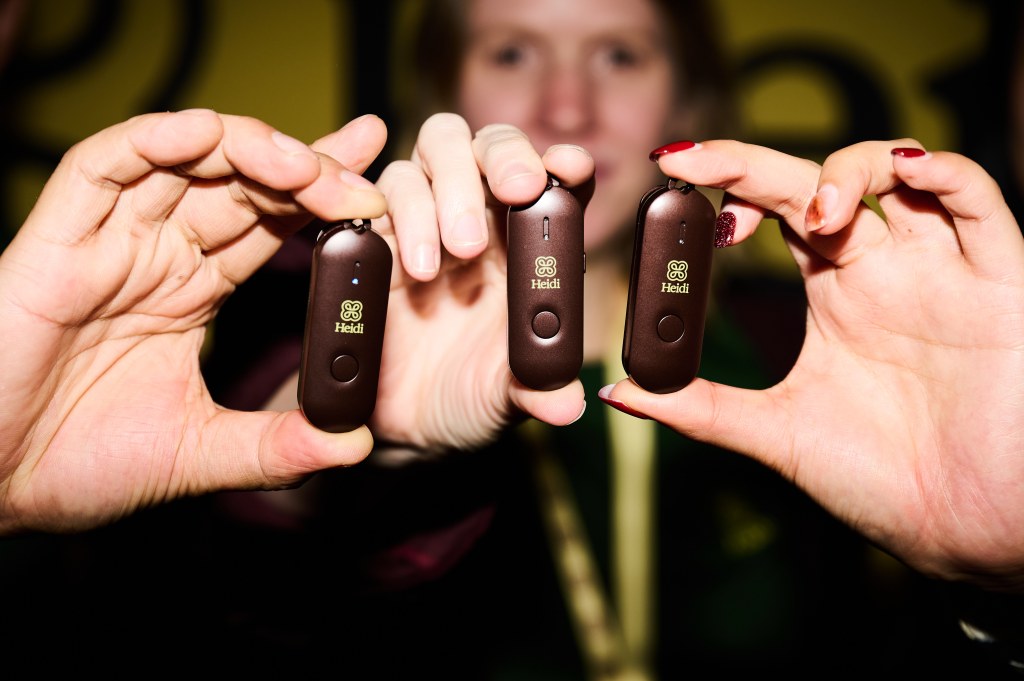
Heidi Health’s Tom Kelly has unveiled a 21-gram wearable designed to replace the smartphone in clinical consultations – the first move in a vertical integration play that aims to process everything on-device.
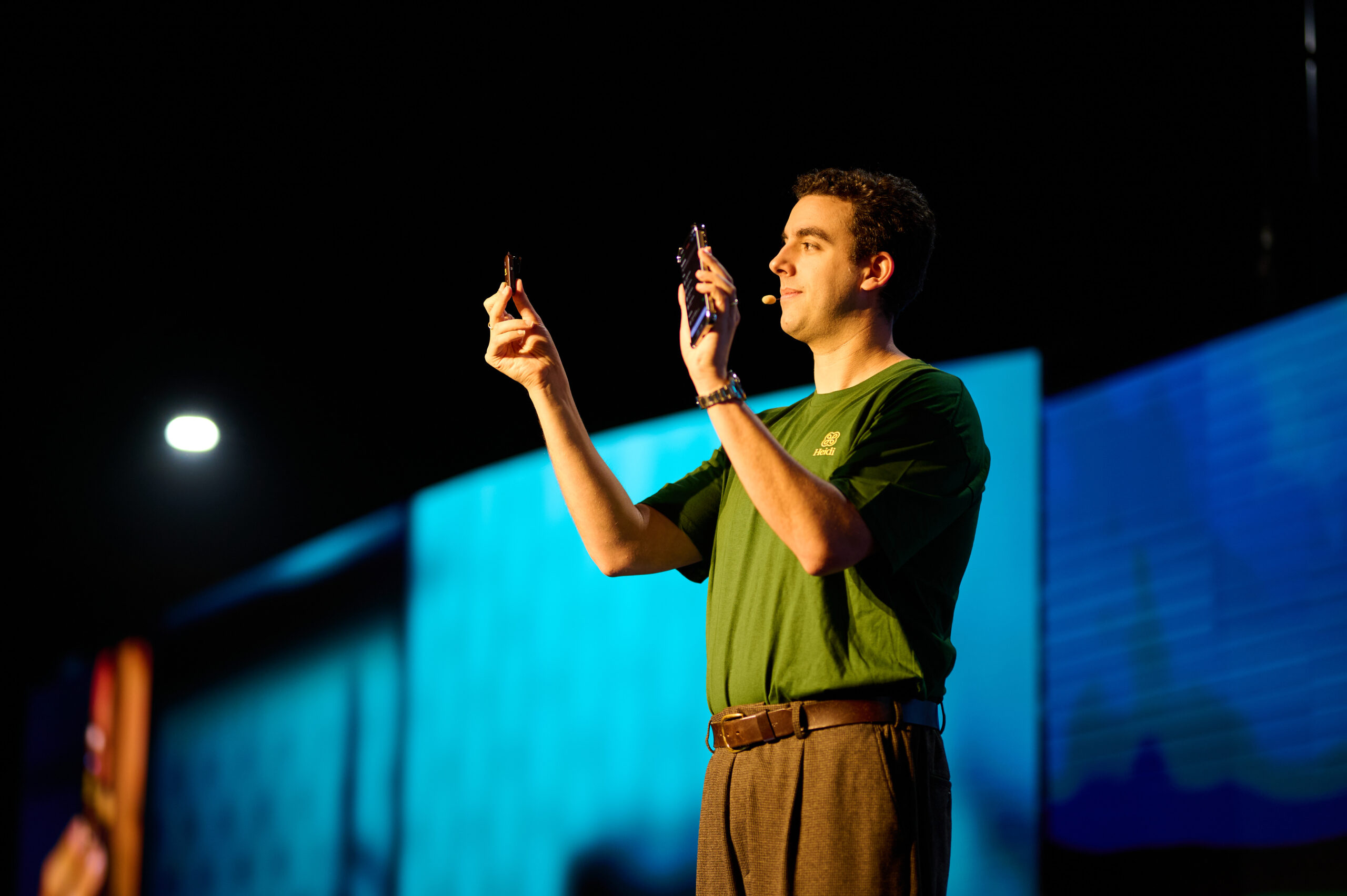
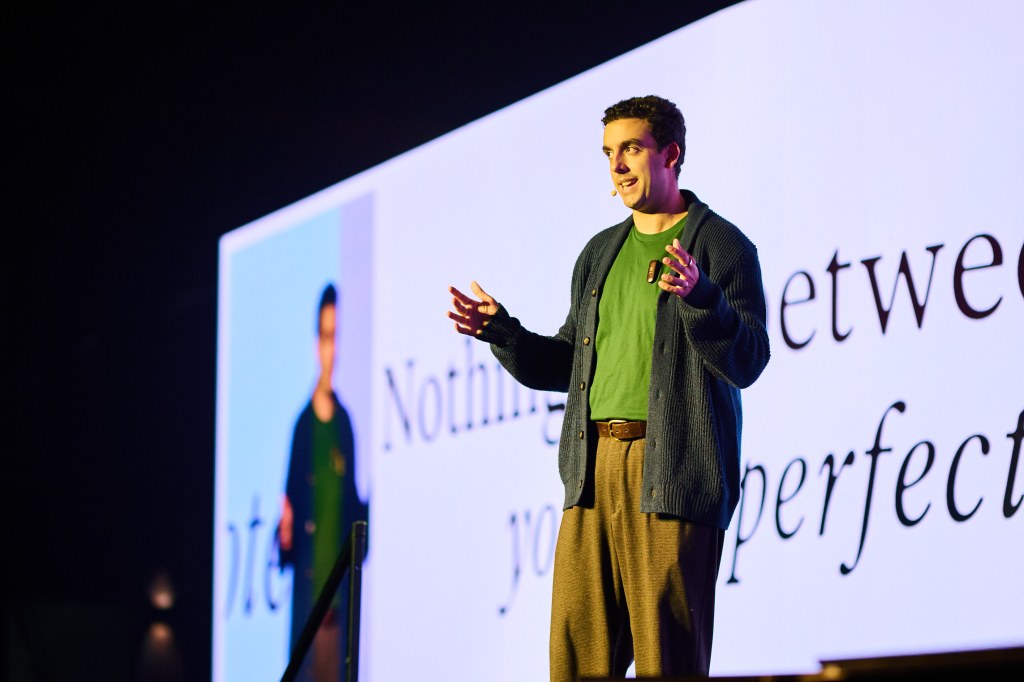
The lighting was low at The Timber Yard in Port Melbourne, as Thomas Kelly paced the stage. The scene was a crafted nod to the product launches of Steve Jobs in California 23 years ago – an era that defined the “one more thing” reveal as the gold standard for tech showmanship.
But where Jobs used his signature black turtleneck to signal a revolution in consumer hardware, Kelly wore a green t-shirt, brown slacks, and – testament to his Australian roots – Blundstone boots.
Kelly’s “one more thing” was not a computer or a phone, but a 21-gram, rechargeable wearable device called Heidi Remote. It can be used to record patient conversations, Kelly says, replacing the voice record function on a smartphone, which he calls an “infectious hazard” and a sometimes unreliable tool.
Kelly noted that existing devices in clinical environments were never designed to support AI-assisted care, and that this new remote is both fit for purpose and an appropriate wearable for a healthcare clinic.
“Your phone drains battery, and if you have it in front of your patient, you look a bit unprofessional,” Kelly told the audience.
The hardware represents another step the company is taking toward owning the technology-driven healthcare experience, a mission Kelly, a vascular surgery registrar, has pursued since launching the concept in 2019.
From The Alfred to the Boardroom
Alongside co-founders Waleed Mussa and Yu Liu, Kelly transitioned into tech during the pandemic. He was working at The Alfred and training to become a surgeon, while also tutoring medical students and tinkering with technology alongside his co-founders.
Mussa, Liu and Kelly first developed an AI solution called Oscer, the precursor to the Heidi platform. which today has been used in more than 118 million clinical sessions around the world.
The shift from tutoring to supporting active clinicians was driven by the objective to minimise the administrative busy work that drains medical resources. “We set ourselves an audacious goal,” Kelly says. “How do we double the world’s healthcare capacity? And we set out to do it with Heidi.”
This clinician-led strategy caught the eye of Blackbird Ventures early on in the company’s journey. Two years into the nascent Oscer’s journey, Blackbird led Heidi’s $5 million seed round, a deal championed by Blackbird Partner Michael Tolo.
“We first invested in Heidi in early 2021, before the world had its “GPT” moment. The past 12 months have been a breakout year for the company, earning its position as the fastest-growing company in Blackbird history,” Tolo tells Forbes Australia.
Kelly pitched Blackbird right after finishing a night shift at the hospital. What struck the investment team was not only the enormous disruptive AI opportunity, but Kelly’s deep customer empathy, his background in mathematics, and the early customer love and traction from clinicians.
“Heidi now powers over 2 million consults every week, most of which are outside Australia,” says Tolo. “We’re just scratching the surface of what might be possible. Scribing is the start, not the end. Its success sets the foundation for a decade-long product roadmap.”
Earlier this year, Heidi unveiled ‘Evidence,’ a clinical-grade research tool now integrated into the platform, and made possible by the acquisition of UK health AI firm AutoMedica. Medical knowledge is doubling every 73 days, Heidi stated at the time, and general-purpose AI is not specific enough for a clinical setting.
Evidence, the edge, and exposure
Compiling authoritative research and methodology into Heidi’s widely adopted transcription service enables the company to broaden and tackle multiple healthcare pain points.
The addition of Heidi Remote this week is another step in the vertical integration strategy. Kelly’s roadmap involves moving the entire processing stack – transcription, inference, and the newly launched Evidence agent – to the “edge.”
Processing clinical knowledge work locally – as opposed to the cloud or on a remote server – means data doesn’t need to leave the clinician’s office. This approach is the only way to ensure the level of reliability and privacy required for the “sacred” patient visit, Kelly says on stage.
Still, an international firm called Mindgard AI, which states it exists to expose AI-risk, says it is possible to jailbreak Heidi, and that “prompt-level manipulation could bypass safeguards, elicit privacy-violating guidance, and induce clinical decision-like output despite the tool’s stated constraints.”
Heidi says this is not the case. Its products have been designed diligently, and with utmost respect for patient privacy, Kelly says. No patient data is used to train Heidi AI. Audio recordings are not saved, only transcripts and notes, meaning playback at a later date is not possible. The platform automatically removes identifiable details from the transcript and notes and can immediately generate referral letters and care plans for patients.
Today, Heidi is used in 116 countries and supports more than 110 languages. Its adoption has spread by word of mouth among GPs, emergency physicians, dentists, and veterinarians, according to the company.
Scaling Heidi’s reach. And its valuation
The investment market responded to this remarkable growth with a significant Series B capital infusion and valuation recently.
Heidi closed a USD$65 million funding round late in 2025, bringing its total capital raised to nearly USD$100 million, and valuing the seven-year-old company at AUD$660 million (USD$465 million). The round was led by Point72 Private Investments, the venture arm of Steven Cohen’s $41 billion New York-headquartered asset management firm.
The entry of Point72 signifies that Heidi has moved beyond being a regional success story to becoming a piece of valuable global healthcare infrastructure. The platform is now integrated into major US systems like Beth Israel Lahey Health in Massachusetts and MaineGeneral, one of Maine’s largest healthcare networks.
In the United Kingdom, Heidi has become a central player in the NHS, where it is used by one in two GPs, and is clocking up 1.5 million patient consultations every month. The company states that “clinicians using Heidi report increased wellbeing, reduction in burnout and improved patient experience” and saving primary care GPs 90 minutes a day in not taking and administration.
Preserving a ‘Red Line’ on selling patient data
Addressing the “freemium” model that has driven Heidi to 2.5 million patient interactions every week, Kelly was explicit about the company’s ethical boundaries.
In an industry where “free” often implies the user is the product, Kelly has drawn what he says is an impenetrable hard line regarding the monetisation of patient information. The sanctity of the clinical encounter must remain free from third-party influence or advertising, he says.
“Although we gave it away for free, there is another red line. We will never, ever monetise our free users by selling their data,” Kelly states. “Competitors do show pharma ads and do sell data as the way that they monetise free products, but we hold ourselves to the highest possible standard. Regardless of the temptation.”
A ‘human in the loop’ is still required in AI-driven clinician consultations, Kelly says.
The company advises medical professionals to review notes and add more detail or context if required. It is trust in the company and system that makes scaling viable, he says, a sentiment Blackbird’s Tolo reiterates.
“Having trained as a vascular surgeon and spending years training medical students, Kelly knows that the product needs to work every time, perfectly. It needs to be something that doctors and patients can both trust. It’s high stakes.”
Scaling the volume and quality of care with AI doesn’t have to be done without the input and sign-off from doctors trained in the craft, says Tolo.
“It’s about using technology to enhance human touch and judgment, which are hallmarks of the best medical care, by giving doctors more time to spend with patients and providing the right clinical information to support their diagnoses.”
The goal is to return the clinician to their original purpose, Kelly tells the room of a thousand attendees in the warehouse in Melbourne, leaving them to practice medicine rather than manage paperwork.
Want to see more Forbes articles on your feed? Tap here to make Forbes Australia a preferred source on Google.
Look back on the week that was with hand-picked articles from Australia and around the world. Sign up to the Forbes Australia newsletter here or become a member here.
Source link