Only about one in 10 students at South Korea’s four elite science and technology institutes, including the Korea Advanced Institute of Science and Technology (KAIST), said they would pursue entrepreneurship, a new survey found. While most students acknowledge the need for startups, concerns over failure and career setbacks are keeping them from taking the plunge.
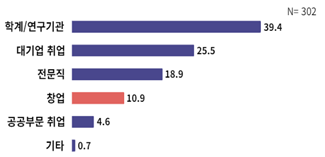
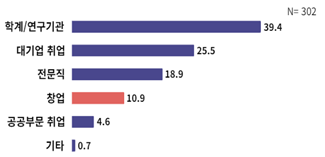
According to a survey released Wednesday by the Entrepreneurship Development Center of the Federation of Korean Industries (FKI), only 10.9% of 302 respondents said they would choose entrepreneurship as a career path. The survey, conducted by polling firm Mono Research, covered students and graduate students at the four leading science institutes — KAIST, Gwangju Institute of Science and Technology (GIST), Ulsan National Institute of Science and Technology (UNIST) and Daegu Gyeongbuk Institute of Science and Technology (DGIST). “Academia and research institutions” was the most popular career choice at 39.4%, followed by “employment at large corporations” (25.5%) and “professional occupations” (18.9%).
A striking 87.7% of respondents said STEM entrepreneurship is necessary, revealing a wide gap between perceived need and actual intent. The FKI said students feel a heavy burden from the risks associated with startup failure. The most cited reason for not considering or attempting a startup was “psychological and financial risk of failure” (28.3%), followed by “the burden of giving up stable employment opportunities” (26.4%). Many respondents said startup failure would negatively affect their future job prospects.
“Students at science institutes tend to perceive that relatively stable career paths are guaranteed to them, so they weigh the risks and opportunity costs of startup failure more carefully,” said Kim Min-ki, a professor at KAIST. “For these students, the experience of attempting a startup and failing seems to be perceived less as a process of building resilience or accumulating capabilities, and more as a risk factor that could cost them stable income and career progression.”
Respondents called for stronger entrepreneurship education to raise awareness and spread successful startup cases in order to promote STEM entrepreneurship. Among specific educational topics, demand was highest for “commercialization and fundraising” (35.9%), suggesting a need for practical training on turning research outcomes into viable businesses — education that can tangibly reduce the probability of failure. “Innovative thinking and problem-solving (idea generation)” (29.6%) and “startup team building and talent management” (19.2%) also drew strong demand.
Government-level institutional reforms are also urgently needed to ensure startup failure does not become an insurmountable risk. “It is important to build safety nets that can convert failures in the startup process into assets for a second attempt,” said Ji Sang-cheol, head of the Sejong Startup Support Center at Korea University. “When policies that mitigate risk — such as support for re-entrepreneurship, pathways back to academic studies, and institutional protections for failure records — are implemented in parallel, students’ willingness to take on the challenge will meaningfully increase.”