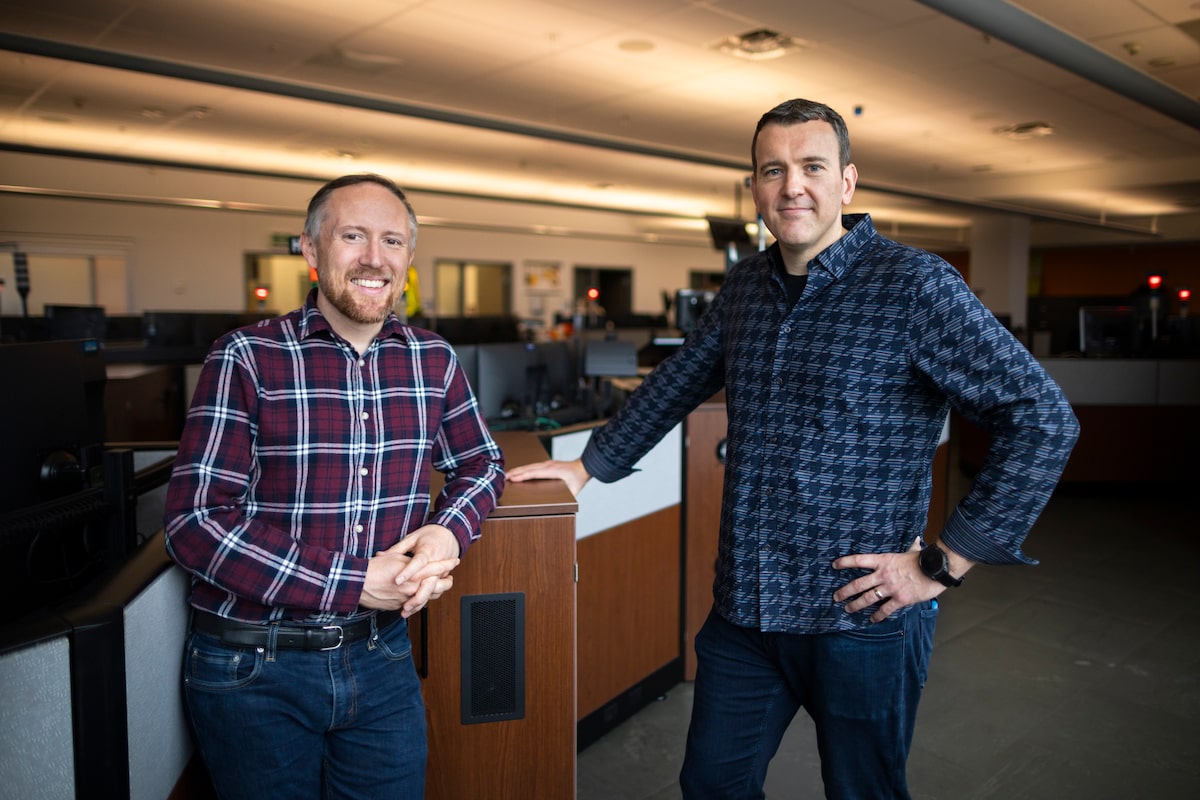
Hyper co-founders Ben Sanders (left) and Damian McCabe at the Halton Regional Police Service headquarters in Oakville, October, 2025. The company’s tech uses AI to handle non-emergency calls placed to 911 operators.Nick Iwanyshyn/The Globe and Mail
Canadian tech startup HyperYou Inc., which uses artificial intelligence to handle non-emergency calls placed to 911 operators, has been acquired by Motorola Solutions Inc. in Chicago, the companies said Thursday.
Motorola plans to integrate Hyper’s technology into its own public safety and emergency response platform, which can transcribe, summarize and translate 911 calls and analyze additional data, among other tasks.
“Hyper’s agentic approach to non-emergency call handling is a new capability that we’re excited to bring in,” Jeremiah Nelson, Motorola’s corporate vice-president of product and technology said in an interview. “They’ve proven it out, and it’s really needed by our customers.”
Financial terms of the deal were not disclosed. Hyper’s 18 employees, including founders Ben Sanders and Damian McCabe, will join Motorola.
How Hyper uses AI to help field non-emergency police calls
“We weren’t looking to necessarily sell,” Mr. Sanders said. “We were well capitalized and had a lot of other opportunities, but this was the fastest and best way to put this technology into the hands of more people.”
Police departments in Ontario, Manitoba and the United States have been deploying Hyper’s AI-based technology to relieve the burden on 911 operators. These workers also field non-emergency calls, which can detract from handling life-or-death situations and add to wait times.
Call centres in both the U.S. and Canada are typically short-staffed. Training new operators can take more than a year and not every applicant makes it through the process, given the emotional and mental strain of the job.
Hyper’s AI voice agents can tackle more than 100 non-emergency scenarios, such as noise complaints, minor vehicle collisions, theft reports and suspicious activities. For some matters, Hyper’s system can take information from callers to fill out forms, tell them about next steps and escalate issues beyond its scope to live operators.
The ability of Hyper’s technology to take action in addition to holding a conversation was appealing to Motorola. “Hyper was making a push into where Motorola was embedded,” said Matt Cohen, founder of Hyper investor Ripple Ventures in Toronto. “But Motorola hasn’t been able to deploy the state-of-the-art agents that Hyper was able to release.”
Hyper’s AI voice agents can tackle more than 100 non-emergency scenarios, such as noise complaints, minor vehicle collisions, theft reports and suspicious activities.Nick Iwanyshyn/The Globe and Mail
Hyper, which started in the Yukon and has offices in Toronto and San Francisco, was founded in 2023. Last year, it raised a US$6.3-million seed round that included funding from Ripple and Eniac Ventures in New York.
The niche world of emergency communications technology is also undergoing consolidation. In September, 2025, Axon Enterprise Inc., best known for making Tasers, bought Prepared, a company that uses AI to synthesize audio, video, text, GPS data and other information for emergency response.
Mr. Nelson at Motorola said using AI to handle non-emergency calls is the priority today, but capabilities could improve to the point where it can field more serious matters. “Will the technology get there? Almost certainly,” he said. “Will industry and society want that? I think that’s yet to be seen.”