When Sourya Choudhury, co-founder and chief technology officer of Apollyon Dynamics, was building his first kamikaze drone, he was also getting graded for it. BITS Pilani has a system that allows students to register independent projects as formal academic work. For the last few semesters of his degree, Choudhury simply logged Apollyon’s work as official coursework. The drone his team was developing for the Indian Army was being evaluated by his professors. They got A grades.
Apollyon Dynamics—a defence startup focused on jet-propelled loitering munitions and electrically propelled interceptors—was founded after Operation Sindoor. BITS Pilani’s zero attendance policy meant that Choudhury could be deployed at an Army base in Jammu or sitting in Sena Bhawan without anyone chasing him for missing a lecture. Professor Sanket Goel, then dean (research) at the technical university, gave financial grants at the zero stage. And when Apollyon was ready for funding, a BITS alumnus—Vikas Katragadda (Naandi Ventures)—became their lead investor. “That is no coincidence,” said Choudhury. “That is the network working exactly as it should.”
Apollyon’s case illustrates something India’s best universities are increasingly trying to engineer—an environment where the line between academics and work dissolves. The urgency is not abstract. As per the Azim Premji University’s State of Working India 2026 report, unemployment among educated 15- to 25-year-olds is nearly 40 per cent. Among those aged 25 to 29, it is 20 per cent. Moreover, only 4.6 per cent of graduates or above (male-only sample) find permanent salaried employment within a year of entering the labour market. The question is not whether universities need to change. It is whether the changes they are making are real.

“In India, the problem is not lack of degrees,” said V. Ramgopal Rao, vice-chancellor, BITS Pilani. “The problem is that many degrees do not translate into capability. The real question is whether a student can apply what he or she has learnt.” BITS is now factoring in a less visible dimension. “We are looking at workload so that students can have a better balance—focused not only on academics and industry readiness but also on mental health and social conduct,” said Prof Sudhirkumar Barai, director, BITS Pilani, Pilani Campus.
Manav Rachna University in Faridabad is rethinking not just what students learn, but how they present themselves when they leave. Every student is required to build an e-portfolio in place of a conventional CV. The portfolio includes a video in which the student discusses their projects, their areas of interest, and specific challenges they encountered. “The recruiter can get to know the individual,” said Deependra Kumar Jha, vice-chancellor, Manav Rachna University. “As far as I know, no other university in the country is doing this.”
The university also has an AI-powered mentor, built in partnership with Google. It is designed to provide what Jha calls “emotional first aid”. Students interact with it the way they might text a friend—typing that they are stressed, that they had a break-up, that they are struggling to pay fees, that someone is bullying them. The AI routes the student to the appropriate support system. It does not investigate, does not escalate informally, and does not replace counsellors. The system follows three principles: short responses, clear next steps and respect for institutional hierarchy.
The results of Manav Rachna’s hands-on approach are visible at the student level, too. Vanshika Sharma, a second-year MSc chemistry student at the school of sciences, has worked on three research projects during her bachelor’s and master’s—including the synthesis of bioplastic and composite materials for wastewater treatment. One project went further. “We invented a reactor for treatment of textile industry effluent,” she said. “It is currently in pre-incubation and we have filed a design patent. I learnt how to pitch in front of investors. These experiences have enhanced my confidence and connected me with innovators and researchers.”
Prashant Bhalla, chancellor, Manav Rachna, makes a broader structural point: nearly 85 per cent of higher education in India is now in private hands, and this segment is increasingly driving change.
Delhi University vice-chancellor Prof Yogesh Singh says universities are not in the business of vocational training. “We are here to build a technological mindset and to make a good human being,” he said. The responsibility for job-specific training, he argues, lies with employers. India, he says, needs hundreds of large companies and thousands of smaller ones to become a developed nation and universities have a role in producing people who can build them, not just join them.
DU has nonetheless been making structural changes. Around 50 to 60 value-addition courses have been introduced. The undergraduate programme has been extended to four years for students interested in research or entrepreneurship, with around 30 per cent opting in so far. On AI, Singh says it will follow the same pattern computers and UPI did. The first did not destroy employment, but transformed it, while the second reshaped banking without eliminating bankers.
Through the All India Council for Technical Education, which Singh now heads in an additional capacity, bootcamps focusing on innovation, design and entrepreneurship are being rolled out across institutions. An AICTE-funded PhD that awards degrees through product development or prototypes rather than publications is also planned.
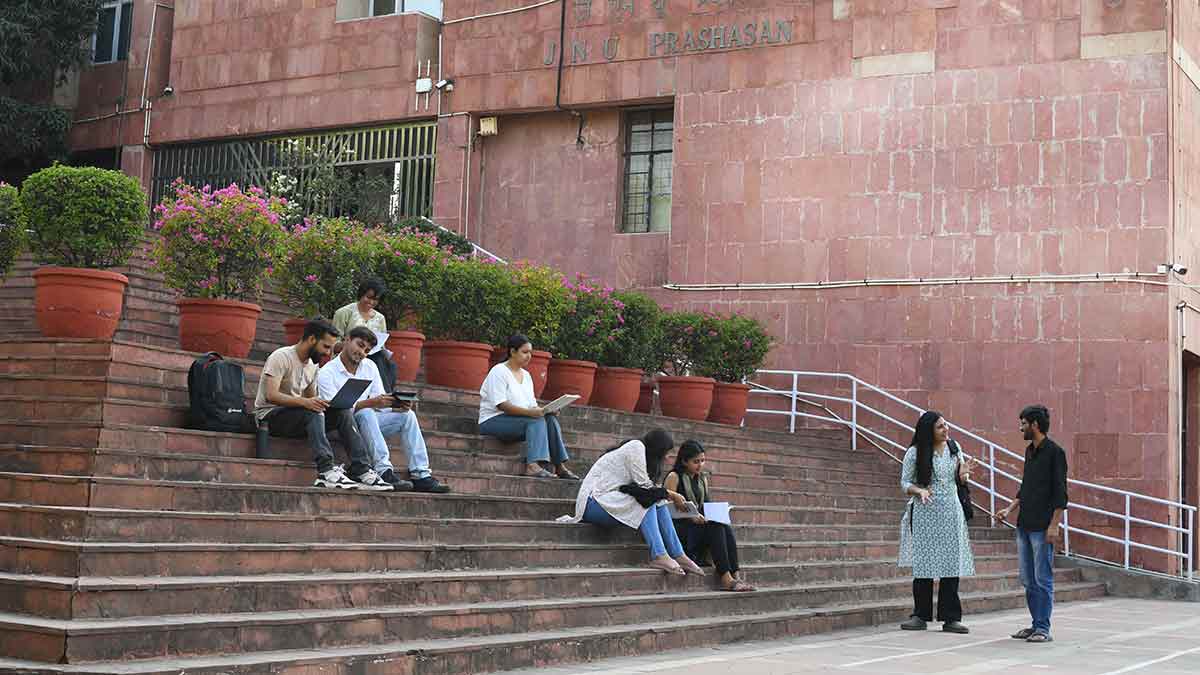
At the Jawaharlal Nehru University, says J. Jeganaathan, associate professor at the centre for European studies and chairperson of alumni affairs, they just teach students “how to fish”. “We build in that confidence that wherever they go, they will somehow get a job because they develop core competence in their field,” he said. The outcomes reflect this: between 60 and 70 per cent of JNU alumni go into academia; around 22 to 25 per cent enter the bureaucracy. The university’s school of international studies produces diplomats, foreign policy experts and geopolitical analysts—a profile now sought after in the private sector as well. “We get calls from international firms about requirement for students with international relations background,” said Jeganaathan.
JNU has recently added an engineering school, to produce graduates comparable to IIT alumni in time.
Shital Baraily, a PhD scholar at JNU’s centre for Chinese studies, offers us a glimpse of what her experience has included. She received a BRI scholarship in 2024 to study at Sichuan University’s Institute of South Asian Studies for five months. She went to China again the following year—this time meeting scholars at think tanks, and visiting the Tsinghua University and the China Foreign Affairs University. She also presented a paper at the CPC Party School, an opportunity few students receive. In 2025, she was in Tibet for six days and went to the strategic tri-junction where China, Russia and North Korea meet. “Such experiences became possible because of the extraordinary faculty members at JNU who constantly encourage students to pursue field exposure and international academic engagement,” said Baraily. “Their mentorship and belief in their students have played a crucial role in shaping my academic journey.”
The Banaras Hindu University has converted its placement cell into a placement and internship cell, integrated internships into curricula, and introduced multidisciplinary undergraduate courses. The university now has units for skill development, life skills and mental health. “Degrees are important, but so are practical skills, adaptability and continuous learning,” said Prof Ajit Kumar Chaturvedi, BHU vice-chancellor. For the faculty, a capacity building cell is in the works. The university has 674 students from overseas (28 countries) and a recent agreement with a Japanese corporation is aimed at creating 50 new scholarships.
While India’s best universities are undoubtedly locked in to their mission of arming the next generation with the tools to take India forward, what separates institutions making genuine progress from those still catching up may come down to a simple distinction between universities that have built systems and those that are still announcing intentions. Apollyon Dynamics did not come out of a policy framework. It came out of a lab, a mentor, a zero attendance policy, and the freedom to spend a semester building a weapon instead of attending lectures. That is a harder thing to manufacture, and a more honest measure of what a university can actually do.
—CS Pawan G. Chandak, President, Institute of Company Secretaries of India
With a company secretary’s role expanding to board advisory, strategic management, stewardship and governance consulting, focus has shifted to leadership development and interdisciplinary knowledge.
—Prof Ch. Satish Kumar, Vice-chancellor, SRM University-AP
Strong universities produce strong nations. Great nations are not just built by brilliant scientists, writers and entrepreneurs but also by citizens who are critical thinkers and engaged in politics and communities. Universities have to [provide] academic offerings that drive enrolment.
—Satyam Roychowdhury, Chancellor, Sister Nivedita University & Techno India University, Tripura
Universities must remain steadfast in their core mission—to nurture intellectual curiosity, critical inquiry, ethical values and a spirit of lifelong learning. While professions may continuously evolve, these enduring qualities empower graduates not merely to secure jobs, but to lead with purpose and impact.
—Lavu Sri Krishnadevarayalu, Vice chairman, Vignan Group of Institutions
By spearheading a “triple helix” collaboration with industry and government, higher education can pioneer original intellectual property and stop domestic capital from leaking into foreign technology ecosystems.
—Koneru Satyanarayana, Chancellor, KL Deemed to be University
Universities serve as centres for research and problem-solving, helping address national challenges in areas such as health care, technology, sustainability and public policy. By promoting diversity, collaboration and lifelong learning, they strengthen democratic values and social cohesion.
—Prof G.K. Prabhu, Vice-chancellor, Sikkim Manipal University, Gangtok, Sikkim
SMU nurtures skilled professionals, advances research and innovation, and delivers quality health care and community services. Through flexible, multidisciplinary programmes and startup support, it equips students with future-ready skills to build successful careers and contribute meaningfully to society.
—Davish Jain, Chancellor, PIMR Deemed to be University, Indore, and chairman, Prestige Education Foundation
The education system should create thought leaders by fostering creativity, critical thinking, adaptability, research and ethical leadership. Institutions must inspire lifelong learning and empower students to become creators of opportunities and solutions for tomorrow’s world.
—Sardar Taranjit Singh, Chancellor, JIS University, and managing director, JIS Group Educational Initiatives
Preparing for the unknown requires a shift from content to capability. Universities must promote interdisciplinary learning, problem-solving, and comfort with uncertainty. The goal is not to predict the future, but to prepare individuals who can navigate it effectively.
—Onkar Bagaria, Trustee and CEO, Vivekananda Global University, Jaipur
The best modern university model is pragmatic in the use of technologies, but traditional in the development of people.
—Prof Kuldeep Kumar Raina, Vice-chancellor, Ramaiah University of Applied Sciences, Bengaluru
[Universities should] focus on building adaptability, problem-solving and practical thinking.
—Shradhanjali Nayak, Director, public relations, Kalinga Institute of Industrial Technology
Universities [should] focus on adaptability, problem-solving, innovation, lifelong learning and soft skills.
—Satnam Singh Sandhu, Chancellor, Chandigarh University
Universities have [to serve] as hubs for research, innovation and incubation, thus fostering national self-reliance.