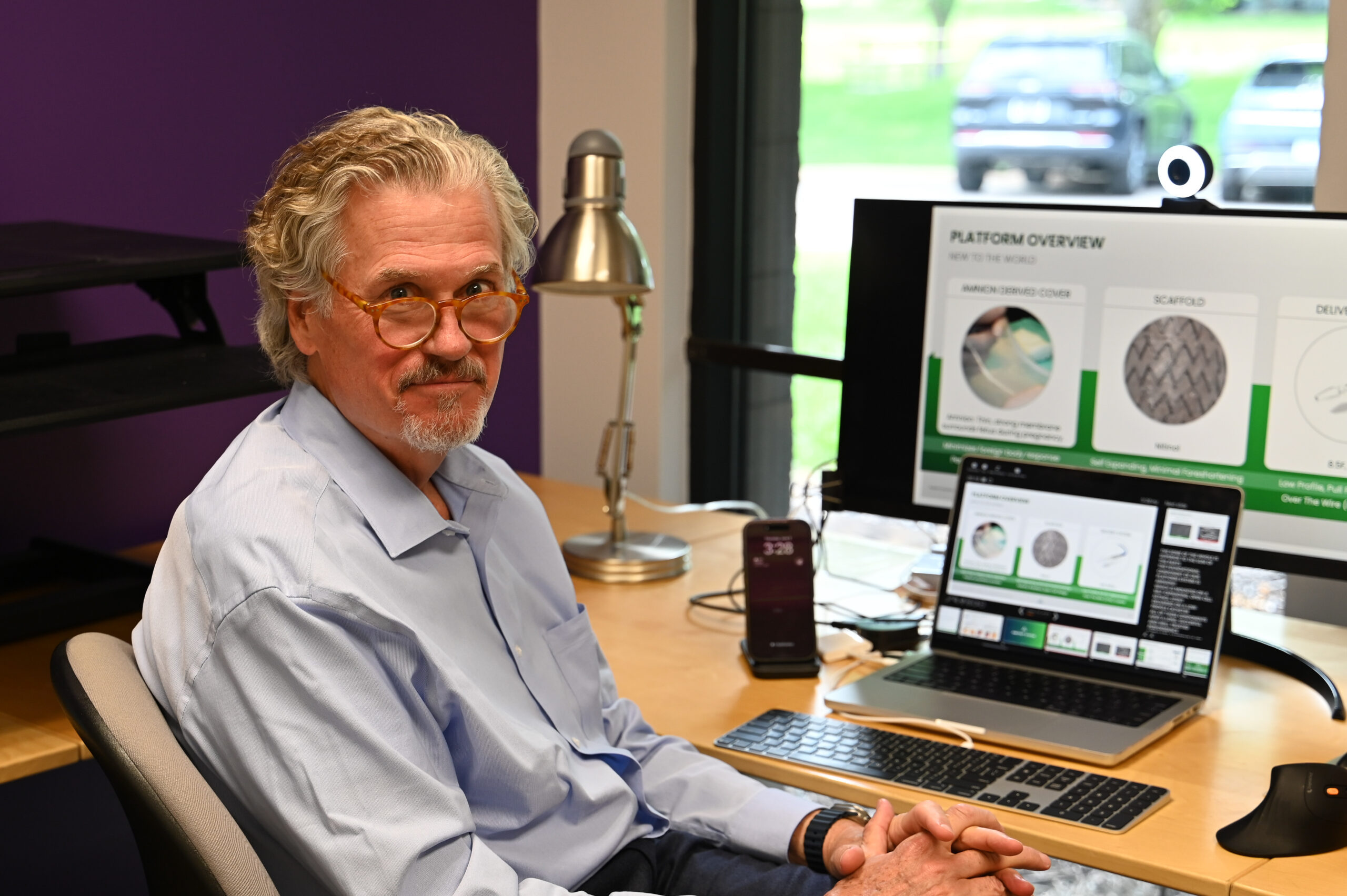
After three decades in the medical device industry, including leadership roles at Pfizer and Baxter, John Schorgl believed there was still room to improve the stent.
Now, as CEO of Plymouth-based Peytant Solutions, Schorgl is leading a Twin Cities startup developing what it says is a first-of-its-kind airway stent covered with human tissue, taken from the inner membrane of the placenta, rather than with synthetic materials. Founded on patents issued in late 2016, Peytant now employs 11 people.
The company’s flagship product, the AMStent Tracheobronchial Covered Stent System, is designed for patients whose airways are obstructed by tumors, often those with advanced lung cancer or cancers that have spread to the lungs. For many patients in stages 3 or 4, opening the airway quickly can be critical to restoring breathing and improving quality of life, Schorgl says.
“It’s pretty straightforward, mechanically or logistically, to implant it,” Schorgl says. “It’s a fairly fast procedure, so the patient doesn’t endure hours of stress.”
Because airway stents must endure repeated pressure from coughing, the company also had to simulate months of compression inside the lungs.
What makes the device one-of-a-kind
Unlike conventional stents, Peytant’s device is coated with human amnion, which is the thin inner membrane of the placenta. Schorgl says human amnion is valuable because it does not trigger the foreign-body rejection response seen with synthetic materials.
“It’s easily sourced because it’s living material,” Schorgl says, adding that “each donated placenta can produce roughly 15 stents.”
Human amnion has been used in such U.S. medical practices as ocular surgery, but Schorgl says using it in an airway stent is new.
Peytant’s leadership team says interest from hospitals is building ahead of commercial rollout, for which there is not yet a date, as it continues to raise Series B funding. The company has been in talks with nearly 50 major physician centers across the country, Schorgl says, and many are asking when inventory will be available. “No patients have used the stents officially yet,” adds Elizabeth Burnett, Peytant Solutions VP of marketing.
What’s next
Building toward commercialization has not been simple. Schorgl says Peytant Solutions had to return to the U.S. Food and Drug Administration three times while seeking De Novo marketing authorization for the AMStent system, meaning it was cleared as a novel Class II medical device and therefore must abide by special regulatory requirements to assure safety and effectiveness, given the device’s novelty. The FDA granted Peytant clearance in 2024.
The company has raised $19 million through seed and Series A funding rounds and has a Series B raise open.
Over the next five years, Schorgl hopes Peytant’s stent becomes a clinical standard for cancer patients needing airway intervention.
Peytant Solutions is one of three Minnesota med tech startups that will be on the MedTech Startup Innovation Stage at Device Talks, a networking event series for the med tech industry, on Monday. The event is at the McNamara Alumni Center at the University of Minnesota-Twin Cities.