

FinTech growth across the Middle East has created a strong pull for foreign startups, including companies from South Korea seeking expansion beyond increasingly saturated domestic markets. Yet many fintech products never reach deployment despite technical readiness and visible market demand. Across Saudi Arabia, the UAE, and other MENA markets, regulators are quietly shifting cybersecurity into a licensing requirement, turning cloud infrastructure, audit readiness, and data governance into decisive market-entry barriers for fintech expansion.
Saudi Arabia’s FinTech Growth Is Accelerating Alongside Regulatory Pressure
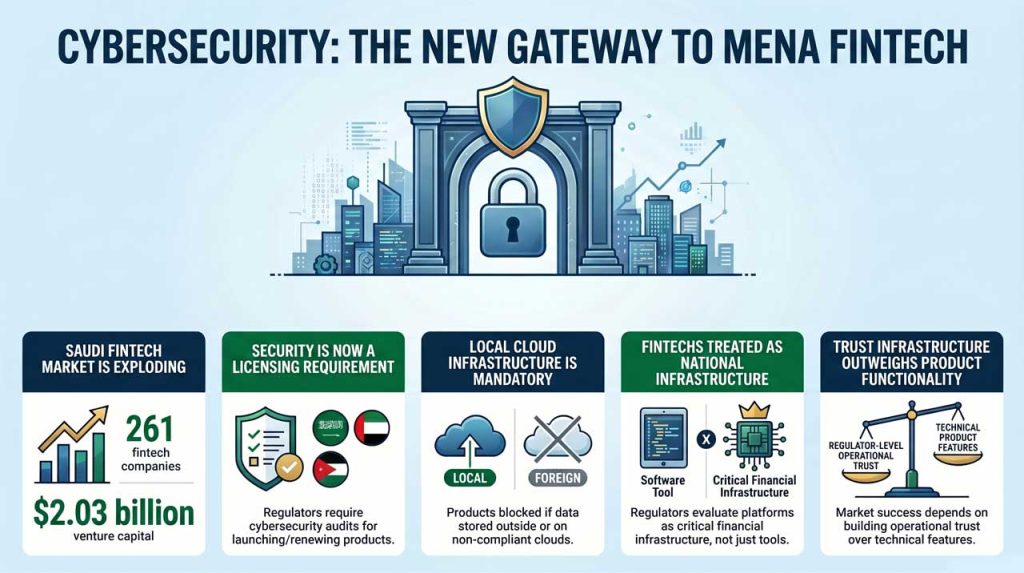
Saudi Arabia has rapidly become one of the region’s largest fintech growth markets. According to Saudi Arabia’s Financial Sector Development Program Annual Report 2024, the Kingdom reached 261 operating fintech companies by the end of 2024, surpassing its original 2025 target of 230 companies. Electronic payments also accounted for 79% of total retail payment transactions during the year, while cumulative fintech venture capital investment exceeded SAR 7.6 billion (approx. USD 2.03 billion).
The UAE is also strengthening its position as a regional financial technology hub. A Korean Global ICT report estimated the UAE ICT market at around USD 17 billion in 2024, including approximately USD 3.2 billion in fintech and USD 600 million in cybersecurity. The figures reflect how financial services expansion and cybersecurity infrastructure are increasingly developing together across the Gulf’s digital economy push.
At the same time, Saudi Arabia’s broader digital transformation agenda under Vision 2030 continues pushing banks, financial institutions, and government-linked platforms toward larger-scale digital infrastructure adoption. That is why Korean startups operating in payments, AI finance, digital banking tools, lending infrastructure, regtech, and financial SaaS increasingly view the Gulf as a strategic growth region.
However, expanding into the region is becoming less dependent on product demand alone. Financial regulators are now placing greater weight on cybersecurity governance, operational resilience, and infrastructure accountability before fintech systems can enter regulated environments.
Cybersecurity Is No Longer an IT Function Inside MENA FinTech
Mohammad Alkhudari, Founder and CEO of Green Circle for Cybersecurity and VP & Chief FinTech Officer at Beeezcrowd, has worked across cybersecurity, fintech infrastructure, and financial technology deployments in Saudi Arabia, Jordan, and the broader GCC ecosystem.
According to Alkhudari, many foreign fintech startups still approach cybersecurity as a secondary operational layer rather than a core licensing requirement.
“Regulators across the region increasingly require cybersecurity certification or audit as a precondition for fintech licensing or renewal,”
Alkhudari told KoreaTechDesk in an exclusive interview.
“This means that a startup with a technically excellent payment or crowdfunding product can be blocked entirely if its cybersecurity posture does not meet baseline requirements.”
That regulatory direction increasingly aligns with public policy frameworks emerging across the region.
At the 24 FinTech Conference in Riyadh, Saudi Central Bank (SAMA) Governor Ayman Al-Sayari stated that fintech growth must continue alongside stronger cybersecurity protection, anti-money laundering compliance, consumer safeguards, fraud controls, and business continuity resilience.
The shift reflects a broader change in how regulators view fintech platforms. Financial products are no longer evaluated purely as software tools or growth businesses. They are increasingly treated as components of national financial infrastructure.
Cloud Infrastructure and Data Governance Are Becoming Market-Entry Filters
One of the most important operational barriers involves cloud infrastructure compliance.
Alkhudari described a real anonymous case involving a fintech lending platform that successfully passed technical evaluation but ultimately failed its cybersecurity audit because its cloud provider infrastructure did not comply with local data classification requirements.
“The product never entered the market, despite months of engagement,”
he explained.
The underlying issue of this case also closely reflects regulatory requirements already visible in Saudi Arabia’s financial cybersecurity framework.
SAMA’s cloud computing guidelines require regulated financial organizations to conduct cybersecurity risk assessments and due diligence reviews on cloud providers before adoption. Financial institutions are also generally expected to use cloud infrastructure located inside Saudi Arabia unless regulatory approval is granted for external deployment environments.
This creates a major adjustment for foreign startups accustomed to globally centralized cloud infrastructure models.
For Korean fintech startups, especially companies building AI-enabled financial systems, payment platforms, or SaaS-based financial products, cloud architecture decisions can now directly affect licensing viability.
Financial Regulators Are Expanding Oversight Beyond Product Functionality
Cybersecurity compliance requirements are also becoming deeply embedded into financial product approval systems.
Saudi Arabia’s New Banking Products and Services Regulation requires financial institutions to conduct risk assessments, operational readiness evaluations, compliance reviews, fraud controls, and technology governance analysis before launching new financial products or services.
Similarly, the UAE Central Bank’s payment services framework requires licensed providers to maintain formal cybersecurity and technology risk management systems. The Dubai Financial Services Authority (DFSA) has also expanded supervised fintech testing through its Innovation Testing Licence framework, allowing companies to operate under controlled regulatory oversight before obtaining broader authorization.
Along with Saudi Arabia and UAE, Jordan is moving in a similar direction. The Central Bank of Jordan’s JoRegBox regulatory sandbox allows fintech innovators to test products under risk-managed supervision while maintaining financial stability and cybersecurity controls. The country has also expanded sector-wide cybersecurity programs through frameworks connected to financial-sector resilience initiatives.
All these then result in a changing operational environment across MENA. FinTech companies are no longer entering markets where cybersecurity is treated as a later-stage technical adjustment. Security governance increasingly shapes licensing, approval timelines, cloud deployment models, and long-term operational eligibility.
Why This Matters for Korean FinTech and AI Startups Expanding Into MENA
Now, South Korean startups continue increasing their presence across the Middle East through government-backed programs, regional partnerships, and fintech expansion initiatives. However, the regulatory expectations inside MENA financial markets differ significantly from many startup scaling environments in East Asia or Southeast Asia.
Alkhudari believes many companies still underestimate how early cybersecurity readiness becomes relevant during expansion planning.
“Cybersecurity readiness is not a parallel track,”
he said.
“It is the prerequisite track.”
That distinction carries major implications for Korean startups entering the region.
Companies building payment systems, lending infrastructure, AI financial services, digital banking products, or crowdfunding platforms may now need to prepare regulator-ready cybersecurity frameworks before commercial expansion begins.
Data residency planning, cloud governance alignment, audit preparation, third-party cybersecurity controls, and infrastructure transparency are increasingly becoming part of market-entry preparation itself.
This also changes how investors and ecosystem operators evaluate fintech scalability across MENA. Product growth alone no longer guarantees expansion viability if the operational infrastructure cannot satisfy financial-sector regulatory expectations.
FinTech Expansion in MENA Is Becoming a Trust Infrastructure Challenge
Finally, the Middle East remains one of the fastest-growing fintech regions globally, and Gulf governments continue investing heavily in digital finance infrastructure under broader economic diversification programs.
Still, the next stage of expansion may depend less on how quickly startups launch products and more on how effectively they build regulator-level operational trust.
Cybersecurity frameworks, cloud governance systems, audit readiness, and financial-sector resilience are increasingly functioning as invisible infrastructure behind fintech growth across MENA.
And for Korean startups pursuing long-term regional expansion, those systems are becoming just as important as product capability itself.
Key Takeaway
- Saudi Arabia’s fintech ecosystem continues expanding rapidly, reaching 261 operating fintech companies and SAR 7.6 billion in cumulative fintech investment by the end of 2024.
- Cybersecurity is increasingly becoming a licensing requirement across MENA financial systems, particularly in Saudi Arabia, the UAE, and Jordan.
- Cloud infrastructure and data residency rules can directly block fintech market entry, even when products successfully pass technical evaluation.
- Financial regulators are treating fintech platforms as regulated financial infrastructure, not only as software or innovation products.
- Saudi Arabia’s SAMA and UAE financial regulators are strengthening cybersecurity oversight, including cloud governance, operational resilience, fraud controls, and risk management requirements.
- Korean fintech and AI-finance startups entering MENA may need regulator-ready cybersecurity preparation before expansion begins, including audit readiness, cloud compliance, and data governance alignment.
- Operational trust is becoming a core competitive requirement for fintech expansion across MENA, alongside product capability and market demand.
🤝 Looking to connect with verified Korean companies building globally?
Explore curated company profiles and request direct introductions through beSUCCESS Connect.
– Stay Ahead in Korea’s Startup Scene –
Get real-time insights, funding updates, and policy shifts shaping Korea’s innovation ecosystem.
➡️ Follow KoreaTechDesk on LinkedIn, X (Twitter), Threads, Bluesky, Telegram, Facebook, and WhatsApp Channel.
Source link