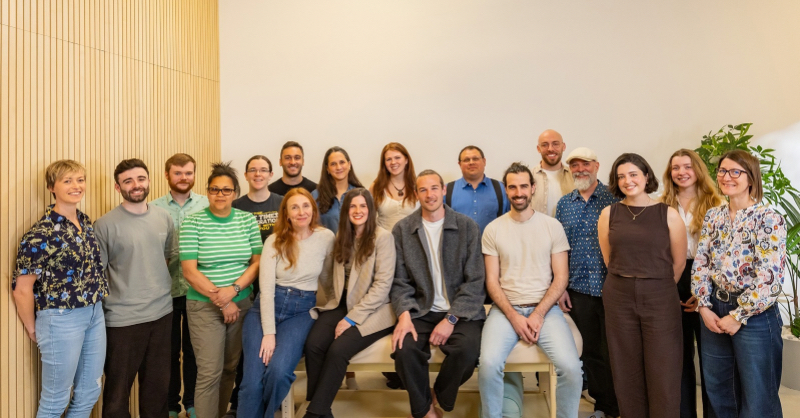
- Flok Health raises $12.5 million Series A led by Albion VC to expand the world’s first AI-operated physiotherapy clinic
- The startup is the first and only AI system in Europe approved to autonomously diagnose, triage, treat, and discharge patients
- Already serving 2.4 million NHS patients, Flok has helped halve waiting lists in some regions while delivering same-day access to care
Healthcare systems worldwide face a simple but stubborn problem: there are far more patients than clinicians available to treat them. That challenge is particularly acute in musculoskeletal (MSK) care, where conditions such as back pain affect millions of people every year while overstretched healthcare providers struggle to keep up with demand.
Cambridge-based Flok Health intends to help bridge this gap with AI. The company has raised $12.5 million in an oversubscribed Series A round led by Albion VC, with participation from existing investors Eka Ventures and Form Ventures, alongside new investor Mercia Ventures.
The funding will support the expansion of Flok’s AI-operated clinic across the UK, broaden its clinical scope beyond back pain, and accelerate international growth.
The world’s first AI physiotherapy clinic
Founded in 2022 by former medic and professional rower Finn Stevenson and technologist Ric da Silva, Flok was created to tackle one of healthcare’s biggest structural challenges: the mismatch between demand for treatment and the availability of clinicians.
Rather than building another healthcare chatbot or symptom checker, the founders developed what they describe as the world’s first AI-operated physiotherapy clinic.
The platform uses real footage of a human physiotherapist to create an interactive virtual consultation experience that responds in real time to what patients say and do. Through a mobile app, patients can receive diagnosis, treatment plans, rehabilitation guidance, and discharge decisions without requiring direct clinician involvement.
The company is touted to be the first and only AI system in Europe to receive regulatory approval to autonomously deliver entire healthcare pathways. It is also the only digital MSK provider approved by the UK’s Care Quality Commission and certified as a Class IIa medical device for autonomous care delivery. In March 2026, the company’s partnership with Cambridgeshire Community Services NHS Trust was named Health Service Journal’s Primary and Community Care Project of the Year.
Tackles one of the NHS’s biggest bottlenecks
Low back pain is the leading cause of disability globally and accounts for more than 30 million lost workdays annually in the UK. Meanwhile, more than 390,000 patients in England remain on waiting lists for MSK treatment.
Flok Health’s technology aims to reduce that backlog by giving patients immediate access to treatment while freeing clinicians to focus on more complex cases.
The results have attracted attention across the NHS. The AI clinic is now available to more than 2.4 million patients across eleven NHS regions. During recent deployments, the company says it helped halve waiting lists in some areas while saving hundreds of hours of clinical time every month.
More than 80% of patients in one NHS rollout reported that the AI service was as good as or better than traditional in-person physiotherapy.
“The most fundamental problem in healthcare today is supply-demand mismatch,” says Finn Stevenson. “AI is a generational opportunity to close that supply-demand gap and ensure that anyone, anywhere, can get the best possible care whenever they need it. We’re particularly proud to already be scaling our AI MSK clinic in the NHS, and seeing incredible results for patients and services.”
The competitive landscape
Flok Health enters a rapidly growing market where investors are increasingly backing AI-powered healthcare providers rather than just healthcare software.
One notable player is New York-based Sword Health. It focuses heavily on AI-driven care delivery — most recently through its Phoenix AI platform, which guides patients through sessions via natural conversation — alongside motion tracking and wearable sensors to deliver real-time corrective feedback on physical therapy exercises, backed by a clinical oversight team. The company raised $130 million in a mix of primary and secondary shares at a $3 billion valuation to expand its AI physical therapy platform.
Another rival is Hinge Health from San Francisco. It operates as a massive enterprise digital health platform that pairs app-guided physical therapy exercises with dedicated 1-on-1 human coaching, physical therapists, and proprietary wearable pain-relief devices for corporate employees. The company raised $400 million in a Series E at a $6.2 billion valuation in October 2021, and completed its IPO on the New York Stock Exchange on 22 May 2025 under ticker HNGE, pricing at $2.6 billion, a near 60% markdown from its private peak valuation.
While these companies focus on augmenting healthcare professionals, Flok Health is taking a more ambitious approach by fully automating specific treatment pathways from diagnosis through discharge.
“The healthcare supply-demand gap remains a major challenge, with over 390,000 people waiting for treatable MSK care in England alone. Finn, Ric and the team have proven that autonomous care pathways can deliver strong outcomes at scale. They’ve earned NHS trust, navigated complex regulations, and built a service that improves access to care. Having proven the model in MSK, we believe the opportunity ahead is far larger,” notes Leigh Brody, investor at AlbionVC.
The broader outlook
The healthcare industry is increasingly turning to AI to address chronic staffing shortages and rising patient demand. Flok Health’s vision goes beyond physiotherapy. The company is already training its AI systems across new care pathways including hip pain, knee pain, and women’s pelvic health conditions.
The challenge for Flok now is scaling safely while maintaining clinical outcomes and regulatory trust. The company could become a blueprint for how AI-operated healthcare services are delivered globally, transforming not only physiotherapy but entire areas of frontline patient care.