- TensorWave has raised $350 million in a Series B co-led by Magnetar and AMD Ventures at a $1.55 billion valuation, bringing total funding to approximately $493 million.
- The Las Vegas startup operates one of the largest all-AMD AI training clusters in North America and has secured more than two gigawatts of long-term data centre capacity.
- Its 28-year-old CEO, Darrick Horton landed on Forbes 30 Under 30 for AI for doing what Forbes called a “seemingly impossible mission”: breaking Nvidia’s dominance in AI infrastructure.
Darrick Horton was working on plasma physics for nuclear fusion at Lockheed Martin’s Skunk Works — the division responsible for the U-2 spy plane and the SR-71 Blackbird — when he decided his next problem was going to be AI compute.
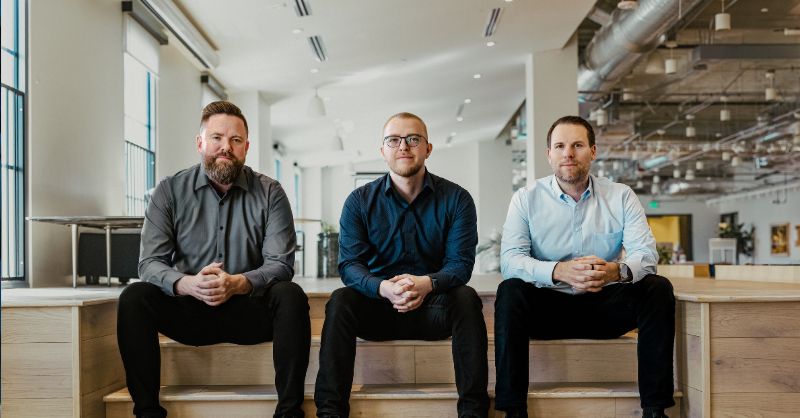
In December 2023, he co-founded TensorWave with Jeff Tatarchuk and Piotr Tomasik, put their chips on AMD in a market almost entirely owned by Nvidia, and raised the largest startup funding in Nevada’s history within their first year. The company is now valued at $1.55 billion
Today, the US-based startup has raised $350 million in a Series B co-led by Magnetar and AMD Ventures, with continued participation from Maverick Silicon, Nexus Venture Partners, and Western Frontier.
Total funding now stands at approximately $493 million, following a $43 million seed in October 2024 and a $100 million Series A in May 2025. The capital will support the deployment of next-generation AMD Instinct MI355X GPU clusters and the expansion of TensorWave’s global infrastructure footprint.
Why AMD, why now
As TFN has reported, Nvidia projects the total AI infrastructure market will reach $1 trillion by 2027, and the company currently dominates it. TensorWave’s entire thesis is that this dominance creates a structural opportunity.
Most AI infrastructure providers are capacity-constrained on Nvidia hardware, creating a supply bottleneck that AMD-based alternatives can fill. AMD Ventures has consistently backed this thesis and co-led Vultr’s $333M raise at a $3.5B valuation, another GPU cloud provider building on AMD infrastructure.
TensorWave builds exclusively on AMD Instinct GPUs, currently the MI325X cluster, with MI355X deployments coming. The MI325X is AMD’s memory-intensive alternative to Nvidia’s H100 and H200, designed for large language model training and high-throughput inference workloads where memory bandwidth is the binding constraint.
The company already operates one of the largest all-AMD AI training clusters in North America, with 8,192 MI325X GPUs online. Customers using the infrastructure include Fireworks AI and Luma AI for large-scale generative AI and production inference workloads.
The scale of the infrastructure build
TensorWave has secured more than 2 gigawatts of long-term data centre capacity, enough to power a small city, to support growing adoption from enterprise, research, and AI-native customers. New MI355X deployments are planned across several data centre regions in North America.
The company employs approximately 117 people, with plans to expand hiring across engineering, infrastructure, operations, sales, and customer success. Since its founding, TensorWave has increased its overall capacity tenfold each year, and Horton has publicly said he intends to do so again.
“The next phase of AI will be defined by who can access enough compute to move from experimentation to production. As models grow larger and workloads become more demanding, enterprises need infrastructure with the memory capacity, performance, and flexibility to scale without being locked into a single ecosystem,” he says.
“As demand for AI infrastructure continues to grow, TensorWave is well-positioned to help enterprises scale AI deployments with high-performance, AMD-powered compute. Their commitment to open, flexible infrastructure aligns strongly with the AMD ecosystem,” adds Sagi Paz, head of AMD Ventures.
The competitive landscape
TensorWave competes in an increasingly crowded market for alternative AI cloud infrastructure. Vultr, which raised $333 million at a $3.5 billion valuation, operates a broad GPU cloud fleet across multiple hardware vendors, including AMD.
Nebius, backed by a $2 billion investment from Nvidia itself, is building hyperscale Nvidia-powered infrastructure across Europe and the US. CoreWeave, which raised $11.9 billion and listed on Nasdaq in 2026, focuses exclusively on Nvidia hardware.
What differentiates TensorWave is its all-in position on AMD, a single-vendor strategy that provides deep product integration and favourable commercial terms but concentrates technical and supply chain risk on one chipmaker’s roadmap.
Market context
The global cloud computing market was valued at $752.44 billion in 2024 and is projected to grow at a CAGR of 21.2% through 2030. The AI infrastructure subset is growing far faster: Nvidia’s own projections put the total AI chip and infrastructure market at $1 trillion by 2027, with GPU cloud providers like TensorWave sitting at the centre of that buildout.
The question for TensorWave is whether AMD’s MI355X, and whatever comes after it, can close the performance gap with Nvidia’s Blackwell architecture fast enough to hold enterprise customers who currently treat AMD as a second choice. At $350 million and 2 gigawatts of capacity,
TensorWave is building as if the answer is yes.