After Santa Monica College’s Business Club, Entrepreneurs Valley, hosted Sharks’ Valley last semester, it held the event again this semester, bringing together a group of venture capitalists to provide feedback and potentially invest. Due to the prize money awarded to the top three pitches, the lineup consisted of several businesses, some that have already launched and others that are awaiting seed money to take their ideas to the next level.
The Orientation Hall was buzzing with anticipation as President of Entrepreneurs Valley Stanislas Shvets asked the ever-growing audience to welcome investors Dan Eidell, Tony Giordano and Lyon Kassab. Kassab, founder and managing director of BoCG Ventures and a returning “shark,” Kassab discussed how his time as an alumnus and former marketing professor at Pepperdine University shaped his opinion on AI in an educational setting.
“Education to me is very important because I don’t think today’s institutions are keeping up with the technology. The kids that are graduating are coming out not prepared to think critically, and then they are at risk of being automated by AI,” Kassab said.
Kassab said, “I’m a big fan of AI because it’s an efficiency tool, but I want to stress tool. It doesn’t replace the brain. So I’m a critical thinker advocate to teach people first how to do whatever they need to do, and then give them the tools to be more efficient so when AI is hallucinating, you know that doesn’t make any sense, right? So for professors that are saying AI has no place in the classroom, you are doing a disservice to the students. However, you are right that they first have to know the basics, and then the building blocks.”
Third-place winner and crowd-pleaser RE-LEV is a “retrofittable magnetic levitation solution for currently existing infrastructure at the Alameda Corridor.” The company has created and patented new proprietary maglev technology that promises to improve the 1- to 1.5-inch gaps between the rail and the train to 2.5 inches. This improves on the 1970s design that is still being used today. Re-Lev has already met with interested venture capital firms like Lachman Godman Ventures and Swell Capital Inc. All three sharks were interested, as were the audience members.
“You’ve got people hooked when you’re pitching this idea, so you don’t have to sell, frankly the cost savings. The only two questions that have to be answered here are why should I take you and your team seriously, and two, once I believe that you can do it, how far away are we from doing it?” said Dan Eidell, a shark and founding partner of Birthmark Capital.
Co-founded by computer science majors and second-place winners Md Safkatul Islam and Peter Guan, Veru is an AI-based academic writing platform that assists students and researchers in writing, exporting and verifying their work in one space. The idea was born when Guan was manually working on a research paper and wanted a tool that could help properly cite sources accurately.
“Right now AI is coming to most places and I do want some assistance, but the AI hallucinating problem is pretty serious,” Guan said.
Islam and Guan aim to make sure that individuals who are interested in working with research papers have a space to get their work done efficiently and plan to scale the product long term.
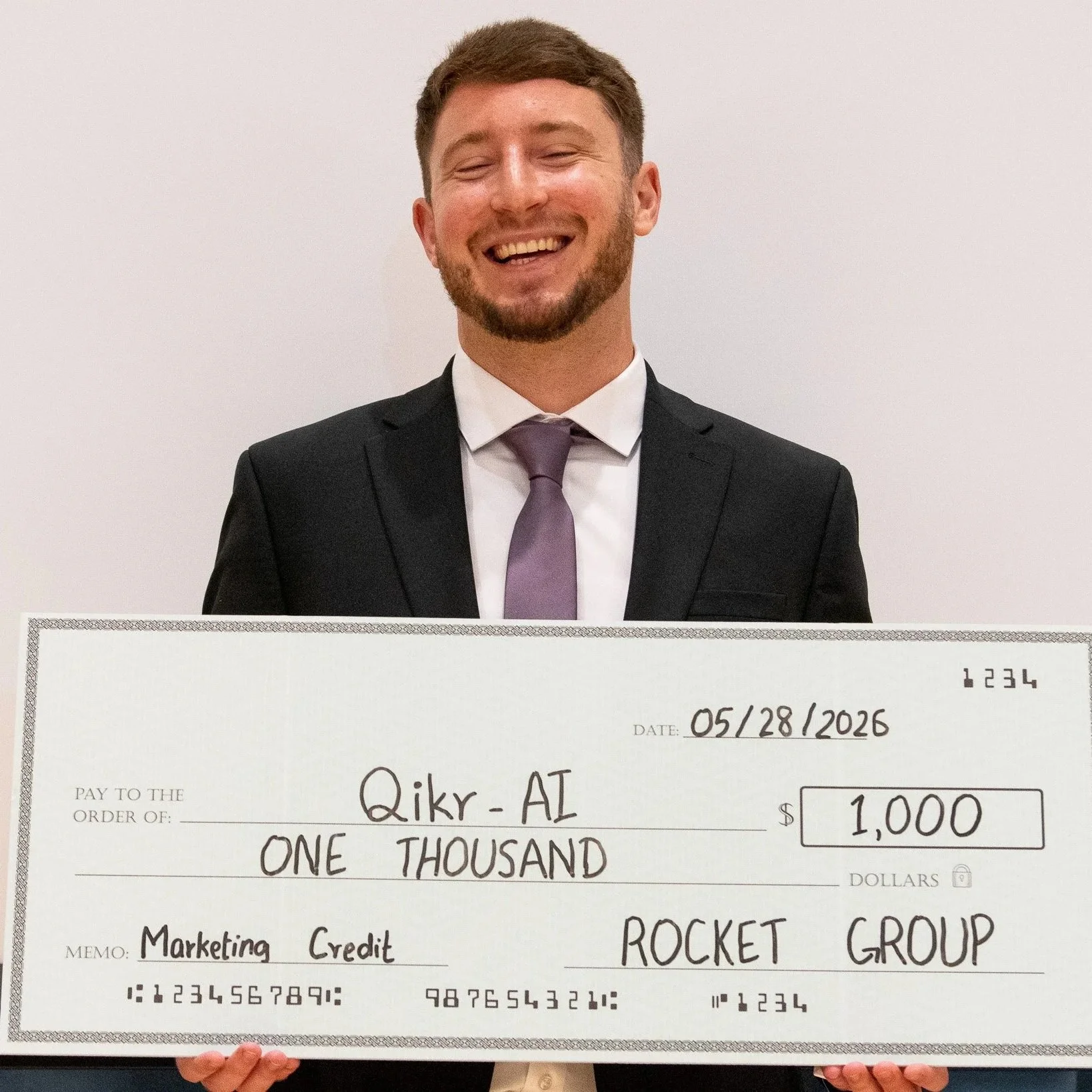
First place winner and Chief Architect/co-founder Sam Vedernikoff accepted his $1,000 check for Qikr, an AI-powered learning tool that helps students learn and retain information in conjunction with information being taught in classrooms.
Vedernikoff and his co-founder Mohan Umapathy created their startup in 2025 when they both left positions at Verizon. They settled on education because of their longstanding relationship with 3C Media Solutions, a California grant-funded media distribution business.
“They provide Zoom, so essentially they’re the ones that facilitate that contract and every professor in any community college has access to Zoom through them,” Vedernikoff said. “So that’s when we decided to step in and realize that there was this market that was really big and that we could actually have some kind of impact and help students, help teachers and kind of integrate AI in a safe way.”
Qikr is already in 13 community colleges, including SMC.
Vedernikoff said, “We have a professor in Santa Monica College, who’s using and piloting our platform — Chris Grant. He used it in the fall, and now he used it again in spring, and he’s the one that gave the testimonial. He’s saying ‘my strongest students love the product.’ Essentially, he’s looking forward to using it again in the fall next year.”