AI emerged as the defining theme of the Indian startup ecosystem in H1 2026. As conversations around the nascent technology intensified, investor interest also picked up sharply.
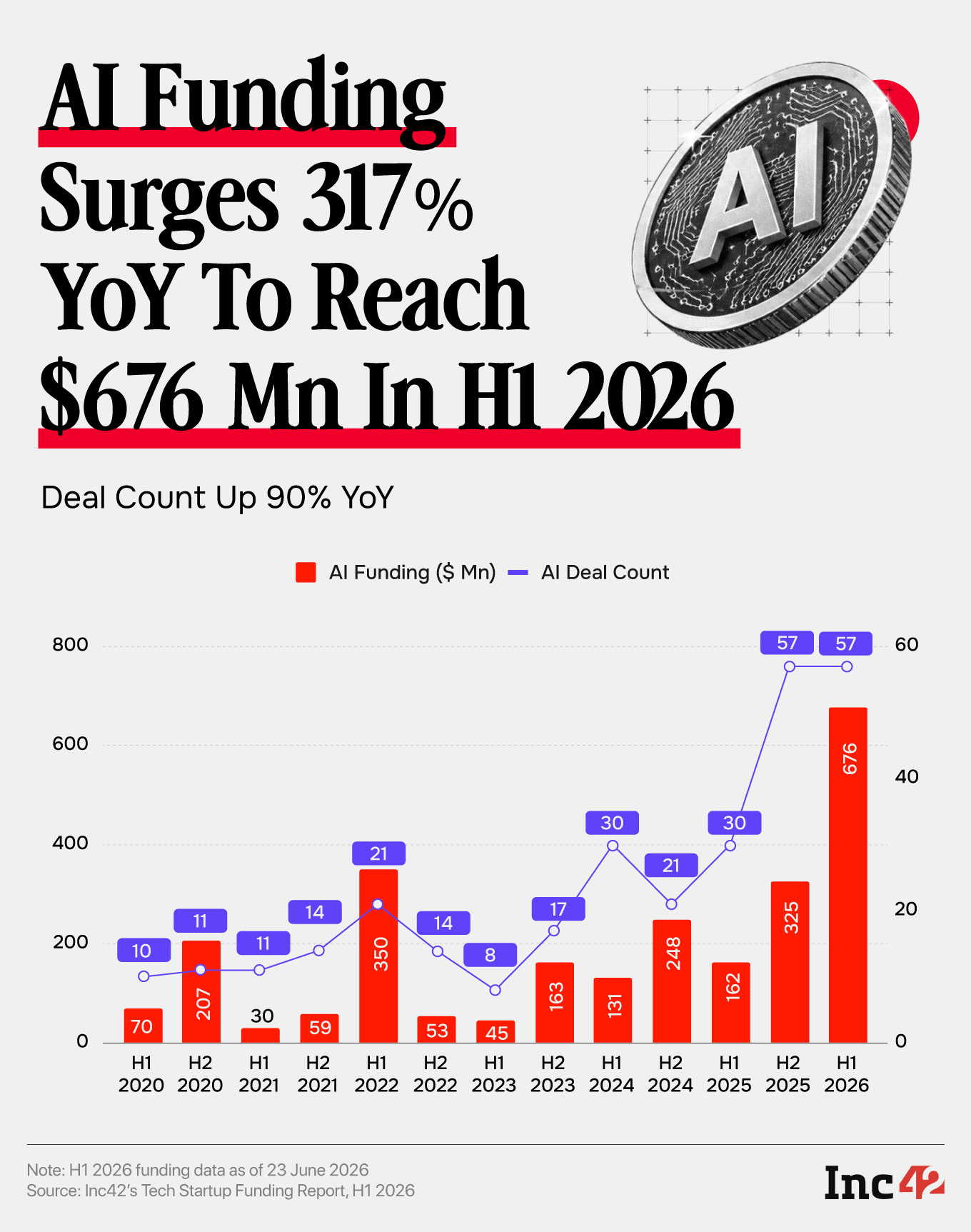
As per Inc42’s ‘Indian Tech Startup Funding Report, H1 2026’, Indian AI startups raised $676 Mn during the first six months of 2026. The number of funding deals also touched a fresh six-month high of 57.
The capital infusion in the AI ecosystem zoomed over 4X from $162 Mn raised across a mere 30 deals in H1 2025. Sequentially, AI funding zoomed over 35% from the over $500 Mn raised by startups.
The funding surge becomes even more apparent when viewed in context. Indian AI startups had raised only about $1.8 Bn cumulatively until 2025. In just the first half of 2026, the sector already attracted nearly a third of that amount.
The investment trend in AI stood in stark contrast to the broader funding landscape in the world’s third-largest startup ecosystem.
Between January 1 and June 23, Indian startup funding declined 9% YoY to $5.2 Bn. Investors also shifted towards a more diversified investment strategy, backing a larger number of startups with smaller cheques. This was reflected in the 7% YoY jump in the total number of deals to 501 in H1.
At the same time, large funding rounds remained scarce. Only five 5 mega deals materialised during the period, dragging down overall funding activity. Consequently, late stage funding slumped 29% to $2.2 Bn.
AI investments, however, bucked the trend. While Sarvam became the second AI unicorn of India after raising $234 Mn, Mukund Jha-led Emergent bagged a $70 Mn cheque.
Following what could be the strongest half year for AI startups, the obvious question is: What drove this surge?
Policy Push Sparks Investor Interest
Investor interest in the sector is largely being driven by the aggressive policy push by the central government to bolster indigenous AI capabilities.
Speaking with key leaders in the homegrown AI ecosystem back in January, Prime Minister Narendra Modi emphasised on the criticality of India to house a distinct AI model that embodies the ethos of “Made in India, Made for the World”.
The PM’s public remarks on the criticality of AI adoption should be viewed in the backdrop of policy initiatives such as the IndiaAI Mission and the India Semiconductor Mission 2.0.
Around 66% of institutional investors surveyed in Inc42’s report believe that the IndiaAI Mission, which was approved last year with an outlay of over ₹10,372 Cr, has influenced their AI investment thesis.
“The government is effectively lowering the cost of entry into AI,” Unicorn India Ventures’ founder Bhaskar Majumdar said.
By investing in subsidised compute infrastructure, encouraging data localisation and creating enabling policy frameworks, it is providing a “genuine policy tailwind rather than just rhetoric,” he said.
Besides the policy push, Majumdar highlighted three structural trends that are driving investor confidence:
- Billions of dollars being committed by global hyperscalers like Microsoft, Google, Amazon, to build AI Infra in India
- Growing investments into sovereign AI infrastructure and foundation models
- Enterprise adoption moving from pilots to production
Further, as AI becomes embedded into core workflows across sectors such as banking, healthcare, defence and agriculture, infrastructure investments are translating into durable commercial opportunities, he added.
While all the investment trends look optimistic at a standalone level, a pertinent question arises when one looks at AI investments from a global perspective.
Is A Sub $1 Bn Capital Deployment In Indian AI Enough?
Although AI funding has accelerated, the funds netted by the ecosystem are a mere fraction of what investors are deploying in AI globally. It must be noted that global giants like OpenAI and Anthropic raised multi-billion dollar rounds during the same period.
OpenAI’s $112 Bn round overshadows the entire capital deployed in the Indian startup ecosystem over the past few years. Anthropic also raised a massive $65 Bn in late May 2026, which pushed the company’s post-money valuation to nearly $965 Bn.
“What has been raised in India is still very minuscule compared to global AI investments. The increase is encouraging, but we are still very early in this journey,” AUM Ventures founding partner Chetan Mehta said.
He added that deeper pools of domestic capital would help retain AI entrepreneurs who might otherwise relocate overseas in search of larger funding rounds and access to customers.
The comments come as AUM Ventures recently launched a ₹750 Cr fund focused on frontier technologies. While the VC firm has so far backed only a handful of AI startups, it plans to ramp up investments in the segment through the new fund.
Even so, investors contend that the current AI funding cycle is no longer being driven solely by hype.
“There is certainly froth, but the foundation is much stronger than previous hype cycles because customers are paying for AI,” Majumdar said.
The shift is also evident in how venture firms are evaluating startups. Now, investors are more prudent in their scrutiny before investing. “They are getting into the nitty-gritties of diligence, including customer adoption, proprietary data, unit economics and whether the product is truly defensible,” Mehta added.
Nevertheless, the funding surge in H1 was driven primarily by a stronger pipeline of investable startups rather than simply bigger cheque sizes. Startups that have demonstrated recurring enterprise revenue, product-market fit and proprietary technology are attracting larger follow-on rounds, while startups built as thin application layers on top of existing AI models are finding it harder to raise capital.
That selectivity is shaping where capital is flowing. Investors are increasingly backing AI infrastructure, sovereign compute, Indian-language foundation models and vertical AI applications in sectors such as financial services, healthcare, defence and agriculture.
Investors Eye M&As As Potential Exits From AI Bets
The increased investor focus on AI is also expected to accelerate consolidation in the sector, as larger companies look to add AI talent, proprietary models and automation capabilities while compressing development timelines instead of building products internally.
Investors believe acquisitions could become a more common exit route than IPOs for many AI startups. “M&A is definitely a potential exit outcome because big players have the capital and they also want to move fast. They don’t want to spend another two years building something when they can simply acquire it,” Mehta said, adding that Indian IT services companies should become more active investors in AI startups either directly or through their investment arms.
The trend is structural as hyperscalers, IT services firms and well-funded startups increasingly prefer acquiring AI capabilities and engineering talent instead of building them from scratch. However, IPOs will remain viable for companies that achieve meaningful scale and durable economics, he added.
For AUM Ventures, the biggest opportunities lie in specialised AI businesses rather than generic applications.
“Gone are the days when you could just build wrappers on top of foundational models,” Mehta said. “You have to build vertically focused products that solve real problems with an AI-first approach.”
Looking ahead, investors expect AI to remain one of the hottest sectors for funding and acquisitions through the rest of the year, although they believe capital will become increasingly concentrated among startups that can demonstrate sustainable business models.