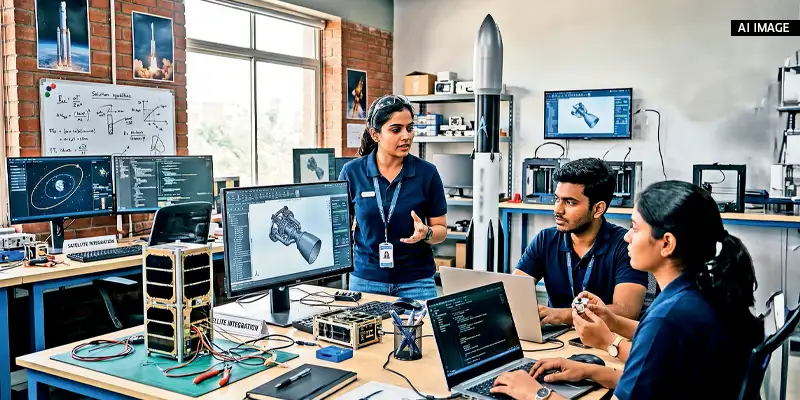
Space policy reforms introduced in 2020-21 have led to rapid ecosystem growth. The number of registered space startups has grown from just one in 2014 to more than 400 as of February 2026. With startups creating new opportunities across the space value chain, universities, government agencies, and industry will need to come together to create and nurture talent to support this growth. Experts claim the biggest challenge is not funding but a gap in academia-industry collaboration, and the way engineering education is designed and delivered.
Speaking to Education Times, Sudheer Kumar, former director, (CBPO), ISRO, says, “Engineering graduates possess fundamental knowledge in disciplines such as electronics, mechanical engineering, materials science, AI and computer science, but lack specific skills required for the space sector. There is no stand-alone discipline called ‘space engineering’. Rather, the space sector integrates multiple engineering branches and applies them to specialised space problems. Due to a lack of hands-on training, there is a shortage of professionals with domain expertise.”
There is a need to expand specialised PG programmes in areas such as aerospace structures, guidance and control, propulsion and satellite systems. Narendra Nath, scientist, Vikram Sarabhai Space Centre, ISRO, says, “Most engineering institutions rely heavily on theory-based teaching and examination-oriented preparation, leaving students with limited opportunities to develop problem-solving skills. Rather than introducing specialised space courses at the UG level, engineering fundamentals should be taught through space-related examples and applications. Concepts such as Newton’s laws, gravitation, materials science, electronics, and structural mechanics form the foundation of rocket and spacecraft engineering. By demonstrating how these principles are applied in satellite launches, orbital mechanics, propulsion systems or launch vehicle design, curiosity of students can be evoked.”
The space sector is highly interdisciplinary, drawing experts from different branches of engineering and science. Prof Amitesh Omar, head, Department of Space, Planetary & Astronomical Sciences & Engineering, IIT Kanpur, says, “HEIs have started introducing specialised programmes in space technology and related fields. IIT Kanpur, IIT Indore, and IIT Roorkee currently offer dedicated UG and PG programmes. They are also working with startups and ISRO to provide internships and industry exposure.”
He adds, “Once the private space sector matures further, students are likely to be attracted to full-fledged UG degrees in space technology on par with other disciplines. At present, many students prefer pursuing minors or specialised PG programmes alongside their core engineering degrees. Another major challenge is the shortage of experienced faculty. Institutions are constantly looking for experts who have worked in space agencies and can contribute to teaching and mentoring students,” he says.
Space startups expansion is driven by not just India’s civil space programme, but also defence and national security reasons. Sudheer Kumar says, “Defence and national security have become major growth areas after recent global conflicts highlighted the importance of space-based capabilities. This has opened new opportunities for startups developing software, satellite components, communication systems, sensors, and other specialised technologies.”

Meanwhile, by simplifying regulatory approvals and ensuring a level playing field between public and private players, Indian National Space Promotion & Authorization Centre (IN-SPACe) has lowered entry barriers for startups. As of June 18, 2026, the agency had 11,964 registered users and over 4,500 registered organisations on its platform and was processing 893 applications spanning satellite development, launch services, downstream applications and deep-space exploration.
Transdisciplinary Approach
The space startup ecosystem is currently transitioning from early-stage formation to execution and commercialisation. Vinod Kumar, director, Promotion Directorate, IN-SPACe, Department of Space, says, “Space education in India has traditionally been centred around the country’s institutional space programme. However, today’s space economy demands a more transdisciplinary approach that combines engineering, entrepreneurship, policy, business, data sciences, and emerging technologies. Students must not only understand how space technologies are built but also how they are commercialised, regulated, and deployed to address real-world challenges. To address this gap, IN-SPACe has been working closely with ISRO, academia, and industry to strengthen the talent ecosystem.”
In collaboration with ISRO, IN-SPACe has designed 12 NCVET-recognised short-term skill development programmes covering key domains such as satellite manufacturing, launch vehicle technologies, orbital mechanics, space law, entrepreneurship, cybersecurity, and space applications. “Till date, 23 short-term courses have been conducted, certifying over 1,000 participants from industry and academia. Additionally, 33 institutions have adopted space technology education in various forms, while around 24 institutions are planning to introduce such programmes soon,” adds Kumar.
Learning cannot remain confined to classrooms. Kumar says, “Every year, IN-SPACe Student Model Rocketry and CANSAT competitions are organised, providing UG student teams from engineering and science disciplines a platform to showcase their innovation. Last year, the initiative saw participation from 68 teams comprising over 600 students. This year, 115 teams from across the country have expressed interest.”
To support practical training, IN-SPACe offers internship and immersion programmes that connect students with space startups and industry partners. Kumar says, “In the previous year, IN-SPACe facilitated internships for 480 students by connecting them with Non-Government Entities (NGEs), while more than 110 students successfully completed the IN-SPACe Student Immersion Programme in Ahmedabad.”
IN-SPACe is working to establish Antariksh Prayogshala (Space Labs), where seven advanced labs will be set up across the country in seven zones. “These facilities will provide access to high-tech cleanrooms, robotics laboratories, control centres, and space experiment chambers. It will not only benefit students and researchers but will also support NGEs and startups, creating stronger industry-academia linkages,” adds Kumar.
Gaps to Address
The gap between academic learning and industry requirements makes difficult to tap right talent for startups. “Besides coding and manufacturing, candidates with strong understanding of the logic behind designing space systems are needed in startups. This knowledge exists within organisations such as ISRO and has not spread widely across industry. As a result, startups spend need to train new recruits as per job demand,” says Sudheer Kumar.
To address this challenge, there is a need to move beyond short-term internships and awareness programmes. He says, “One or two-month internships are too short for students to develop meaningful skills. Instead, year-long, credit-based industry placements as part of UG engineering programmes will be useful. Students should work on live research projects in ISRO, DRDO, CSIR, semiconductor companies, aerospace firms, and private space startups while completing their degrees. Such long-term exposure would allow them to build practical skills, contribute to ongoing projects, and become industry-ready by the time they graduate.”
Structured Internships
Institutions such as IN-SPACe should focus more on creating structured internship programmes and industry partnerships rather than only recommending curriculum changes. “Students need opportunities to apply that knowledge in real-world settings. There should be a national system where laboratories and companies regularly announce internship positions. This will create a steady pipeline of skilled professionals for the growing space industry,” adds Sudheer Kumar.