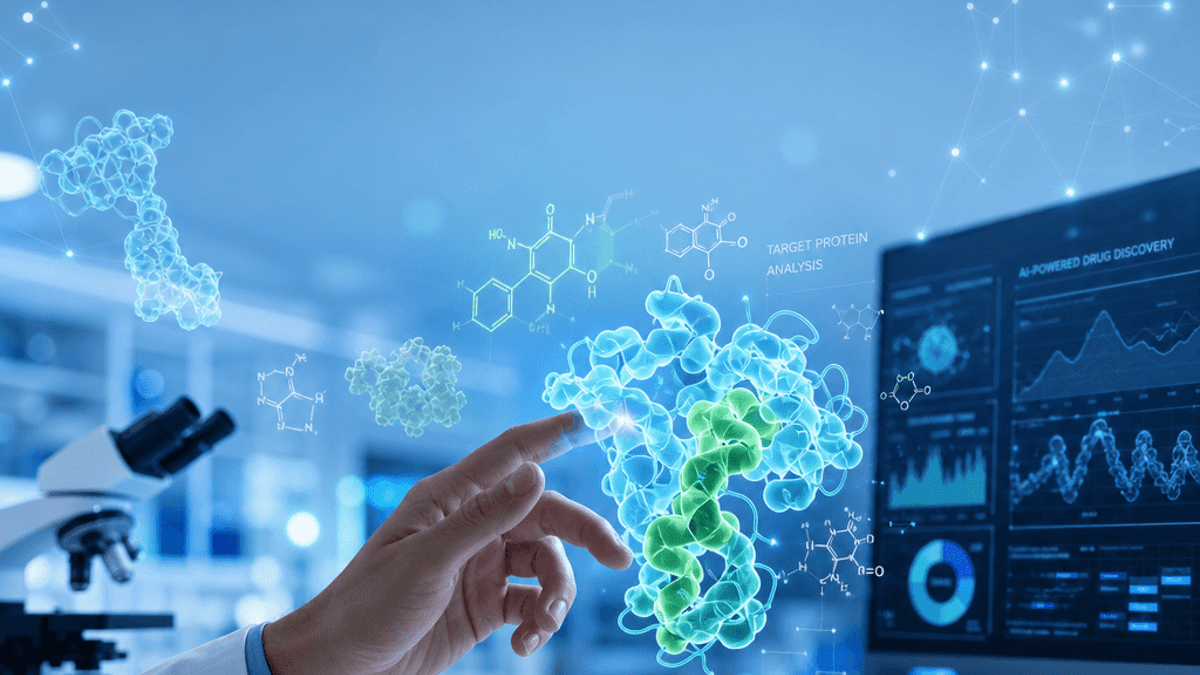
OpenAI researcher Miles Wang is in advanced talks to spin out and launch an AI-powered drug discovery startup at a staggering $2 billion pre-money valuation, according to sources familiar with the matter. Lightspeed Venture Partners is in discussions to lead what would be one of the largest debut funding rounds in biotech history, signaling how aggressively investors are betting on AI’s potential to revolutionize pharmaceutical development. The move marks another high-profile exodus from OpenAI as top talent increasingly leaves to commercialize AI breakthroughs in specialized verticals.
Miles Wang is about to make one of the boldest leaps in biotech. The OpenAI researcher is finalizing terms to launch an AI drug discovery startup that’s already commanding a $2 billion pre-money valuation before it’s even officially announced, sources tell TechCrunch. Lightspeed Venture Partners, the Silicon Valley firm behind early bets on Snap and Affirm, is in active discussions to lead the round.
The timing couldn’t be more telling. Just as OpenAI cements its position as the dominant force in foundation models, its top researchers are racing to apply that technology to high-stakes industries where AI promises to collapse timelines and costs. Drug discovery sits at the top of that list – developing a new medication typically takes over a decade and costs upward of $2.6 billion, according to pharmaceutical industry estimates. AI platforms claim they can shrink that to three years and a fraction of the expense.
Wang’s venture would enter a suddenly crowded but well-funded space. Recursion Pharmaceuticals went public in 2021 and now carries a $2.1 billion market cap. Insilico Medicine raised $95 million last year at a $1.2 billion valuation. Isomorphic Labs, spun out of Google DeepMind, secured a $3 billion collaboration deal with Eli Lilly earlier this year. The sector has pulled in over $15 billion in venture capital since 2024 as investors bet that AI can finally deliver on biotech’s long-promised digital revolution.
But Wang’s $2 billion starting valuation still stands out. Most AI biotech startups launch at valuations between $200 million and $500 million, even with strong founder pedigrees. The premium likely reflects both Wang’s OpenAI credentials and Lightspeed’s conviction that large language model techniques can transfer directly to protein modeling and molecular prediction. Sources familiar with the deal say Wang has been developing proprietary approaches to apply transformer architectures – the technology behind ChatGPT – to biological data during his time at OpenAI.
The departure fits a pattern that’s accelerating across OpenAI’s research teams. Over the past 18 months, the company has seen key figures leave to build specialized AI applications. Former safety researchers launched Anthropic, which has raised over $7 billion. Robotics leads spun out to create autonomous systems companies. Now, biotech is drawing talent. The exodus reflects both opportunity and tension – OpenAI’s focus on general AI leaves domain experts eager to pursue vertical applications where near-term commercial traction is clearer.
Lightspeed’s involvement signals more than just capital. The firm has been methodically building a portfolio around AI infrastructure and applications, backing companies like Writer (enterprise AI content) and Character.AI (consumer chatbots). An AI drug discovery bet would extend that thesis into regulated industries where AI adoption is just beginning but potential returns are massive. Pharmaceutical companies are desperate for innovation as blockbuster drugs lose patent protection and R&D productivity stagnates.
Still, skepticism remains. AI drug discovery companies have stumbled before – Atomwise promised breakthrough results in 2015 but has yet to bring a drug to market. BenevolentAI went public via SPAC in 2021, then saw its stock crater 80% as clinical trial results disappointed. The technology works better in some therapeutic areas than others, and predicting molecular behavior in silico remains vastly easier than proving efficacy in human trials.
Wang’s venture will need to navigate both scientific and business challenges. Recruiting top computational biologists and medicinal chemists. Securing partnerships with pharmaceutical giants who control clinical trial infrastructure. Choosing which disease areas to target first. And, ultimately, generating real-world validation that AI-designed molecules actually work in patients. The $2 billion valuation buys time and talent, but the real test comes when molecules enter the clinic.
For now, investors are betting that AI’s moment in drug discovery has finally arrived. The combination of better models, more biological data, and cheaper compute makes this wave feel different from previous hype cycles. If Wang can deliver even one successful drug candidate, the valuation will look prescient. If not, it’ll join the long list of biotech bets that promised revolution but delivered disappointment.
Wang’s $2 billion AI drug discovery startup represents the latest chapter in a broader story – OpenAI’s research talent is scattering across industries, armed with cutting-edge AI techniques and hungry to prove they work beyond chatbots. Whether that translates to actual drugs reaching patients remains the billion-dollar question. But with Lightspeed’s backing and biotech’s desperate need for innovation, Wang has the resources and runway to find out. The real risk isn’t the technology failing – it’s whether the 10-year timeline from molecule to market can stomach the pace of AI hype cycles. For investors betting $2 billion upfront, patience will be as critical as the science.