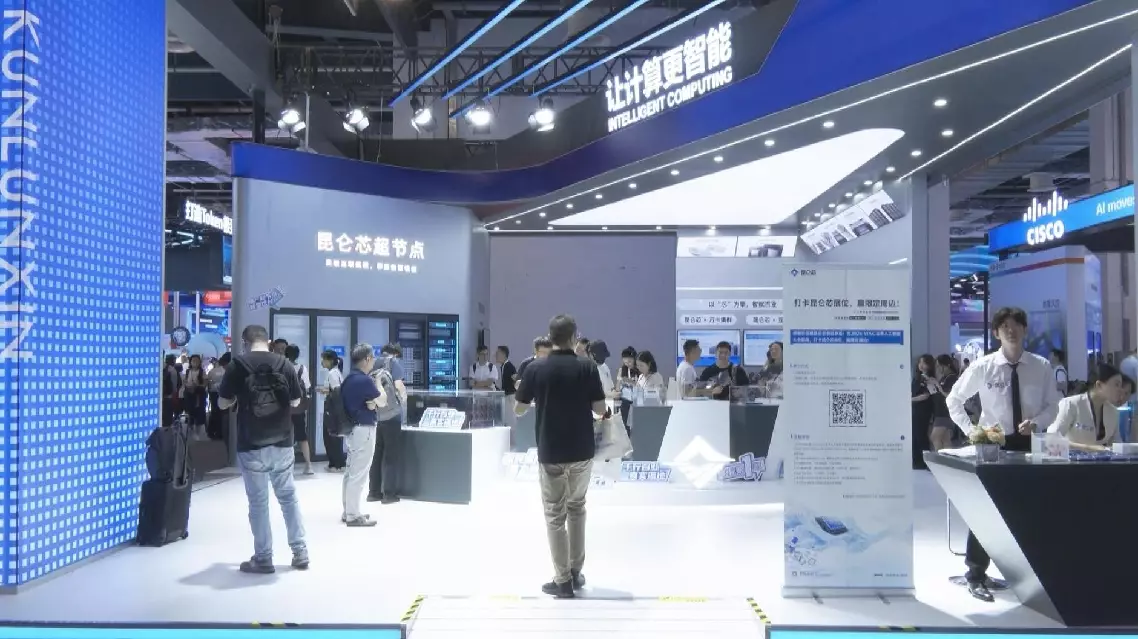

Chinese exhibitors at the 2026 World AI Conference (WAIC) in Shanghai focused on transitioning homegrown AI computing from “usable” to “affordable” by scaling up clusters, upgrading chips, and exploring new technologies, with the aim of reducing large-model inference costs and making AI more accessible.
At the exhibition hall, AI agents made their way into a wide range of fields — from writing documents and creating slides in offices, to quality checks and drawing reviews on factory floors.
But each time an agent performs a task, it burns through quite a lot of tokens.
“Our MoMA large model platform now sees 6.5 times more daily peak calls than at the start of the year, and token revenue has jumped tenfold,” said Xiao Liang, deputy general manager of China Mobile Cloud, a cloud service brand under Chinese telecom giant China Mobile.
Industry insiders say they are using computing platforms to coordinate multiple mainstream large models in order to reduce token costs. At the same time, they are accelerating the construction of large-scale computing clusters across China. Domestically produced chips that power these ultra-large computing clusters are the key to driving down costs further.
“We’ve gone from a 10,000-card cluster last year to a 100,000-card one this year. Users are getting more and more comfortable with homegrown computing power. It has proven its cost-effectiveness in large-scale model training and inference, and it’s bringing costs down,” said Ouyang Jian, CEO of Kunlunxin, an AI chip subsidiary under Chinese technology firm Baidu.
“We want to turn AI computing power from a ‘luxury’ into something as basic as your utility bill — so that everyone can afford it and use it well. Domestic AI computing power is now at a critical breakthrough moment. Whoever can truly bring down inference costs will have a say in the next decade,” said Wang Jiacheng, chairman of Zhongcheng Hualong Computer Technology Co., Ltd., a Chinese chipmaker.
In addition, the rollout of more cutting-edge technologies such as optical chips over the next three to five years is also expected to offer another avenue for reducing computing costs.
“Compared with electronic chips, optoelectronic chips offer lower computing latency and lower power consumption. This translates into faster inference speeds for large models and a reduction of 50 percent or more in cost per token,” said Yang Qisheng, founder of PhotonCore, a Chinese hard-tech startup.
Chinese exhibitors at WAIC 2026 push AI from usable to affordable
The Ministry of Water Resources on Monday issued an orange alert, the second highest level in its four-tier system, for flash floods in south China’s Guangxi Zhuang Autonomous Region.
The ministry held a joint consultation meeting to assess national flood control situation, warning that parts of eastern Guangxi face a high risk of flash flood between 08:00 Monday and 08:00 Tuesday.
On Sunday, many rivers in Guangxi’s Baise City experienced rising water levels following heavy rains. The largest increase was recorded on the Tianzhou River in Tianyang District, where the section near Toutang Village in Toutang Town saw floods exceed the warning mark by more than 0.8 meters.
As of 09:00 on Monday, 15 rivers in some provincial-level regions across China including Jilin, Liaoning, Heilongjiang, Inner Mongolia, Tianjin, Hebei, Yunnan, and Guangxi experienced floods above warning levels with maximum recorded as 2.29 meters, according to the Ministry of Water Resources.
Ministry issues warning for flash floods in Guangxi
Source link