Long before a doctor makes a formal diagnosis, the way a person walks — their gait — can provide clues about emerging disease.
For conditions like Parkinson’s disease, Alzheimer’s, peripheral artery disease and more, gait changes serve as an early warning sign. But clinicians often miss these signals because gait — often called the “sixth vital sign” — is difficult to measure and often overlaps age-related changes.
Harnessing the power of gait as a biomarker is the concept behind Grasshopper Health, a startup launched by University of Nebraska–Lincoln engineer Fadi Alsaleem to commercialize a wearable, low-cost medical device that continuously delivers gait data to a patient’s smartphone and a provider’s chart. The goal of this device — called the Axis Patch — is to pave the way for earlier diagnoses, improved treatments and better tracking of how well certain interventions, like medicine or surgery, are working.
With a recent investment and strategic partnership from Omaha, Nebraska-based CQuence Health, the company is advancing toward clinical trials and broader adoption of its gait-monitoring device.
“The company formed around this technology because gait is an indication for at least 18 diseases where people show illness in the way they walk,” said Alsaleem, James and Virginia Blackman Associate Professor of architectural engineering and Grasshopper co-founder and technology adviser. “We were initially focused on peripheral artery disease but soon realized gait changes relate to heart attacks, Parkinson’s and more. A small idea changed into a big one that might change everything we do in the medical field.”
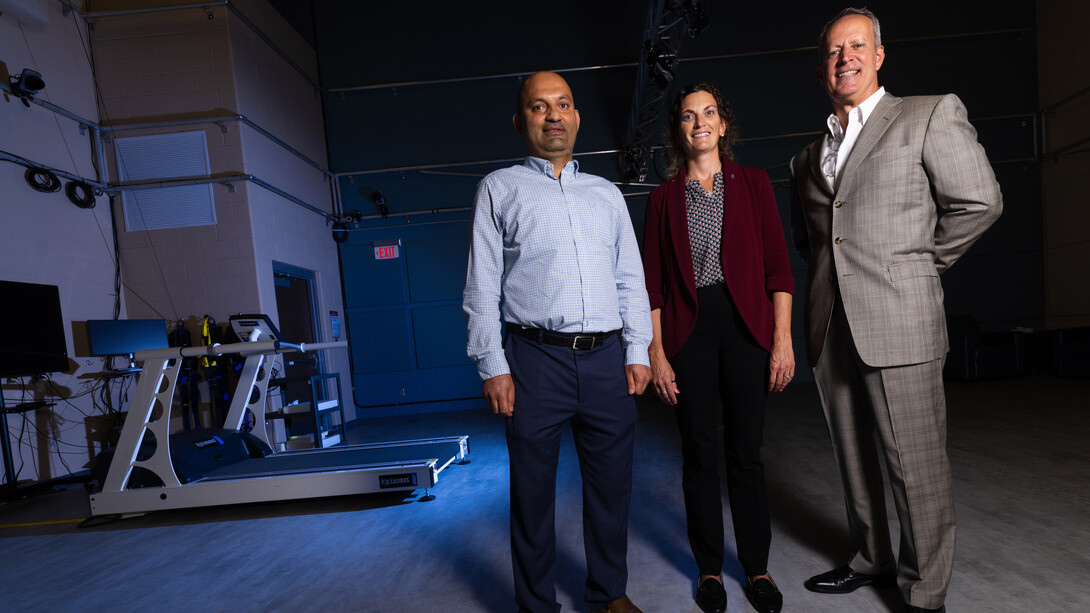
Grasshopper Health represents a merger of expertise across three University of Nebraska institutions. The collaboration dates to 2021, when a team including Alsaleem received a University of Nebraska Collaboration Initiative grant to develop a machine learning-based wearable designed to improve the diagnosis and treatment of peripheral artery disease.
Sara Myers, professor in the University of Nebraska at Omaha’s internationally recognized Department of Biomechanics and associate vice chancellor for research and creative activity, and Iraklis Pipinos, a vascular surgeon and professor of surgery at the University of Nebraska Medical Center, had 20 years of peripheral artery disease-related data from prior research. Alsaleem — who specializes in wearable devices with long battery lives — was inspired by this trove of data, which included information from both healthy individuals and patients with the disease.
To an engineer, it was the kind of information machine learning thrives on — a chance to train algorithms to recognize the hidden signatures of disease.
“That’s where things clicked,” Alsaleem said. “We figured out how to leverage all of this existing data.”
Though researchers have long recognized the link between gait and disease, multiple hurdles have prevented its use as a reliable biomarker. During office visits, doctors are limited to seeing patients walk in short bursts at a single point during the day. And even highly trained professionals can miss subtle shifts — especially when age-related gait changes can be normal.
For the devices that have been developed, one or more problems have prevented their widespread adoption — cost being the most significant. None have been affordable for the general population, and up until a few years ago, insurance did not reliably cover physician-prescribed wearables.
Grasshopper is launching into a transformed landscape: Recent changes in health care reimbursement have created pathways for broader insurance coverage.
“A major advantage is our timing,” Alsaleem said. “People have tried to bring similar devices to market, but they’ve died out because of confusion about who will pay for it. Now, we have a new reimbursement model for digital devices.”
Bulkiness and uncomfortable fit have also stymied other models. Husker engineer Eric Markvicka is helping Grasshopper to achieve a lightweight and low-profile patch.
“We envision the final product being like a Band-Aid, where you just put it on your lower back and forget about it,” Alsaleem said.
The device’s other advantages include a long battery life — the device is expected to last about two weeks without needing to be charged, with hopes of eventually reaching a month or longer — and the ability to continuously, wirelessly transmit data to patients and doctors. This would allow doctors to remotely monitor hundreds of patients at once.
The patch is also unique for tracking multiple potential diseases, rather than just a single condition, which has been the standard to this point.
Alsaleem credits university resources and expertise, along with Nebraska’s startup ecosystem, with helping the team launch Grasshopper. NUtech Ventures, the University of Nebraska–Lincoln’s technology commercialization affiliate, supported Alsaleem in patenting the machine learning-based methods for diagnosing peripheral artery disease and licensing the technology to Grasshopper.
Support from Paul Eurek, an entrepreneur in residence in the College of Engineering, helped Alsaleem understand Nebraska’s startup landscape and capture early funding from the college and the Nebraska Department of Economic Development. The college also provided commercialization support through the Ken Jones Donor Fund.
Dr. Jeffrey P. Gold, president of the University of Nebraska system, inspired Alsaleem to make commercialization a central piece of his work at the university — part of NU’s broader mission to improve lives and strengthen the economy through tech transfer.
“Commercialization pushes faculty outside their traditional comfort zones,” Alsaleem said. “We’re accustomed to publishing papers, but building a startup shifts the focus to positively impacting people’s lives.”
Gold also connected Alsaleem with Peter Savas, a biotechnology entrepreneur and chair of Grasshopper Health’s board, and Richard Vlasimsky, the company CEO, who has significant expertise in bringing health innovations to market. Myers and Pipinos, part of the original NU collaboration, serve as advisers to the company.
“While our research has been very laboratory focused, our team always wanted to have a translational impact,” Myers said. “Being able to work together with my colleagues from the other NU campuses shows the breadth of expertise that we have here in our state’s universities.”
Alsaleem said Husker students are benefiting from the startup, too. Through a research agreement between Grasshopper and the university, three doctoral students receive research funding to support the work.
“It’s a win in all directions,” he said. “It exposes my students to how to move from research to a real product, and they have research money approved by the university. For me, I get to go beyond my typical academic life to advise a company based on my research.”
Original release: https://news.unl.edu/article/startup-harnesses-gait-data-to-improve-health-outcomes