Nigerian startup Blockops Network is building OnchainStacks to power stablecoin financial operations for fintechs, PSPs, banks, and remittance companies.
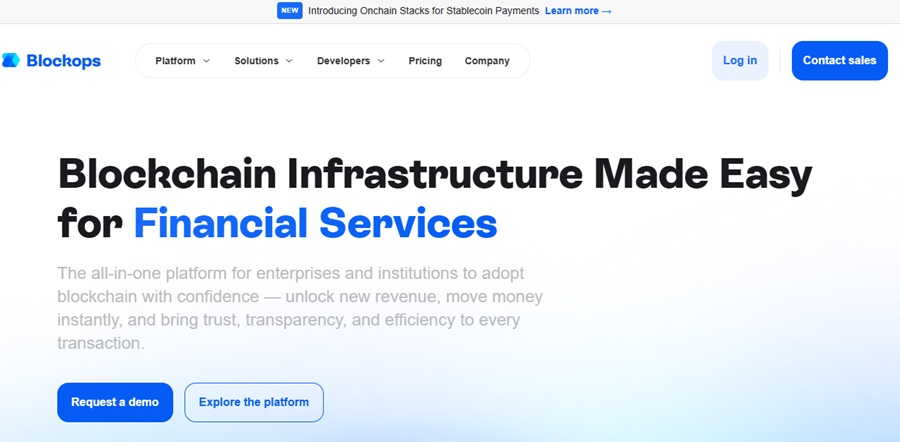
Blockops is an all-in-one platform that aims to help enterprises and institutions to adopt blockchain with confidence — unlock new revenue, move money instantly, and bring trust, transparency, and efficiency to every transaction.
Its Onchain Stacks platform, however, is specifically focused on stablecoins. Sub-Saharan Africa moved over US$200 billion in on-chain value between mid-2024 and mid-2025, with stablecoins representing 43 per cent of that activity. But nearly all of the infrastructure serving that volume optimises for the same handful of popular corridors like Africa – Asia Trade corridors, Western corridors, and intra Africa remittances in major markets like Nigeria, Kenya, and South Africa, said Blockops founder and CEO Adedayo Akinpelu.
“Meanwhile, a large share of African cross-border payment demand sits on underserved corridors — routes like the Francophone corridors and East African corridors that most stablecoin infrastructure simply doesn’t touch,” he said. “That’s a quiet but real bottleneck – a fintech moving money on an underserved corridor often has to fall back on slow, costly, manual settlement precisely because no automated routing exists for that path.”
Onchain Stacks has integrated a routing engine that serves the popular corridors, but is also built to reach the underserved ones too, dynamically routing transactions across stablecoin rails, banking rails, and mobile money on corridors that larger infrastructure players have skipped.
“In practice, that means a fintech settling on East African corridors can move money in roughly one instead of three days, at a fraction of the typical remittance cost,” Akinpelu said.
Before founding Blockops, Akinpelu spent over 10 years building blockchain and frontier infrastructure for successful blockchain protocols, such as Zama, Flow Blockchain, Obol, and Hyperbridge. The company therefore sprung from years of infrastructure work helping teams deploy nodes, wallets, indexers, and blockchain systems.
“We actually initially wanted to onboard banks, so we went seeking out banks in Nigeria and emerging markets to onboard stablecoin payments. We talked to about 17 banks and that was where we saw that even though stablecoin adoption was growing, the infrastructure required for businesses to use stablecoins in production was extremely fragmented, complex and expensive,” Akinpelu said.
“A company that wants to move money with stablecoins still has to manage wallets, liquidity, ramps, payout providers, compliance, treasury, monitoring, and reconciliation across multiple vendors.”
Blockops realised that part of the reason infrastructure was so expensive was a dependence on other infra companies, which makes the margins thin.
“But we have already built all this infra that makes stablecoin work, the only thing was that it was only available via dashboard. Hence we decided to make all the infrastructure they need available in one simple API,” Akinpelu said.
The startup recently secured a US$250,000 pre-seed investment from Antler VC, and is also about to close on some additional funding. Uptake, Akinpelu said, has been strong, “because the problem is urgent”.
“For Onchain Stacks, we currently have dozens of enterprises and businesses that are currently in our pilot, and have committed over US$100 million in potential stablecoin settlement volume in our pipeline,” he said.
“We are starting with emerging market money movement, with Africa as our first wedge. Our initial use cases include cross-border settlement, treasury movement, liquidity access, supplier payments, remittances, and payouts. Over time, we plan to expand into other emerging-market regions including Latin America, Southeast Asia, and the Middle East. The problem is not Africa-specific; businesses across emerging markets face similar issues with dollar access, liquidity, settlement speed, and cost.”