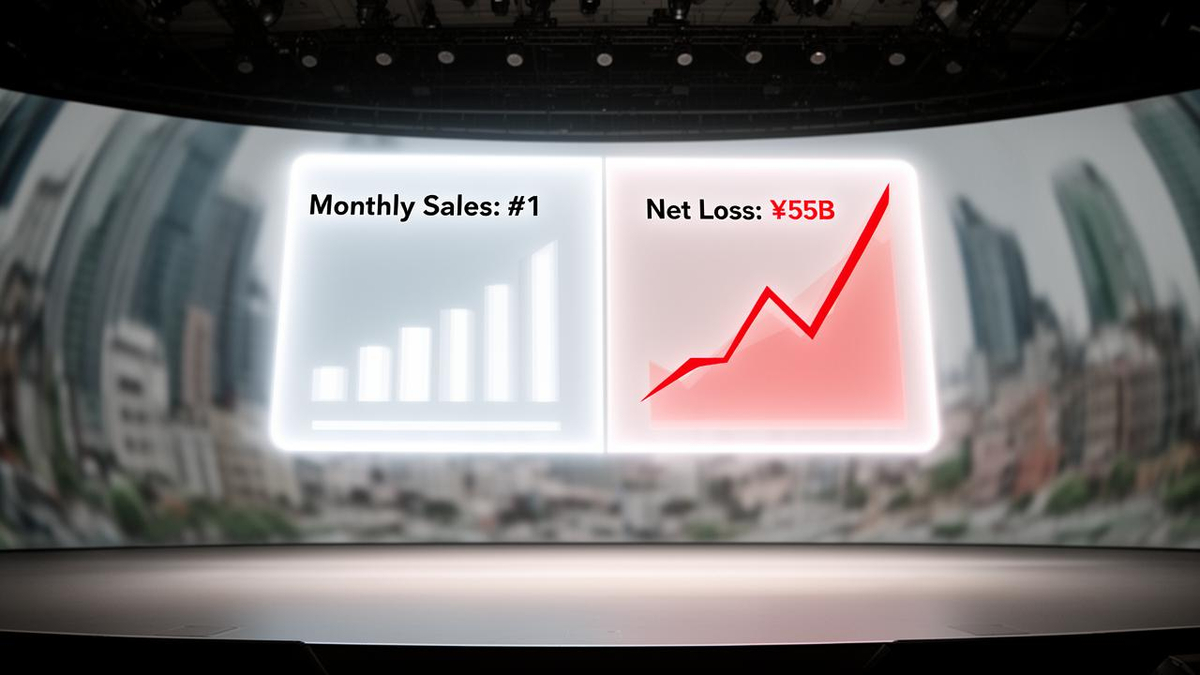
China’s emerging electric vehicle (EV) makers are struggling with a dilemma between sales volume and profitability. In June 2026, Leapmotor took the top spot in monthly sales for the first time, delivering over 90,000 units—a 95% year-on-year increase. However, its January-March 2026 quarterly results showed a net loss of approximately CNY 390 million (roughly ¥9.4 billion). Li Auto (2015.HK), which was once the first among the startups to achieve profitability, also plunged to a net loss of about CNY 2.3 billion (approximately ¥55 billion, or $340.0 million) in the same period. The market’s focus is rapidly shifting from “sales volume” to “can they make a profit.”
Leapmotor’s Rapid Sales Growth Masks Plunging Gross Margins
Leapmotor, which is increasing its presence in China’s emerging EV market, has achieved rapid growth by leveraging high cost-performance and a multi-model lineup. Its monthly deliveries exceeded 90,000 units for the first time in June, solidifying its lead with a wide margin over second-place HIMA (Huawei’s EV alliance), which delivered 50,624 units.
However, the years-long industry-wide price war has taken a heavy toll. In the January-March 2026 quarter, Leapmotor’s gross margin plunged from 14.9% a year earlier to 9.4%, while its quarterly net loss swelled to approximately CNY 390 million (roughly ¥9.4 billion).
A warning light is also flashing for its full-year target. Leapmotor set an annual goal of 1 million units for 2026, but cumulative deliveries in the first half totaled only about 356,000 units, representing an achievement rate of just 35.6%. To reach its target, the company would need to sell an average of 107,000 units per month in the second half. If it continues to rely on discounts to boost sales volume, the pressure on earnings is likely to intensify further.
The End of the Range-Extender ‘Special Demand’ for Li Auto
Li Auto, once a symbol of the emerging EV makers, is also facing headwinds. Its cumulative deliveries in the first half of 2026 fell 5.1% year-on-year to 193,500 units. Full-year net profit for 2025 shrank to CNY 1.124 billion (approximately ¥27 billion), and it swung to a loss of about CNY 2.29 billion (approximately ¥55 billion, or $340.0 million) in the January-March 2026 quarter.
What once propelled Li Auto to the top of the startup pack was its “range-extender” technology—using an engine to generate electricity for the motor—and its clear brand strategy of “family-oriented vehicles” (dubbed “dad cars”). Equipped with a refrigerator, large displays, and comfortable seats, range-extender vehicles without range anxiety offered an overwhelming advantage in an era when charging infrastructure was underdeveloped.
But the situation has changed dramatically. Charging infrastructure, such as BYD’s (1211.HK) 1,500kW ultra-fast “Flash Charger,” has rapidly spread, and advances in battery and motor technology have extended the driving range of pure EVs year by year. As consumers begin to choose “pure EVs without range anxiety,” the relative appeal of range-extender vehicles has diminished.
Furthermore, automakers that were previously pure-EV specialists, such as GAC Aion and XPeng (9868.HK), have successively launched range-extender models, poaching Li Auto’s potential customers. Li Auto’s mainstay L6 saw its average monthly sales fall below 6,000 units in the first half of 2026, while the L7 dropped below 3,000 units.
Ironically, Li Auto’s sales are now being supported by the pure-electric i6. It recorded monthly deliveries of over 20,000 units from March to May 2026. Li Auto had announced a product plan of “4 range-extender models + 4 pure EV models” in 2024, but the plan was delayed due to insufficient sales network capacity and sluggish sales of the premium MPV MEGA. The recall of around 10,000 MEGA units in the fourth quarter of 2025 was also a blow. Reports emerged in early 2026 of around 100 store closures, which Li Auto explained as “closing inefficient stores opened during the expansion period to reduce operating costs.”
XPeng and NIO Maintain High Gross Margins but Remain Far from Profitability
While XPeng may not stand out in terms of sales volume, its group-wide gross margin reached 20.6% in the January-March 2026 quarter, topping the list among major EV startups. However, this was largely boosted by high-margin service-related businesses and does not directly reflect the profitability of its automotive business alone.
NIO (9866.HK) also saw its automotive business gross margin improve to 18.8% in the same period, up from both the previous year and the previous quarter. Nevertheless, both companies continue to invest heavily in expanding their sales networks and research and development, and have yet to achieve stable profitability.
None of the major emerging EV players reached 50% of their full-year targets in the first half. Li Auto achieved 39.68%, while XPeng and Xiaomi (1810.HK) were around 30%, and HIMA remained below 20%.
Li Auto Bets on Self-Developed ‘Mach 100’ Chip and Overseas Expansion for a Turnaround
Li Auto is not sitting idle. In June 2026, it unveiled the “Mach 100,” a self-designed autonomous driving chip that has been under development since 2021. With computing performance of 1,280 TOPS and memory bandwidth reaching 273GB/s, the chip aims to further strengthen the company’s already industry-leading autonomous driving technology at the hardware level.
On the product front, Li Auto successively launched new versions of its flagship L9 and L8 in May and June, comprehensively revamping the pure-electric driving range, handling stability, autonomous driving functions, and in-car infotainment. The L9, in particular, has gotten off to a strong start, with 90% of orders opting for the higher-grade “Livis version.” The premium pure-electric SUV i9 is also scheduled for release in the second half of the year, establishing a “9 Series Dual Flagship” lineup alongside the L9.
Overseas strategy is also accelerating. Li Auto President Ma Donghui revealed at a May earnings briefing that the company had entered Macau, Cambodia, Laos, and Myanmar that month. In the second half of the year, it plans to launch the i6 in Europe and introduce an overseas-specific version of the L9, optimized for local environments, in the Middle East and East Asian markets in the third quarter. By year-end, it plans to release a right-hand-drive version of the MEGA for right-hand-drive markets.
The Biggest Challenge: Penetrating the Lower-End Market
Li Auto’s annual target for 2026 is approximately 487,600 units, a 20% increase year-on-year. With a first-half achievement rate of 39.68%, the possibility of reaching the target remains if it can capitalize on China’s peak auto sales season, which typically begins in September.
However, XPeng and NIO, once two of the “Big Three” startups, are already pursuing a “value over volume” strategy to penetrate the lower-end market. XPeng’s MONA series sells an average of over 13,000 units per month, while NIO has positioned itself in the mid-to-low price range with its Firefly and ONVO brands.
Leapmotor, the most dynamic among the startups, has also made the mid-to-low price range its main battleground and is a prime example of achieving profitability through sales volume scale. The strong performance of Li Auto’s i6 is also not unrelated to its affordable pricing.
For now, Li Auto’s main battleground remains the market above CNY 200,000 (approximately ¥4.8 million), and it has not announced plans to launch a second brand or introduce lower-priced L or i series models. While the launch of new high-end vehicles and the technological advantage of its self-developed chip are expected to drive a sales recovery in the second half, a product lineup skewed toward the high-price segment and a lack of presence in the lower-end market remain structural challenges that cap its sales volume potential.
As Chinese EV makers’ overseas expansion gains full momentum—BYD, for instance, increased its overseas sales by 95% year-on-year to 174,897 units (43.5% of its total) in June 2026—Li Auto’s cautious global strategy of “consolidating the domestic market first, then going overseas” could become a drag on long-term growth.
With price competition cannibalizing demand and the domestic market heading toward saturation, China’s emerging EV makers are entering a more complex phase of survival competition that cannot be measured by the single yardstick of “sales volume” alone.