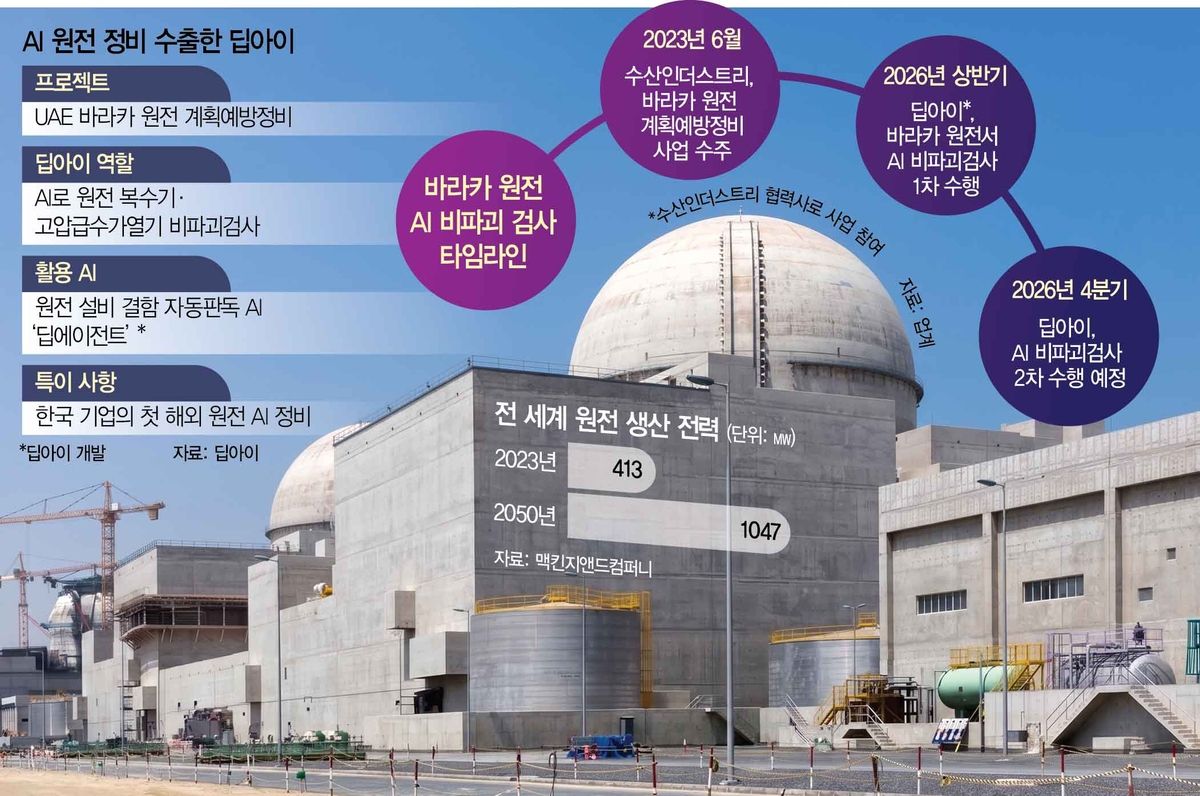
A five-year-old South Korean startup has carried out nuclear power plant maintenance work built around artificial intelligence at the Barakah nuclear plant in the United Arab Emirates. It marks the first time a Korean company has exported AI-based maintenance services to an overseas nuclear plant. Industry officials expect the Barakah project to be the first of many AI technology export attempts by Korean nuclear firms.
DeepEye, a startup specializing in non-destructive testing for nuclear plants, recently completed AI-based non-destructive inspections of the condensers and high-pressure feedwater heaters at Barakah units 1 through 4, according to industry sources on the 3rd. A condenser turns steam that has passed through the turbine back into water, while a high-pressure feedwater heater applies heat and pressure to that water before sending it to the steam generator. Each piece of equipment contains thousands of heat exchanger tubes. Non-destructive testing sends eddy currents through those tubes and analyzes the resulting signals to detect flaws.
DeepEye, founded in 2022, automated the inspection work using DeepAgent, an AI-based non-destructive testing solution it developed in-house. The AI analyzes every signal collected by the inspection equipment and automatically flags segments with abnormal readings. Workers then review the flaw candidates and the reasoning the AI presents before making the final call on whether the equipment is defective. Nawah Energy, the operator of the Barakah plant, was also satisfied with DeepEye’s inspection results, according to sources. Having completed its first service contract, DeepEye will return to the UAE in the fourth quarter of this year for a second round of AI-based non-destructive testing.
DeepEye took part in the project as a partner of Soosan Industries, the main contractor for planned preventive maintenance at Barakah. Korean companies emphasized their AI-driven technological edge to the UAE side from the bidding stage, and as a result won planned preventive maintenance contracts that had until now gone to Croatian and French firms.
The case is expected to accelerate the adoption and field testing of AI at Korean nuclear companies. Nuclear plant maintenance has long been seen as a laggard in AI adoption. Because the work carries a high risk of accidents, the practice of leaving final judgments to the experience and know-how of skilled workers has been deeply entrenched. But the mood has shifted as AI capabilities improve rapidly and demand grows within the industry to cut the time and cost of relying on people alone. A growing number of companies in the nuclear market are now racing to secure AI technology.
Daon Technology, a specialist in radioactive waste dismantling, plans to develop within this year an AI system that analyzes contamination data on metal waste and recommends the optimal decontamination method. Named Daon D-ACS, the AI will be embedded in a combined decontamination device. The company aims to build an AI that calculates efficient contamination removal methods based on the condition of the waste and then carries out the decontamination inside the device. KEPCO KPS (051600.KS) and startup MUtron are jointly training an AI model for welding robots. The two plan to unveil an AI model for robots that weld autonomously at reactor bottom-mounted instrumentation (BMI) penetrations in the first half of next year.
Some in the industry expect Team Korea to win overseas projects on the strength of AI for nuclear plant maintenance. “Until now, foreign companies such as Zetec of the U.S. have held the lead in the market for nuclear maintenance software, but there is still no clear frontrunner in nuclear-related AI,” DeepEye Chief Executive Kim Ki-soo said. “AI developed by Korean companies with real expertise can absolutely take an early lead in the global market.”