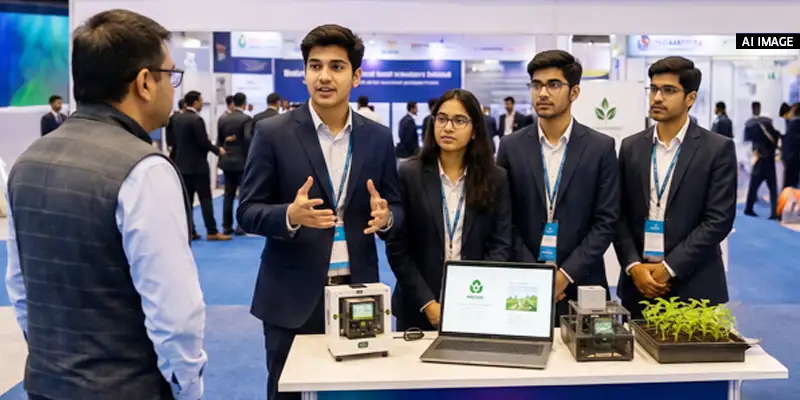
India’s deep-tech ecosystem is entering a new phase of maturity. With Bharat Innovates 2026 concluding in Nice, France, recently, India’s position as a global deep-tech and innovation hub seems to have reached new heights. Drawing over 2,000 participants from 29 countries across the world, the event witnessed over 50 collaboration agreements; pitches by 80+ startups before over 50 global investors from more than 10 countries; confirmed investor follow-up commitments for over 40 startups; and approximately USD 254.5 million in funding commitments.
“The showcase of 120 deep-tech startups and 45 Higher Education Institutions (HEIs) technologies on a global platform demonstrates that our institutions are no longer just producing research papers, they are building deployable solutions with real-world impact. Additionally, 30+ strategic partnerships were signed with global stakeholders with partnerships spanning joint research, technology development, startup acceleration, market access, talent mobility, and soft-landing programmes. They are long-term relationships, not one-time meetings,” says Prof Rajeev Ahuja, director, IIT Ropar, while speaking to Education Times.
The event provided the kind of ecosystem access that a deep-tech startup otherwise spends years trying to build on its own, Prof Ahuja says. A total of 13 frontier technology domains, including semiconductors, biotechnology, healthcare and medtech, advanced computing, space and defence, climate technologies, advanced manufacturing and agri-tech were showcased. These are also the sectors expected to shape the next wave of economic growth and strategic competitiveness worldwide.
“The initiative marks a significant transition for India’s deep-tech ecosystem, from isolated innovation successes to a globally connected, commercially oriented innovation movement. HEIs have been central to this transition because deep tech begins where serious science, patient capital, advanced infrastructure, and risk-taking students converge. IITs and other HEIs are no longer only producing graduates, but IP, startups, manufacturing pathways and mission-scale technologies,” says Prof Suman Chakraborty, director, IIT Kharagpur.
“A notable development has been the increasing emphasis on moving technologies systematically from research labs to the marketplace through Technology Readiness Levels (TRLs) and Manufacturing Readiness Levels (MRLs). Institutions are now focusing not only on generating scientific discoveries but also on advancing technologies through validation, prototyping, pilot-scale manufacturing, industrial testing, and commercialisation pathways. At the same time, there is growing recognition that intellectual property (IP) creation and protection are critical indicators of innovation maturity. HEIs are therefore strengthening their support for patenting, licensing, technology transfer, and IP commercialisation to ensure that research outcomes create both societal and economic impact,” says Prof KK Pant, director, IIT Roorkee where over 80 startups engaged with over 50 investors and institutions from more than 10 countries at Bharat Innovates 2026, collectively managing over $3 trillion in assets. “The strong investor interest and follow-up engagements demonstrate growing international confidence in India’s ability to generate globally relevant deep-tech ventures,” Prof Pant adds.
Focus Areas
In terms of the 13 focus areas at the event, Prof Chakraborty says, “These sectors are not fashionable labels but markers of strategic leadership that will define national competitiveness. At IIT Kharagpur, our emphasis is on moving from demonstration to deployment in areas such as affordable healthcare and MedTech, AI-enabled diagnostics, cyber-physical systems, advanced manufacturing, sustainable energy, defence technologies, semiconductors and robotics. The message is clear: a deep-tech startup must not end as an exhibition stall but become a product, platform, or national capability. A special emphasis is on technologies that can serve both India and the Global South, because the future of deep tech will be judged not just by sophistication, but scale, affordability and societal impact.”
Thirumalai Madhavnarayan, CEO & director, IITM Global, seconds his views. “We are creating pathways through which startups can connect with customers, strategic partners, investors, regulators, and international ecosystems. The true measure of success is not the number of exhibits, but the number of commercially meaningful outcomes,” he says.
The 13 domains, while representing the frontiers of scientific depth, combine strong IP potential with the ability to tackle complex national and global challenges, says Prof Ahuja. “The startups that came to Nice reflected this perfectly. From Astrome Technologies and Dhruva Space in the space sector, to BrainSightAI in healthcare, to QNu Labs in quantum technologies, and Noccarc Robotics in medical equipment, the breadth was remarkable. From IIT Ropar’s own ecosystem, we took innovations like CPS Lab Plug-and-Play Laboratory, Biodiversity Sensor, and GudLyf Mobility’s high-pressure composite cylinders for hydrogen and CNG storage. Each tells the story of research becoming real,” he adds.
Discussing the scale of such innovations, Prof V Kamakoti, director, IIT Madras, says. “India’s deep-tech future will be shaped by institutions that seamlessly integrate world-class research, entrepreneurship, industry collaboration, and societal impact. Our objective is not merely to create startups but to build globally competitive technologies that address real-world challenges.”
Key Players
Notably, the IITs have played a catalytic role in nurturing deep tech by investing early in research infrastructure, incubation, industry partnerships, and entrepreneurship support. “However, India’s future competitiveness depends on creating collaborative ecosystems rather than isolated centres of excellence,” says Prof Manu Santhanam, dean, ICSR, IIT Madras. “Deep-tech innovation requires multidisciplinary capabilities, and no single institution can build these ecosystems alone,” he adds.
“The IITs and IISc may have played an anchoring role, but the ecosystem they are embedded in includes IIMs, AIIMS, IISERs, NITs, central and state universities, Atal Incubation Centres, AICTE Idea Labs, and many more,” says Prof Ahuja. “Startups are being incubated across state and central universities, and research is happening in labs across the country. What has made this possible is strong, sustained government backing through programmes like CoE for AI by MoE, Startup India, Atal Innovation Mission, IndiaAI Mission, National Quantum Mission, Semicon India, Biotechnology Industry Research Assistance Council (BIRAC), and Research, Development and Innovation Fund (RDIF). These aren’t just funding schemes; they have created the infrastructure, mentorship, and commercialisation pathways that deep-tech ventures need,” he adds.
Addressing Challenges
Despite their promise, deep-tech ventures face significant hurdles, namely long gestation, high capital needs, regulatory complexity, uncertain markets, and the challenge of turning prototypes into reliable products. “One of the most significant challenges is navigating the ‘valley of death’ between laboratory success and commercial deployment. Many promising technologies demonstrate strong technical potential but struggle to secure the patient capital, validation infrastructure, manufacturing support, industry partnerships, and market access needed to scale. In addition, deep-tech startups often require access to sophisticated equipment, pilot-scale facilities, testing infrastructure, certification processes, and skilled technical manpower, all of which can be resource-intensive,” says Prof Pant.
Academic institutions are addressing many of these challenges by creating shared infrastructure, research facilities, incubators, industry partnerships, mentorship networks, and funding support mechanisms. Technology transfer offices drive IP commercialisation, research parks foster industry collaboration, and specialised incubators offer domain expertise and access to labs that would otherwise be prohibitively expensive for early-stage companies,” says Thirumalai Madhavnarayan.
The future looks promising because the missing middle between lab research and commercialisation is finally being built. “The world is no longer looking at India only as a market or back-office talent base, but as a source of frontier technologies, frugal engineering, scalable solutions and globally relevant startups,” Prof Chakraborty adds.
Going forward, the success of India’s deep-tech journey will depend on building stronger networks and collaborations among institutions rather than concentrating in a few centres. “The future lies not in generic incubators but in mission-driven platforms that bring together researchers, startups, industry, investors, regulators, and testing facilities around specific technology domains. Deep-tech innovation thrives when all critical capabilities are available within a connected ecosystem,” Prof Pant adds. Bharat Innovates 2026 made that possible on a global stage.