Fintech investment in Europe, the Middle East and Africa (EMEA) witnessed a decline in the first half of the year, driven by ongoing uncertainties including increasing geopolitical tensions, new US tariff policies, and concerns over inflation and interest rates caused by the outbreak of war in the Middle East, according to a new report by KPMG.
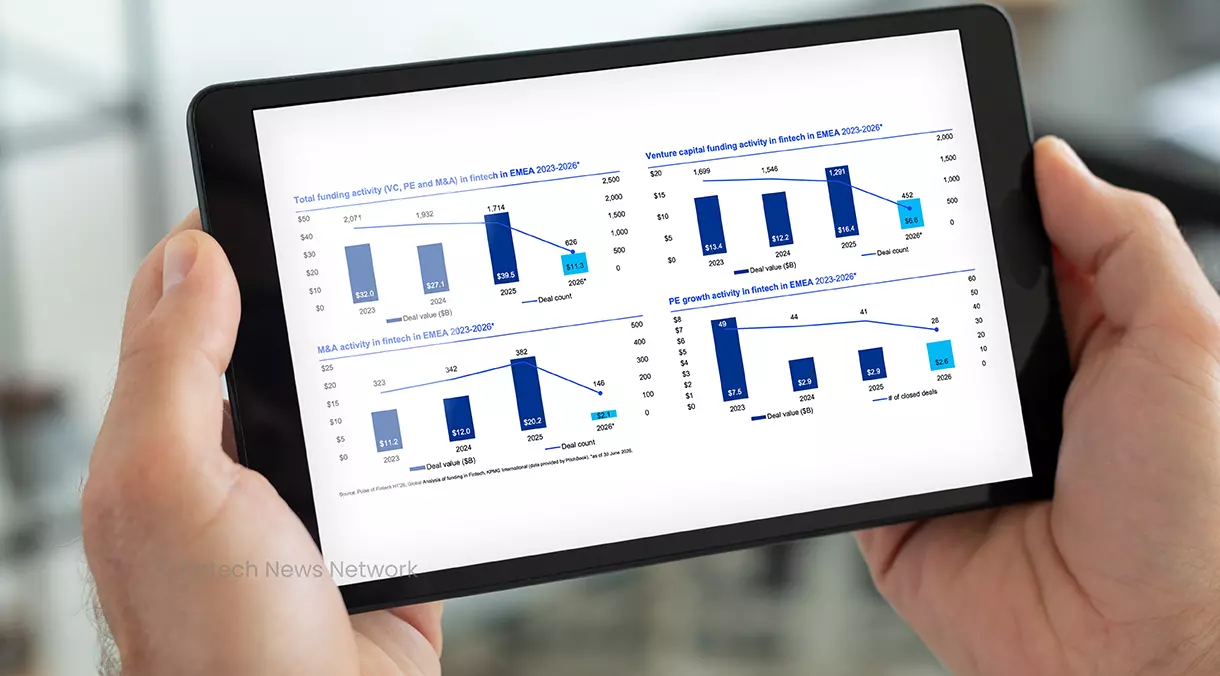
In H1 2026, EMEA attracted US$11.3 billion across 626 venture capital (VC), private equity (PE), as well as mergers and acquisitions (M&A) transactions, data from the Pulse of Fintech H1 2026 report show. The figures mark a notable decline of 17.5% from US$13.7 billion and 759 deals in H1 2025.
VC played a significant role in H1 2026 funding activity, securing US$6.6 billion in 452 transactions, followed by PE deals, which amounted to US$2.6 billion and involved 28 transactions, and M&A transactions, which generated US$2.1 billion through 146 deals.

The KPMG report also highlights several trends that emerged in the first half of 2026. It emphasizes the UK’s continued dominance in European fintech deal activities, growing focus on stablecoins and digital assets amid increased regulatory obligations, and sustained interest in AI startups, especially those that are AI-native and which provide fintech solutions to corporates in areas such as compliance, digital identity, and cybersecurity.
UK continues to lead European fintech investment activity
In H1 2026, the UK continued to attract the largest volume of deals and share of total fintech investment in EMEA, with US$2.5 billion across 205 transactions.
One notable transaction was Ebury, which secured GBP 550 million (US$738.7 million) in April in the third largest fintech deal in EMEA in H1 2026. Ebury is a global fintech platform focused on cross-border payments and international trade solutions. The platform allows clients to make and receive international payments, manage foreign-exchange (FX) risk, move funds subsidiaries in real-time and integrate with their financial systems. It operates in 30 regulated markets and serves more than 27,000 businesses worldwide, enabling payments in over 140 currencies across 160 countries.
Ebury said it will use the proceeds to accelerate growth through product development and geographic expansion, with a focus on scaling the business and enhancing AI capabilities to improve payment processing, optimise FX solutions and enhance customer experience.
While the UK dominated EMEA in fintech investment volume, Denmark and Belgium were leaders in the number of fintech deals. Notable transactions in these countries included Saxo Bank’s US$1.2 billion buyout, and Kpler’s US$1 billion growth equity investment, the two largest fintech deals in EMEA in H1 2026.
In March, Danish fintech bank Saxo Bank was acquired by J. Safra Sarasin Group, a private banking and wealth management specialist from Switzerland. Saxo Bank specializes in online trading and multi-asset investing, serving more than 1.5 million investors, traders, and institutional partners.
In June, Belgium’s Kpler secured a minority strategic growth equity investment of over US$1 billion from global investment firm Sixth Street. Founded in 2014, Kpler is an intelligence platform for global physical trade, providing transparency to the flows and forces shaping markets, economies, and security worldwide. The platform combines proprietary data, advanced analytics, AI-powered technologies, and expert market analysis to help businesses and governments navigate volatility, manage risk, and uncover opportunities across global markets.
Digital assets heat up
Digital assets was a prominent investment theme in EMEA during the first half of 2026. Notably, interest in stablecoins and digital assets intensified, fueled by the regulatory certainty provided by the Markets in Crypto-Assets (MiCA) regulation in the European Union (EU) and the rush of companies looking to obtain their MiCA licenses before the end of the transitional period.
MiCA is a comprehensive legal framework that regulates the crypto-asset market in the EU. It sets uniform rules for issuers of crypto-assets and crypto-asset service providers (CASPs) across all member states.
MiCA’s main regime applied from December 30, 2024, and the transition for existing crypto service providers ended across the EU on July 01, 2026. Since then, all CASPs serving EU clients must hold MiCA authorization or cease providing crypto services. Firms operating without a license were required to implement an orderly wind-down immediately, with no further extensions permitted, and non-compliant operators face penalties under the new enforcement framework.
In the UK, the Bank of England and the Financial Conduct Authority (FCA) outlined their approach to regulating large and systemic stablecoin issuers in June, setting out stricter requirements around reserves, capital, safeguarding, redemption and access to payment systems, with a transition period of 12 to 36 months for businesses. The FCA will focus more on consumers, market conduct and crypto regulation, while the central bank will focus on financial-stability risk, especially stablecoins becoming widely used for payments, the agencies said.
In Europe, the implementation of MiCA and regulatory developments in the UK have turned regulatory readiness into a commercial advantage rather than merely a compliance cost, shifting digital asset funding activity toward licensed providers.
Investors have also pivoted their focus from speculative retail-facing ventures to blockchain-based infrastructure for custody, settlement, stablecoins, and tokenized assets. This shift is being driven by the increasing interest of traditional financial institutions in tapping into the digital asset opportunity and the growing emphasis on stablecoins.
There are currently 335 regulated CASPs in the EU, according to the European Securities and Markets Authority. Notable holders include Coinbase and Bitstamp, which operate with licenses from Luxembourg; Kraken, which holds a license from Ireland; well as OKX and Gemini, which secured licenses from Malta.
Rising interest in AI-native startups
In H1 2026, EMEA investors continued to show interest in AI-native fintech startups, particularly those focused onn digital identity, cybersecurity, and regtech.
This trend is evident in several notable transactions. Taktile, an AI agent decisioning infrastructure from Berlin, raised US$110 million in a Series C funding round in June. Taktile enables financial institutions to transform into AI-native organizations, enabling banks and insurers to combine AI agents, rules, relevant context, and human oversight to safely automate and optimize their decisions. The company serves institutions including Mercury, Monzo, Faire, and Pleo.
In May, Fonoa, an Irish AI-powered tax infrastructure, secured a US$110 million Series C round, and announced its acquisition of Edge, an indirect tax compliance system.
Fonoa is an AI tax operating system for global businesses. It supports tax determination across over 190 jurisdictions, validates tax IDs in more than 100 countries, power e-invoicing for millions of sellers, and processes more than a billion of transactions annually. Fonoa works with leading global companies such as Canva, Uber, Netflix, Nebius, and Booking.com.
With new capital and the acquisition of Edge, Fonoa plans to expand its platform to cover the full indirect tax lifecycle.
Featured image: Edited by Fintech News Switzerland, based on image by magnific via Magnific