As demand grows for more practical, globally focused business education, Dubai is increasingly becoming a destination for young entrepreneurs seeking exposure to international markets, investment ecosystems and fast-growing industries.
The trend reflects a broader shift in higher education, where students are looking beyond traditional classroom learning towards programmes that combine entrepreneurship, international mobility and real-world business experience. Institutions are increasingly building curricula around startup creation, internships and engagement with investors rather than relying solely on academic coursework.
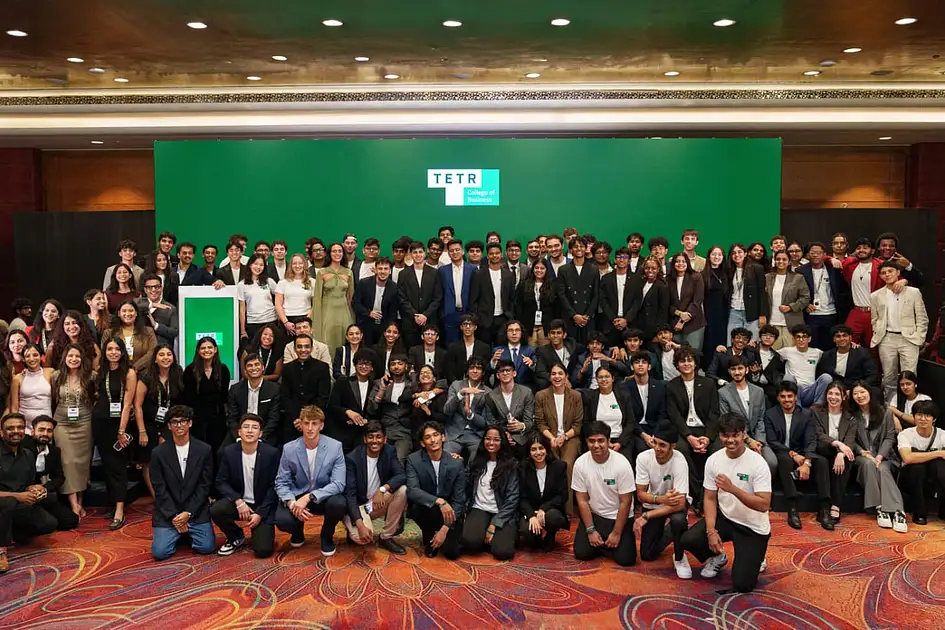
Against this backdrop, Tetr College of Business recently launched its third global cohort, whose latest intake of 300 students from 60 countries has begun a four-year programme spanning India, the UAE, China, Ghana, the US, Argentina and Europe. Dubai will serve as one of the key stops in the students’ international journey.
The Class of 2030 brings together students from fields including entrepreneurship, finance, engineering, artificial intelligence, management, law and science. The cohort has an average SAT score of 1,440 and collectively speaks more than 18 languages.
Several students in the UAE contingent have already been involved in entrepreneurial and social-impact projects. They include Angel Tejas Sanghavi, who raised Dh170,000 through Project Teranga, assistive technology entrepreneur Reyaansh N Dugad, and Shabbir Jethajiwala, who has worked on brand collaborations and technology initiatives.
Industry engagement is central to the model. Students are expected to develop a new business in each market they visit, test their ideas with customers and pitch ventures to investors at the end of each term.
“When we started Tetr College, we wanted to rethink what an undergraduate business education could look like if students were given the opportunity to build instead of only study,” said Pratham Mittal, founder of Tetr College of Business. “They are coming to Tetr College with strong academic foundations, but also with businesses they have started, competitions they have won, audiences they have built and problems they want to solve.”
The college says its first two cohorts have built 59 dropshipping companies generating more than $172,000 in revenue, while student ventures have collectively generated over $1 million in revenue and raised more than $500,000 in funding.
“What makes the Tetr experience different is that students do not just study how businesses work, they experience what it takes to build one,” said Tarun Gangwar, co-founder of the college. “Students have to make decisions, test ideas, respond to real market feedback and work towards tangible outcomes.”
For Dubai, hosting such programmes reinforces its growing role as a global hub where young entrepreneurs, investors and businesses increasingly converge to gain international market exposure.