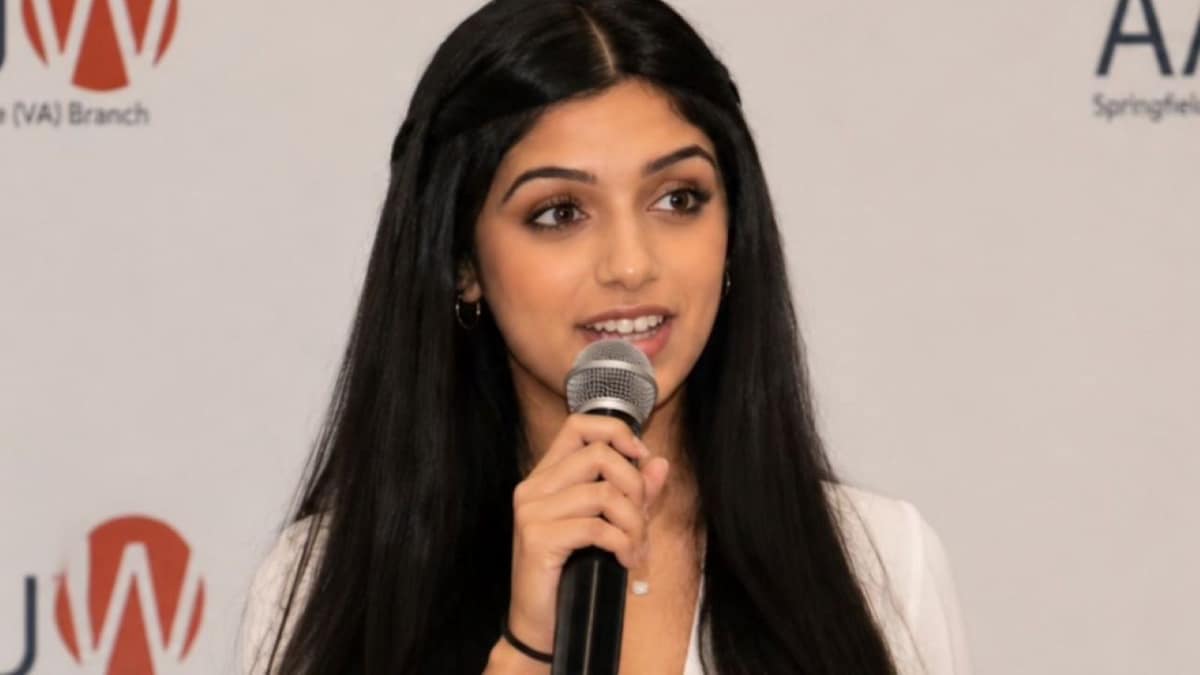
A 17-year-old senior at Thomas Jefferson High School for Science and Technology, Tuteja serves as the president of her school’s AI club, as per Fortune magazine.
Her school had blocked ChatGPT and other generative AI tools. Despite this, her interest in artificial intelligence grew.
Not being able to use AI during the school day forced Tuteja to focus on her problem-solving skills and studies. She still keeps up with the habit now that she is building Raaha.
In a LinkedIn post sharing the Fortune article on Tuteja, her school clarified that the ban on ChatGPT was county-wide and not limited to their institution.
Navya Tuteja’s parents
Tuteja’s mother, Deepti, leads data management oversight for TD Bank in the US. She also sits on the board of a Harvard-affiliated venture capital fund.
Her father, Deepak, works in Sentara Health, a Virginia hospital and insurance network, where he focuses on cybersecurity governance, risk, and compliance.
Tuteja built an AI agent to answer her mother’s text when she does not have time to reply herself.
Why Navya Tuteja built Rahaa
Tuteja’s inspiration for the platform came from her own home. Her mother is hard of hearing.
Over the years, Tuteja had noticed something neurodivergent applicants faced while sending in applications – the job postings were silent on what the day-to-day work actually feels like.
The listings only laid emphasis on the employer’s requirements. This inspired her to create Raaha.
The platform’s quiz examines listings against several factors so that candidates can get a look at how the job is before they send in their application. Tuteja bootstrapped the tool herself and is keeping it free for the time being.
The 17-year-old told Fortune that she wrote Raaha’s underlying algorithm herself. Tuteja uses AI for the more mechanical parts of the platform, mostly for cleaning up the website’s design.
She also uses artificial intelligence to draft emails or easily understand information when she is short on time.
Tuteja does not use AI for schoolwork. “I try to do all my learning myself, especially for stuff I have exams for,” she said.
While Tuteja has included the word ‘AI’ as part of Raaha’s branding, she stated that people have a different view of a product if they find out that artificial intelligence was involved in making it. “They’re going to be like, ‘Oh, you didn’t do it, it was all AI.’ People don’t think you had any thought behind it.”
As of now, she still plans to go to college. But if Raaha keeps growing at its current pace, she may choose to run it full-time
She is also working on Legible, a tool to simplify special-education documents for families.
She has also developed a proposed transparency standard called Traceable Accessibility, which she has pitched to local state senators and even discussed with the Department of Education.