

Ten years, $1.89 billion, and almost no liquidity.
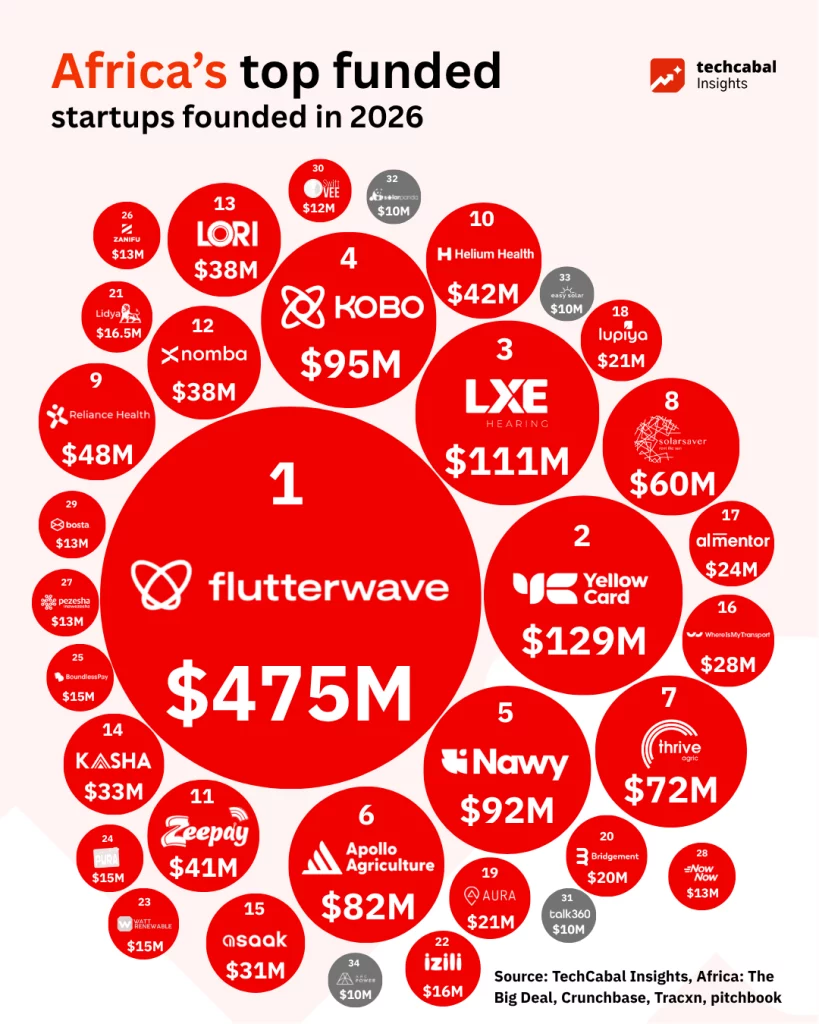
Since its founding in 2016, Flutterwave has raised about $475 million, more than any of the 200-plus African startups founded that year. The 166 smallest companies in its cohort have raised roughly $210 million between them over the same decade.
This disparity in how one payments company from Lagos took in more than twice what two-thirds of its class managed in ten years combined is the story of Africa’s venture capital industry, shown in a year’s intake.
The mid-2010s were a good moment to start a company on the continent. Mobile money was spreading, smartphone prices were falling, and global funds were beginning to treat Africa as an asset class. In 2016, startups were founded across Nigeria, Kenya, South Africa, Egypt, Morocco, Uganda and Ghana, spanning fintech, agritech, e-commerce, cleantech and health.
TechCabal Insights tracked all of them through October 2026.
Venture funds are typically built with a 10-year lifespan, making a decade the industry’s own yardstick. By that timeline, the cohort has had time to do everything a startup can do: scale, sell, stall or stop. Together they raised about $1.89 billion, around 8.6% of the roughly $22 billion that flowed into African startups since 2016, but they produced almost no liquidity.
If you think of fundraising as a metric of success, then this reads like success. If you measure it by African startup exits, it reads like something else.
The concentration
Thirty-four companies account for $1.68 billion of the $1.89 billion. That is 89% of the cohort’s capital going to under a fifth of its members. More than 20 companies raised nothing. The median company raised about $1 million. The average, dragged by the top, was $9.45 million, a figure that describes few companies in the cohort.
Strip out the top 34, and the remaining 166 companies averaged $1.25 million each across ten years.
For most startups, $1.25 million over a decade finances a small team, a product that never gets the engineering it needs to scale, and a founder who spends much of the year raising money. Companies in that band were running a different business from the winners, one where survival was the daily objective and growth was a hope.
Power laws are normal in venture capital. Silicon Valley’s 2016 vintage concentrated too. What matters is what the concentration produces. In a functioning market, the winners exit, capital returns to funds, funds recycle it into the next cohort, and early employees become the next founders. The Class of 2016 generated very little of that.
The money also had a strong view about where problems were worth solving. Fintech took the largest share. Nigeria, Kenya, South Africa and Egypt took almost all of it. A founder in Kampala building for agriculture in 2016 competed for a different pool of capital compared with the one Lagos fintech drew on, and the Kampala pool was nearly empty.
The exits that were not exits
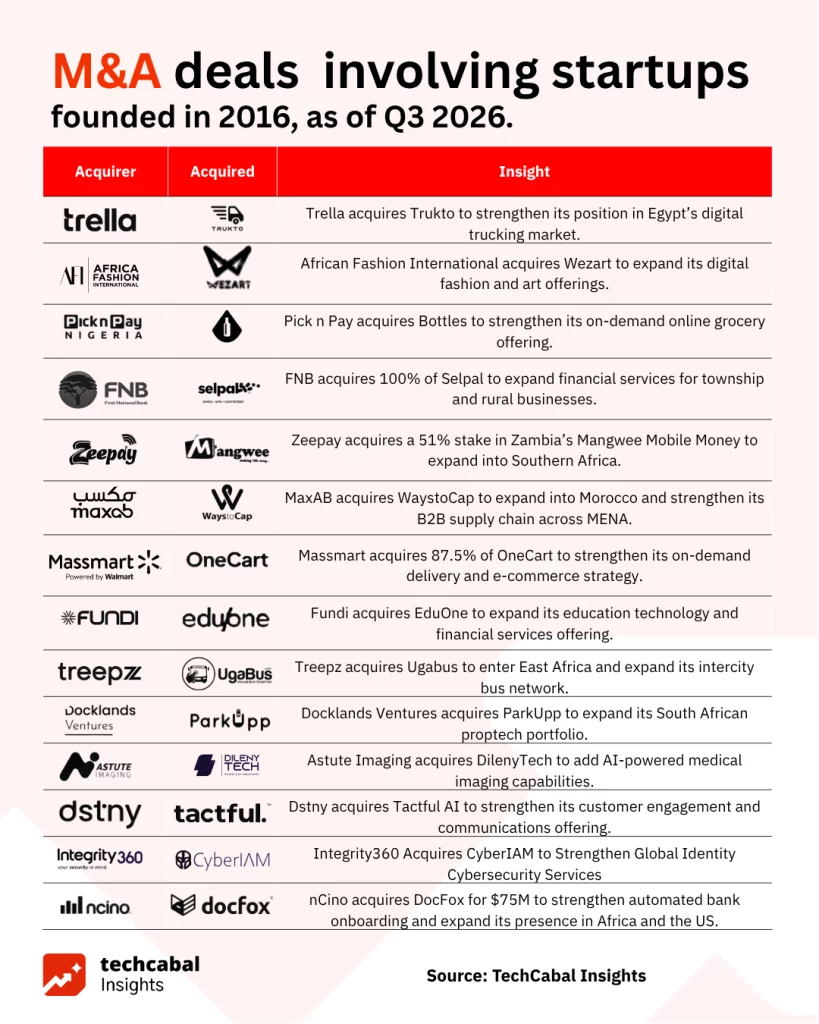
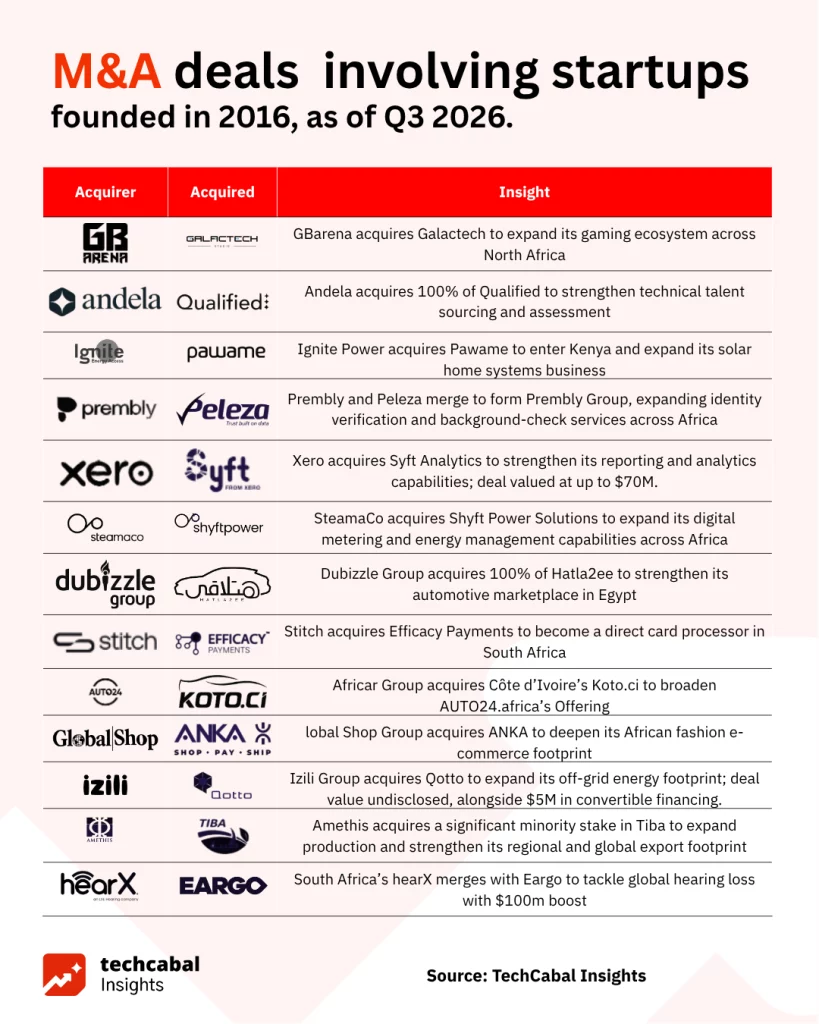
Twenty-seven companies were acquired or merged between 2019 and October 2026. Twenty-one of those deals had undisclosed prices, which is a finding in itself. Sellers publicise good numbers. A decade of silence on 21 transactions is a result.
The disclosed deals reveal a strategy that works for African startups seeking to offer returns to investors.
DocFox, a Johannesburg company selling client-onboarding software to banks, was acquired by the American banking-software firm nCino in March 2024. nCino announced a $75 million price, and its filings record $74.3 million paid in cash.
Syft Analytics, also from Johannesburg and bootstrapped from the start, agreed to sell to accounting platform Xero in September 2024 for up to $70 million, with $40 million upfront. It had reached $4.4 million in revenue from 75,000 customers across 80 countries. The deal closed in October 2025.
Neither company raised anything close to what it sold for. They are, by a distance, the best disclosed returns in the cohort. Neither was a consumer fintech platform. Neither was a household name in Lagos or Nairobi. Both sold software to businesses abroad in hard currency to a foreign strategic buyer. The decade’s two best outcomes came from companies that focused on a global market.
LXE Hearing, formerly HearX, took a different route to the same destination. The South African hearing-technology company raised $111 million over the decade and merged with the American firm Eargo in March 2025. The combined company is headquartered in San Jose and backed by $100 million from Patient Square Capital, an American private-equity firm. A success, and one that left the continent.
The rest of the acquisitions were consolidation. Zeepay, the Ghanaian fintech with operations across more than 10 African countries, acquired Zambia’s Mangwee. Treepz, a Nigerian-based mobility-as-a-service platform, bought Uganda’s Ugabus. These are category leaders buying licences and market share. Deals at that scale do not produce venture-scale returns.
The failures and what they cost
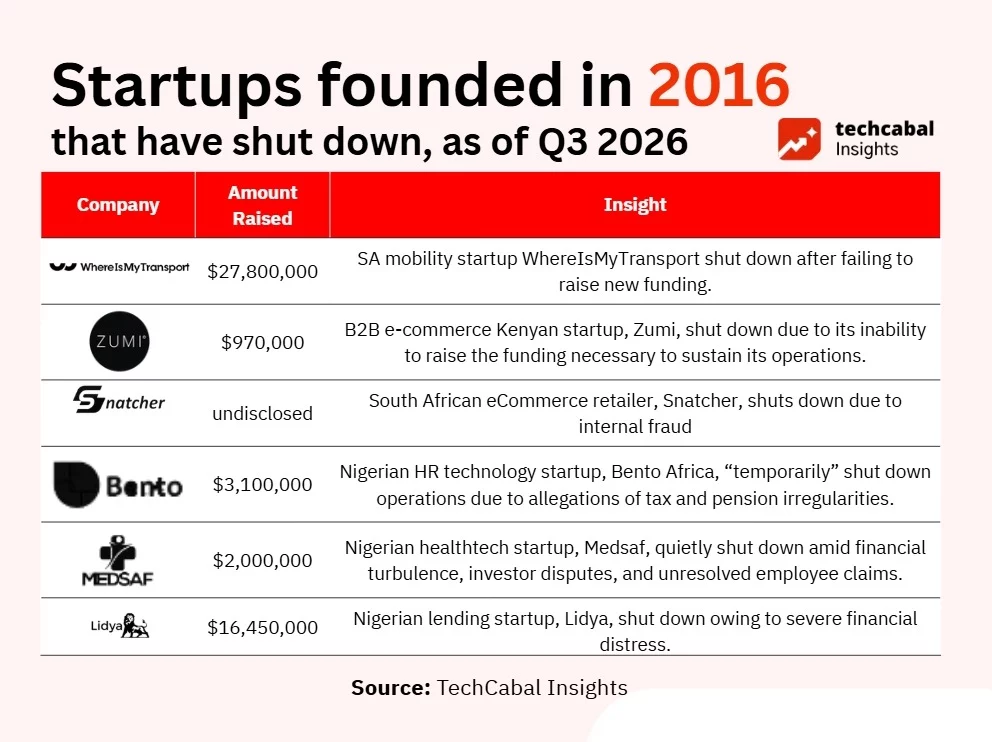
Six companies announced shutdowns publicly. Between them, they had raised about $55 million.
WhereIsMyTransport raised $28 million to map informal transport networks and closed in October 2023 after failing to raise again. Zumi, a Kenyan e-commerce platform, closed in March 2023, raising just under $1 million.
Snatcher, a South African retailer, closed in late 2024 following internal fraud. Bento Africa, a Nigerian payroll startup that raised $3.1 million, temporarily halted its operations in February 2025 after its founder resigned amid allegations of tax and pension irregularities, missed January salaries, and laid off its engineering team. Medsaf, which raised $7 million to digitise Nigeria’s pharmaceutical supply chain, shut down in 2024.
Read together, the causes do not rhyme. One ran out of investors. One ran out of market. One was stolen from. One was governed badly. One could not make the unit economics of physical distribution work. There is no distinctly African failure mode here, only the ordinary range of ways a company dies, compressed into a cohort.
The most instructive story did not end in a shutdown notice. Kobo360 raised more than $79 million in equity and debt, including backing from Juven, a Goldman Sachs spin-off, the International Finance Corporation (IFC) and TLcom Capital, to digitise freight across five African countries. It aggregated more than 50,000 trucks for clients including Unilever, Dangote and DHL.
The model consumed cash. Kobo360 paid transporters immediately and waited 30 to 90 days for large corporates to pay. When a bank partner cut its credit line over unserviced debt, the gap became unbridgeable. In March 2025, its venture backers sold their equity to co-founder Obi Ozor for an undisclosed sum, with the IFC saying publicly that it had not transferred its own stake. Ozor inherited a company owing more than ₦10 billion ($6.5 million) to banks. As of October 2026, Y Combinator lists Kobo360 as inactive. There was no liquidation, no filing and no announcement.
Beneath all of this sits the silent majority. Dozens of companies in the cohort now show no working website, no product, and no news in years. They were never liquidated. They stopped. No filing marks the moment, which is why the true failure rate of any African cohort runs higher than the announced one.
What the decade proved
Most of the cohort still exists in some form, and some of it is quietly profitable. African founders did not fail. The lesson is narrower and harder than that.
Legibility to foreign investors decided who got funded. The companies that raised the most were the ones whose business models a fund in London or San Francisco could invest in without understanding Lagos.
Returns followed a similar rule. The companies that returned the most sold software abroad in dollars.
The companies that took on the hardest local problems—freight, pharmaceutical distribution, transport data—raised the biggest rounds and returned the least.
Venture capital requires liquidity events, and this cohort produced almost none. After ten years and $1.89 billion, the two clearest wins were B2B software companies that raised less than $10 million and sold to foreign acquirers.
Africa’s demographic weight is not in doubt, and demand for technology in logistics, health, agriculture and finance will only grow. The Class of 2016 shows that a decade of venture capital was never going to be the mechanism that met it. The next cohort will need instruments this one lacked: revenue-based finance, local-currency debt, development finance, and patient capital with no ten-year clock.
Business as usual produced 34 winners and 166 companies averaging $1.25 million each. There is no sign it will do better the second time.
Data note: 200-plus startups founded in Africa in 2016, tracked through October 2026 across funding, mergers and acquisitions, and operating status. Compiled from the TechCabal Insights database alongside Africa: The Big Deal, Crunchbase, Tracxn, PitchBook and Briter, which do not always agree on founding year. Funding totals include disclosed equity, debt and grants. Rounds with undisclosed amounts are excluded, so the real total is higher than the figure reported here. 21 of the 27 acquisitions had undisclosed values.
True scale demands moving beyond surface-level integrations to robust execution. We’ve filtered the noise out of Moonshot 2026, optimising the conference strictly for high-calibre connections between startup founders, global financial operators, enterprise leaders and individuals rewiring Africa’s technical frameworks. Get 20% off Early Bird tickets for a limited time.
Source link