
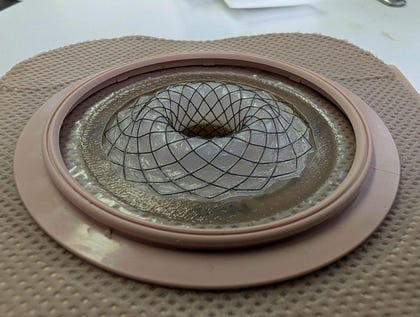

An Israeli medical technology company founded by a Toronto surgeon has raised $5 million to develop a device that could allow doctors to create an opening in a patient’s abdomen to drain the bowel without conventional surgery or general anesthesia, the company said Thursday.
Phantom GI, founded in Tel Aviv in 2025 by Dr. Eran Shlomovitz, Dr. Eliyahu Bechor and CEO Ido Sadan, said the seed round was led by Pitango HealthTech, with participation from RAD BioMed and RUNI Ventures. The company’s device is designed to create a stoma through a single puncture in the skin under X-ray guidance.
About three years ago, Dr. Eran Shlomovitz treated a cancer patient in serious condition who was suffering from a bowel obstruction. The patient was supposed to undergo an ostomy – a surgery designed to create an opening in the abdominal wall that allows intestinal waste to drain, also known as a stoma – but her condition was too severe for her to undergo the operation.
Shlomovitz, a general surgeon at the University Health Network in Toronto and an associate professor at the University of Toronto, obtained the patient’s consent to try an experimental approach: using existing medical equipment off-label to drain the bowel through a minimally invasive procedure under local anesthesia. The procedure was successful.
The patient was able to eat and function again, and many more patients were referred to Shlomovitz for the same procedure.
The device, which is undergoing a patent application process, is designed to enable the creation of a stoma without conventional surgery or general anesthesia, using a single puncture through the skin under X-ray fluoroscopic guidance.
In 2024, Dr. Eli Bechor, a senior surgeon at Beilinson Hospital in central Israel, trained under Shlomovitz in Toronto. The two then began developing Shlomovitz’s technique and, after several attempts, concluded that new technology would be needed to deliver optimal treatment.
A mutual acquaintance introduced them to CEO Ido Sadan, an engineer by training who works in medical devices, and the three joined forces.
According to estimates, in the United States alone, about 50,000 patients each year suffer from malignant bowel obstructions and are not suitable candidates for conventional surgery because of their complex medical conditions. Another significant target group is cancer patients with abdominal tumors who undergo surgical removal.
“Today, when a tumor is removed from the bowel and the ends are reconnected, there is always a risk of a life-threatening leak at the connection site,” Sadan explains.
Sadan said that in previous treatments, patients required additional surgery under anesthesia to close the stoma and restore the intestine. Their device, he said, is designed to eliminate the need for that second surgery.
According to Sadan, the device “inserts a supporting tube, or stent, through the skin to drain the bowel without having to bring the intestine outside the body or perform another operation. Once the intestinal tissue heals, the stent can be removed through a simple outpatient procedure.”
Asked whether the new technology could help Crohn’s disease patients, Sadan said Crohn patients have much to gain from the treatment, but some are reluctant to have a stoma created because they fear they may be left with it for the rest of their lives after surgery.
Phantom GI is currently in the preclinical stage. The startup expects to begin a clinical study in Canada in early 2027, followed by a larger trial whose results will form the basis of its application for FDA approval.
“The Phantom GI team is challenging a surgical paradigm that has remained almost unchanged for decades. The shift to a percutaneous approach – through the skin – could significantly reduce the complexity of treatment and expand access to patients who currently have no suitable treatment options,” says Dr. Yonatan Glazer, a partner at Pitango HealthTech.
Phantom GI has presented long-term preclinical evidence and advanced a broad patent portfolio to the international Patent Cooperation Treaty stage.
Source link