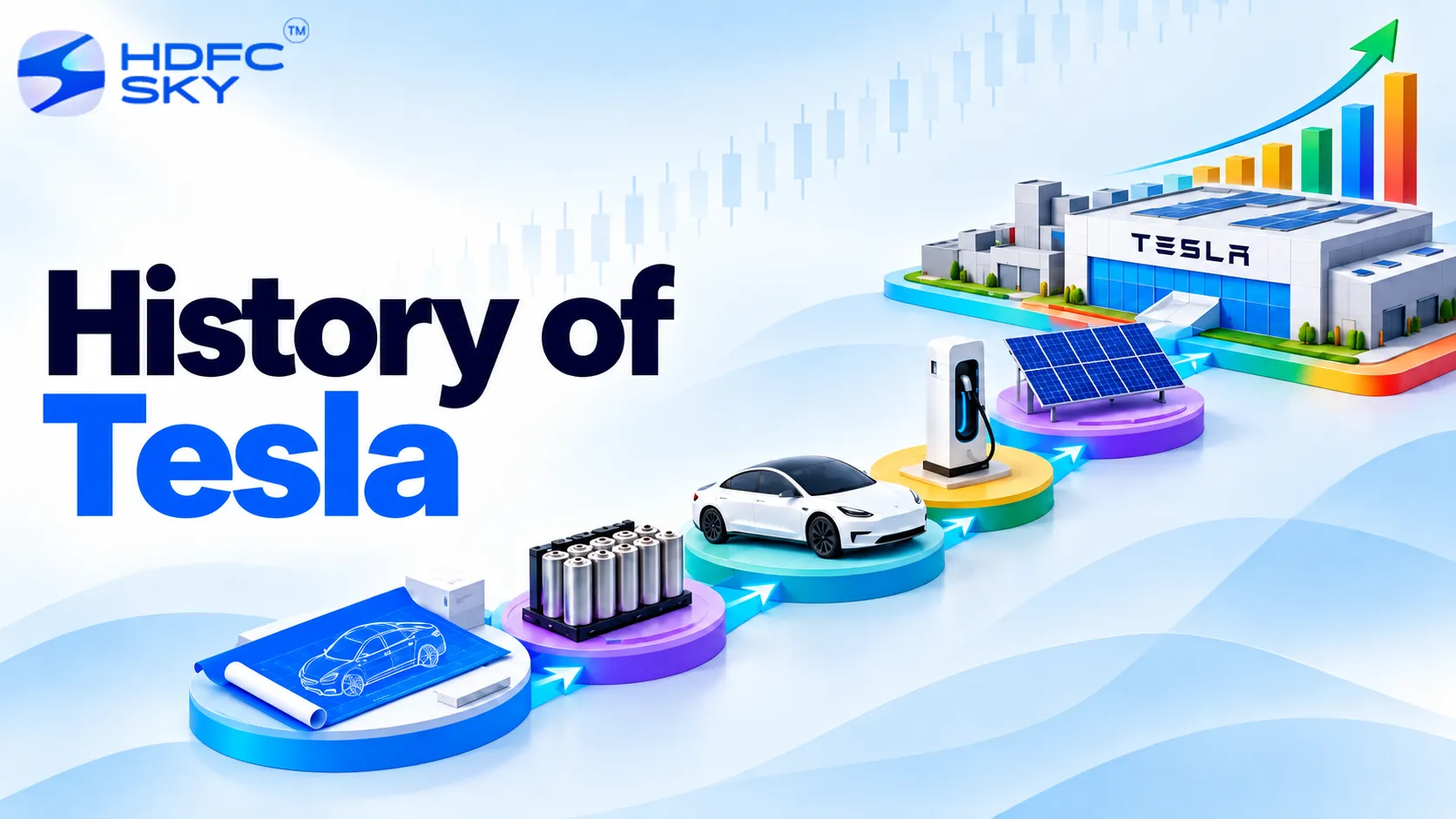
Tesla began as an electric vehicle startup in 2003 and grew into a company valued at more than $1 trillion. Its history includes ambitious product launches, difficult manufacturing periods, international expansion, and a shift towards energy storage and artificial intelligence. Elon Musk became central to its growth after investing in 2004, but the company’s story also reflects the work of its founders, engineers, factory teams, and suppliers in global markets.

2003–2005: The Founding of Tesla and Musk’s Entry
Martin Eberhard and Marc Tarpenning founded Tesla Motors in California in July 2003 to develop electric cars combining environmental benefits with sports car performance. Their experience with lithium-ion batteries helped shape the company’s vision.
In 2004, Elon Musk invested $6.5 million in Tesla’s $7.5 million Series A funding round, becoming chairman and its largest shareholder. The investment provided essential capital to support Tesla’s early development.
2006–2008: The Roadster Challenges Expectations
Tesla unveiled its Roadster prototype in 2006, demonstrating that electric cars could offer impressive acceleration and driving performance. Developed with a chassis from Lotus, the vehicle used lithium-ion battery technology.
Production began in 2008. The original Roadster offered a claimed range of approximately 245 miles and accelerated from zero to 60 miles per hour in under four seconds. However, its price exceeded $100,000, limiting its customer base. Production delays and high costs created additional challenges, and Musk became chief executive in 2008.
2009–2012: Funding, IPO, and the Model S
Tesla secured a $465 million US Department of Energy loan in 2009 to support its manufacturing and technology development. It repaid the loan, with interest, in 2013.
In 2010, Tesla purchased a former automobile manufacturing plant in Fremont, California, and went public, raising approximately $226 million. Its Model S sedan launched in 2012, attracting customers seeking a practical luxury electric car. Tesla also introduced Supercharger stations to improve charging access and support longer journeys.
These developments helped the company expand beyond expensive sports cars and establish a stronger position in the electric-vehicle market.
Also Read: How to Invest in Apple Stock from India
2013–2015: Software, SUVs, and Energy Storage
Tesla reported its first quarterly profit in 2013, marking progress towards financial sustainability. In 2014, it introduced Autopilot, a driver-assistance system designed to support certain driving tasks. Drivers must nevertheless remain attentive because the system does not make vehicles fully autonomous.
In 2015, Tesla launched the Model X, an electric SUV featuring additional passenger space and distinctive falcon-wing doors. It also expanded into energy storage through Powerwall for homes and Powerpack for larger installations. These products diversified its business beyond vehicle manufacturing.
2016–2018: The Model 3 Production Crisis
Tesla unveiled the Model 3 in 2016, targeting a broader customer base with a more affordable electric car. It received more than 325,000 paid reservations within a week, creating substantial pressure to increase production.
The company invested heavily in factory automation, but excessive reliance on robots contributed to manufacturing bottlenecks and delivery delays. Musk described this period as “production hell.” Tesla subsequently adjusted its processes, increasing Model 3 production significantly by late 2018.
In 2016, Tesla acquired SolarCity through an all-stock transaction valued at approximately $2.6 billion. In 2017, it changed its name from Tesla Motors to Tesla, Inc., reflecting its broader ambitions in transportation and energy.
2019–2020: International Expansion and Profitability
Tesla introduced the Model Y crossover in March 2019, combining passenger comfort with additional cargo space. Its Shanghai factory began Model 3 production that year, strengthening its presence in China and reducing dependence on exports from the United States.
Tesla recorded four consecutive profitable quarters from July 2019 through June 2020, qualifying for inclusion in the S&P 500, which it joined in December 2020.
Its shares surged during 2020, making it the world’s most valuable automaker by market capitalisation. A five-for-one stock split reduced the price per share without changing the company’s overall market value.
2021: Tesla Reaches a $1 Trillion Valuation
Tesla’s market capitalisation exceeded $1 trillion in October 2021, supported by investor optimism about electric vehicle adoption and future growth. A substantial vehicle order from rental company Hertz further strengthened market enthusiasm.
However, market capitalisation reflects the market value of outstanding shares, not cash reserves or profitability. While investors saw potential in Tesla’s vehicles, software, batteries, and energy products, critics questioned whether its valuation adequately reflected competition and financial risks.
Tesla also purchased $1.5 billion worth of Bitcoin in 2021 and briefly accepted it for vehicle purchases before suspending payments over environmental concerns related to cryptocurrency mining.
2022: Growth Meets Economic Pressure
Tesla expanded manufacturing as its Berlin and Texas factories began production in 2022. It also moved its headquarters from California to Austin, Texas.
However, supply-chain disruptions, rising material costs, and Shanghai lockdowns affected production. Tesla increased vehicle prices to address higher expenses, while its shares declined during a broader market downturn.
Musk’s acquisition of Twitter, later renamed X, also raised concerns among some Tesla shareholders about his divided attention. The year highlighted the challenges of managing expansion, operating costs, and leadership responsibilities simultaneously.
2023: Cybertruck and Intensifying Competition
Tesla began delivering the Cybertruck in November 2023. Its angular design and stainless steel body distinguished it from conventional pickups, although manufacturing complexity presented challenges.
Tesla reduced prices on several models to attract buyers and respond to competition. However, lower prices can reduce profit margins when production costs remain high.
Competition from Chinese automaker BYD intensified, particularly in China. Meanwhile, Tesla’s North American Charging Standard gained wider industry acceptance, creating opportunities to expand charging-network usage and revenue.
2024: Cost Cuts, Legal Disputes, and Robotaxi Plans
Tesla faced slower demand and stronger competition in 2024. In April, it announced plans to reduce its global workforce by more than 10% to lower costs and improve efficiency.
Its driver-assistance systems also faced regulatory scrutiny over safety measures and driver behaviour. Separately, a Delaware court rescinded Musk’s 2018 compensation package, valued at approximately $56 billion at the time of the ruling, citing concerns about its approval process. Tesla subsequently pursued renewed shareholder approval and changed its state of incorporation to Texas.
In October, Tesla presented its Cybercab and Robovan concepts, highlighting its ambitions in autonomous transportation. Their commercial success would depend on technological development, regulatory approval, and customer demand.
2025: India Entry and Slower Deliveries
Tesla opened its first Indian showroom in Mumbai in July 2025, initially offering the Model Y. India provided access to a large vehicle market, but import duties, pricing, and established competitors posed challenges.
Tesla also introduced Grok, the AI chatbot developed by Musk’s xAI, to vehicles through a software update. The feature expanded in-car technology but did not give the chatbot control over vehicle functions.
Meanwhile, Tesla continued investing in autonomous driving, robotaxis, and robotics. However, these businesses still face technical, regulatory, and commercial challenges.
Tesla delivered approximately 1.64 million vehicles in 2025, compared with roughly 1.79 million in 2024. BYD also surpassed Tesla in annual battery-electric vehicle sales, highlighting intensifying global competition.
2026: Evaluating Tesla’s Growth and Financial Performance
Tesla’s development spans electric vehicles, energy storage, software, and autonomous-transport ambitions. Its valuation reflects investor expectations for these businesses, not vehicle sales alone.
Tesla reported approximately $94.8 billion in revenue for 2025, compared with $97.7 billion in 2024. Net income attributable to common shareholders declined to approximately $3.8 billion from $7.1 billion.
These figures highlight the distinction between market valuation and financial performance. Revenue measures sales, while net income reflects earnings after expenses and other recognised costs. Share prices, meanwhile, also respond to expectations about future growth.
Tesla’s long-term performance will depend on controlling costs, maintaining competitive products, expanding demand, and converting investments in emerging technologies into sustainable revenue and profits.
Conclusion
Tesla’s rise came through product innovation, investment, manufacturing growth, and a willingness to enter new markets. Musk shaped its expansion, but founders, employees, and suppliers also contributed. Its next chapter will depend on competitive products, disciplined execution, and evidence that newer technologies can deliver reliable services and lasting financial results.
Investors who find Tesla’s global growth story compelling can also choose to invest in the company’s stock through HDFC SKY’s global investing feature, which provides access to international markets in a simple, seamless way.