

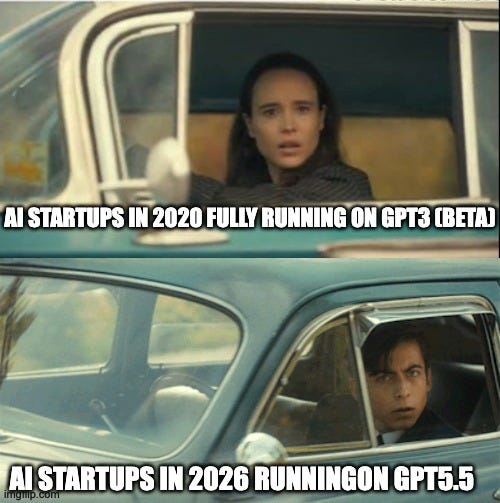
Yesterday, I opened Codex and asked it to rebuild a product I had spent months building in 2020.
Back in the day our idea would be considered edge tech – state of the art speech to text, realtime insights, unsupervised data extraction thanks to GPT3 and more.
Thanks for reading Eugenefinch’s Substack! Subscribe for free to receive new posts and support my work.
Subscribe
I have been fortunate to get involved in AI space since 2016, building products across very different eras of AI, and looking back, the challenges were never quite what I expected.
When AI Was Mostly Manual Work
My first experience building an AI company was around 2018 in Vietnam.
At the time, my team was focused on conversational AI for enterprises. We built chatbots for large organizations and eventually worked with companies including OPPO.
Today’s AI products make it easy to forget how much work was required back then.
There were no large language models capable of understanding context, reasoning through problems, or generating useful responses out of the box. Every deployment required extensive preparation. We trained intent classifiers and built entity recognition systems.
We literally had to hire an intern just to work on data labeling. Prep work would take months just to gather clients data and train.
The bottleneck to entry was high too. My previous team included three PhDs, yet even with that level of expertise, progress was slow.
At the time, this was simply how AI products were built.
The Change from Models to products
In 2020, I joined Antler in Singapore (SG4 cohort) and started building Dirac, a conversation intelligence platform for sales teams (competitors Chorus and Gong)
The inspiration came from my own experience trying to do b2b sales and failing to close miserably, so I needed a tool for myself to understand what went wrong with my sales calls and what I could improve to close more.
Dirac was designed to solve that problem. Here’s my old pitch deck for reference.
The idea was straightforward: record sales conversations, extract insights, and assess salespeople against different frameworks such as BANT and others.
What surprised me was that the hardest part was not the intelligence itself.
Most of our effort went into infrastructure. Connecting to meeting platforms, handling recordings, maintaining integrations, and adapting to changes introduced by third-party providers consumed a remarkable amount of time. Product development often felt less like building intelligence and more like maintaining a complex network of dependencies.
Around the same time, large language models began changing what was possible.
When GPT-3 arrived, many tasks that previously required custom machine learning pipelines could suddenly be solved through prompting. For the first time, extracting useful insights from conversations became dramatically easier than collecting the conversations themselves.
Rebuilding the same Idea in 2026
Yesterday, I made a decision to review my old startup ideas. So I opened Codex and started experimenting.
Within hours, I had the product that would have required a significantly greater effort only a few years ago. Instead of relying on meeting bots and fragile integrations, the concept evolved into a desktop application with direct access to system-level capabilities. (similar to the Granola app)
What once required a team, months of development, and countless technical decisions can now be prototyped by a single person in a fraction of the time.
What Hasn’t Changed
Whenever people discuss AI, the conversation often focuses on what it can do.
My experience has led me to focus on something different.
The tech keeps changing, but underlying challenges remain consistent.
- Customers still need real problems solved.
- Distribution matters.
- Understanding users matters.
In 2018, the challenge was building capable AI systems.
In 2020, the challenge was turning those systems into usable products.
In 2026, building software is easier than ever, but deciding ‘what” and “why” remains just as difficult
Looking back, I’m less impressed by how much easier it has become to write code and more impressed by how quickly our assumptions about what is difficult can become outdated.
Source link