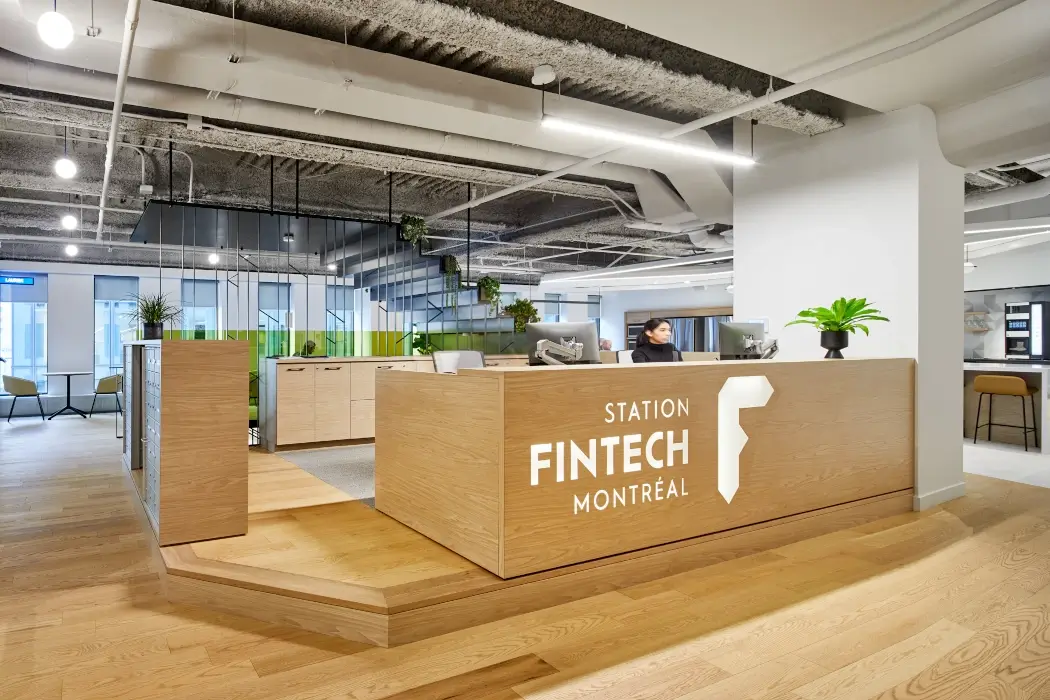



Station FinTech Montréal tracks the rise of agentic commerce and the forces reshaping fintech in Québec.
Artificial intelligence is moving deeper into the systems that power financial services, putting pressure on the industry to confront questions about standards, interoperability, and capital.
Surinderjit Kaur Bhatti,
“The real breakthrough in agentic commerce is not that AI can make decisions, but that ecosystems are being built to let those decisions translate into trusted transactions.”
Fathom4sight
Those findings come from a new report released by innovation hub Station FinTech Montréal and Toronto-based Fathom4sight at the 2026 Canada FinTech Forum this week. Now in its fourth year, the report tracks the evolution of Québec’s financial technology ecosystem, including investment activity, sector employment, and vertical trends.
This year’s report zeroed in on one of the sector’s fastest-moving fronts, agentic commerce, which is drawing global firms into a race to write the rules of a new market. It also looked closer to home at the financing and commercialization challenges that could determine how much of Québec’s AI strength can translate into successful products and companies.
Here are three trends from the 2026 Québec FinTech Report that are worth watching.
Agentic commerce creates a new rules race
One of the clearest trends highlighted in this year’s Québec FinTech Report is the emergence of payments infrastructure and protocols designed specifically for AI agents. The report pointed to a new payments stack that is being assembled at several layers simultaneously, without a settled architecture for merchants to plug into.
Agentic commerce refers to transactions in which an AI system can carry out purchases on behalf of a consumer, all the way from product discovery to payment. Making this vision of commerce a functioning market requires a new rulebook for how agents connect to merchants, prove who they are, and move money securely.
Some of the world’s largest payments infrastructure companies have already started building those layers. In April of 2025, Mastercard launched Agent Pay, its own framework for agentic commerce that uses network tokens and biometric authentication. One day later, Visa unveiled its Intelligent Commerce initiative, which also includes tokenization and personalization features.
Agent Pay and Intelligent Commerce primarily address the payment and trust infrastructure needed to authorize agent-led transactions. A separate wave of initiatives is trying to standardize different parts of how agents interact, establish authority, and transact across the commerce ecosystem.
In September of 2025, Google published its Agent Payments Protocol; one month later, Visa launched a Trusted Agent Protocol with Montréal-founded Nuvei among the organizations supporting it. The report also highlighted the Agentic Commerce Protocol launched by OpenAI and Stripe, Google and Shopify’s Universal Commerce Protocol, and x402, a cryptocurrency-based payments protocol built around instant on-chain transactions.
These new protocols span several distinct functions, including checkout orchestration, which coordinates the purchase; delegated payment authority, which allows an agent to transact; agent identity, which verifies what is initiating the transaction; and finally, settlement, which refers to the transfer of funds. With different protocols addressing different and sometimes overlapping parts of the stack, merchants are left deciding which standards they should support, according to the report.
“The sequence shows a market that standardized before it settled,” the report said.
The growing protocol landscape is now pushing the industry toward making all of these standards work together across the commerce ecosystem.
The next hurdle for merchants is interoperability
How do merchants and financial institutions support different approaches to agentic commerce without needing to build separate infrastructure for each one? The 2026 Québec FinTech Report suggests the shift toward standards coordination is already underway.
In April of 2026, Google donated its Agent Payments Protocol to the FIDO Alliance, a neutral standards body, to ensure its protocol remained platform-agnostic. Visa’s Intelligent Commerce Connect was also launched as a single-merchant integration designed to help businesses accept agentic payments across multiple card networks.
“The real breakthrough in agentic commerce is not that AI can make decisions, but that ecosystems are being built to let those decisions translate into trusted transactions,” said Surinderjit Kaur Bhatti, CEO and Founder of Fathom4sight. “The organizations that embrace interoperability today will be best positioned for tomorrow’s autonomous economy.”
The technical pieces may be falling into place, but the business case for agentic commerce is still being tested. In March, OpenAI shut down Instant Checkout, a feature that allowed ChatGPT users to purchase products directly inside the chat interface. The firm cited inaccurate pricing and inventory data, and repositioned ChatGPT around product discovery. The report suggests this is evidence that the commercial model for agentic commerce remains largely unproven.
Interoperability may help solve some of the technical friction around agentic commerce, but adoption will still depend on whether companies have the resources to build and deploy these capabilities. In ecosystems like Québec, that brings the conversation back to dollars and cents.
Capital is the dividing line for Québec
Québec’s FinTech ecosystem has continued to expand over the past five years. According to the report, the province is now home to 296 FinTech companies, up from 294 last year. Thirty of those companies are categorized in the AI and data sector, while the report found that AI is being used in the operations or offerings of a majority of Québec FinTech companies across sectors.
FinTech companies in the province also sit alongside major financial institutions and a globally renowned AI research ecosystem. According to the 2026 Québec FinTech Report, however, Québec’s ability to participate in the next phase of AI-enabled financial services depends partly on who can afford it.
Financing for Québec FinTech companies rebounded in 2026, with companies collectively raising $615 million in 2026, up significantly from $161 million in 2025 and on par with investment in 2022. However, the report identified a gap between organizations that are experimenting with AI and those investing enough capital to build mature capabilities.
Among organizations spending more than $100,000 USD ($138,000 CAD) annually on AI, 62 percent had reached an advanced stage of AI maturity. The same share reported higher profitability from AI, compared to 39 percent of organizations spending below that threshold. Those findings do not establish causation, but suggest organizations making larger AI investments are also more likely to report advanced capabilities and stronger business outcomes.
The report noted that many smaller businesses understand the potential business case for AI, but lack the capital needed to accelerate their plans. In response, development banks are now pairing financing with advisory support, while established institutions are taking a larger role as capital providers.
“AI investment is entering a new phase,” said Samy Bjaiji, Director of Technological Innovation at Finance Montréal. “What was once driven primarily by venture capital is increasingly being shaped by financial institutions, development banks, and corporate balance sheets. This shift signals that AI is no longer an emerging technology trend. It is becoming a strategic economic priority.”
The AI commercialization gap also remains significant, and commercialization is, in part, a capital problem. Data from Mila and Inovia Capital estimate that Canada produces roughly 10 percent of the world’s top AI research talent, while attracting less than two percent of global AI venture capital. Turning research strength into lasting companies requires sustained investment well beyond the early stages.
The 2026 Québec FinTech Report suggests that established financial institutions, development banks, and holding companies may play a larger role in that next phase. Their involvement could determine how much of the province’s strength stays concentrated in research, and how much makes its way into the market.
PRESENTED BY
Want the full picture? Download the 2026 Québec FinTech Report to explore the latest data on AI adoption, investment activity, talent, and emerging opportunities across Québec’s FinTech ecosystem.
Featured image courtesy Station FinTech Montréal.
Source link


