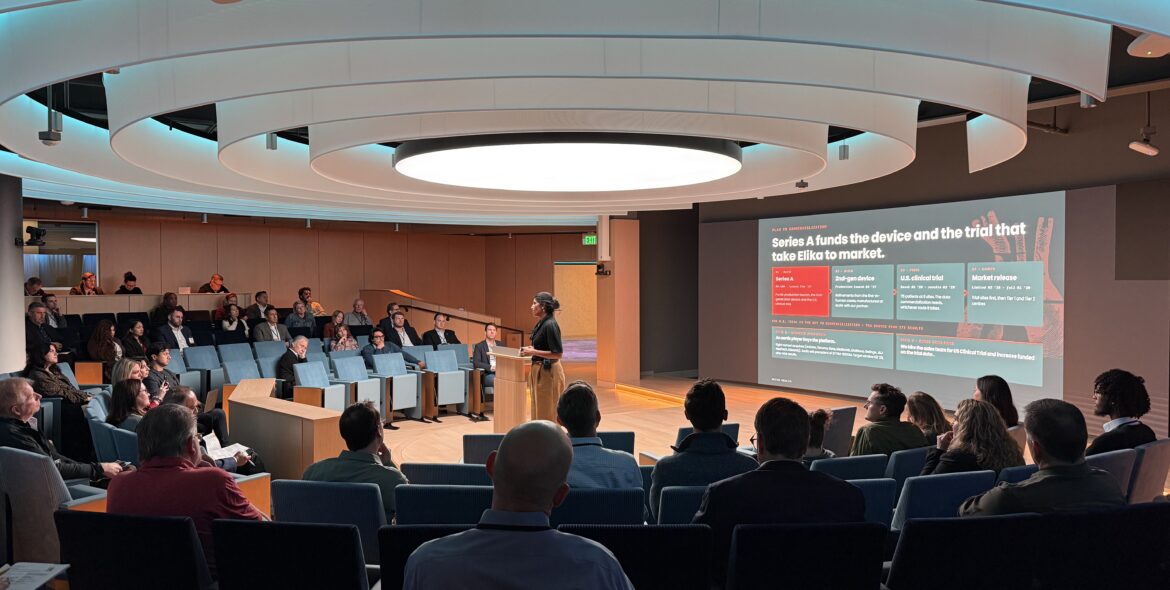
On Thursday, some of the states most innovative med tech startups hit the stage at CliftonLarsonAllen in Eagan to compete in the Medical Alley Innovation Showcase, a competition that provide a venue for emerging startups to share their story and make new connections.
A familiar name took home the top prize. Octin Health, fresh off winning the state’s premier startup competition, the Minnesota Cup, back in September, won an all-expenses paid trip to Sydney, Australia next spring to compete for another major cash and service grand prize at an unnamed pitch competition.
Octin, which was founded by Mayo Clinic-trained surgeon Meghana Helder, is planning to submit FDA clearance in February for its Elika device used in aortic surgery. Helder began discussing her startup idea back in 2023 with other surgeons and received the feedback that ultimately helped convince her to launch the company the following year.
At Medical Alley’s event, five health and life science startups had eight minutes to pitch to investors and entrepreneurs. Medical Alley connects startup companies with venture capital, scaling, and operational support, alongside networking events. While Octin won the event, all participants received valuable time making their pitches to the assembled group.
Here is what you need to know about the emerging businesses that appeared as finalists at the event.
Winner: Octin Health
Octin’s Elika device is designed to allow surgeons to maintain blood flow to the brain and body during aortic arch surgery, potentially eliminating the need for a dangerous procedure known as deep hypothermic circulatory arrest that stops all blood flow in the body.
The device pairs with the bypass machine to flow over while integrated balloons block the entry, giving a clear surgical field and enabling a normal body temperature and blood flow during repair.
Aortic surgery is among the most complex and high-risk procedures in cardiac surgery. Helder says that national data shows an operative mortality rate of about 9%.
The company plans to submit Elika to the U.S. Food and Drug Administration for clearance early next year. It had its first clinical use in August, a month before it won the Minnesota Cup.
Octin raised $4.7 million in its seed round, and plans to launch a Series A round in February to raise $8-$10 million. Helder says those funds will allow Octin to create its second-generation device.
Runner-up: Anser Implants
Founded by Paul Hoogervorst, a surgeon and University of Minnesota assistant professor, Anser Implants is working towards improving surgical outcomes for collarbone fractures.
Traditionally, doctors treat these fractures with slings or plates. But these leave scars and bumps in the patient’s skin. The Anser Clavicle Pin restores alignment of a person’s collarbone through three components—a pin, a lateral fixation device, and endcap—while leaving no noticeable bumps.
RELATED: Startup Snapshot: Fasikl
Hoogervorst says that in their solution, “surgeons use small instruments to add a one-size-fits-all [pin].” Plus, surgeons do not have to remove the pin once the fracture has been fixed.
So far, Anser has cleared FDA approval and has already treated nearly 300 patients. It has existing contracts with military hospitals and is now looking toward commercialization and raising a seed round.
Runner-up: Ew2health
Nearly 72% of adults in the U.S. are overweight, according to Ew2health co-founder, Saskia Korink Romani.

To help achieve weight loss, many people seek out GLP-1s, but 65% stop the drug within the first year. Then, the weight that they lost often returns.
Romani’s startup operates as a behavioral intelligence platform that can predict weight-loss trajectories, enabling care teams to intervene before patients disengage.
Right now, most of its customers are in Brazil. However, the U.S. government has approved a patent that will apply to the U.S. market. The startup is aiming to receive FDA clearance by 2028.
Runner-up: SentryDx
SentryDx founder Matt Nelson wants to selectively amplify cancer DNA to increase accuracy of testing and reduce the cost for health systems.
In other words, Roseville-based SentryDx invented an “off-off switch,” which is placed on a DNA strand, to target specific cancer hotspots, while selectively amplifying rare, mutated circulating tumor DNA from a simple blood draw.
The company is raising a $2 million seed round to bolster its research and development to create new detection kits. The government has issued the startup a patent.
Runner-up: Optimal Mobility
Before retired U.S. Army colonel Patricia McCracken founded the Minnetonka-based startup in 2024, she noticed an unmet need for the 1.5 million wheelchair users in the country: they need daily standing time to maintain a healthy lifestyle.
However, today’s “standers” require transfers and caregivers. That’s why Optimal Mobility created a rolling, standing wheelchair. Its Ascendus chair lets users—primarily kids—rise with power assist and keep rolling while upright. The chair has the ability to fold up and fit in your trunk.
Optimal Mobility wants to provide its chairs to Twin Cities metro schools. It named Hopkins, Minnetonka, and St. Paul as options on Thursday.
The startup has received two issued U.S. patents and has three more pending. Pending completion of its pre-seed round, the company is targeting 2027 for receiving FDA clearance for the Ascendus chair.