Knit Health announced on November 16, 2026 that it had raised a $35 million Series A led by NEA to expand its scientific and engineering teams and deploy its Med-BEAM healthcare world model in more clinical settings. Frist Cressey Ventures, Town Hall Ventures and SignalFire also participated, alongside continued support from Uncork, Moxxie, the Aligned Fund and Coalition Operators.
Knit describes Med-BEAM as a healthcare world model trained on billions of healthcare decisions across hundreds of millions of patient records, learning how conditions evolve, what clinicians do and what follows different interventions. The initial applications are patient navigation, specialist routing, scheduling and hospital operations, with the model intended to supply clinical context alongside language models that serve as interfaces for patients, clinicians and AI agents.
Referral Coordination and a Shared Platform
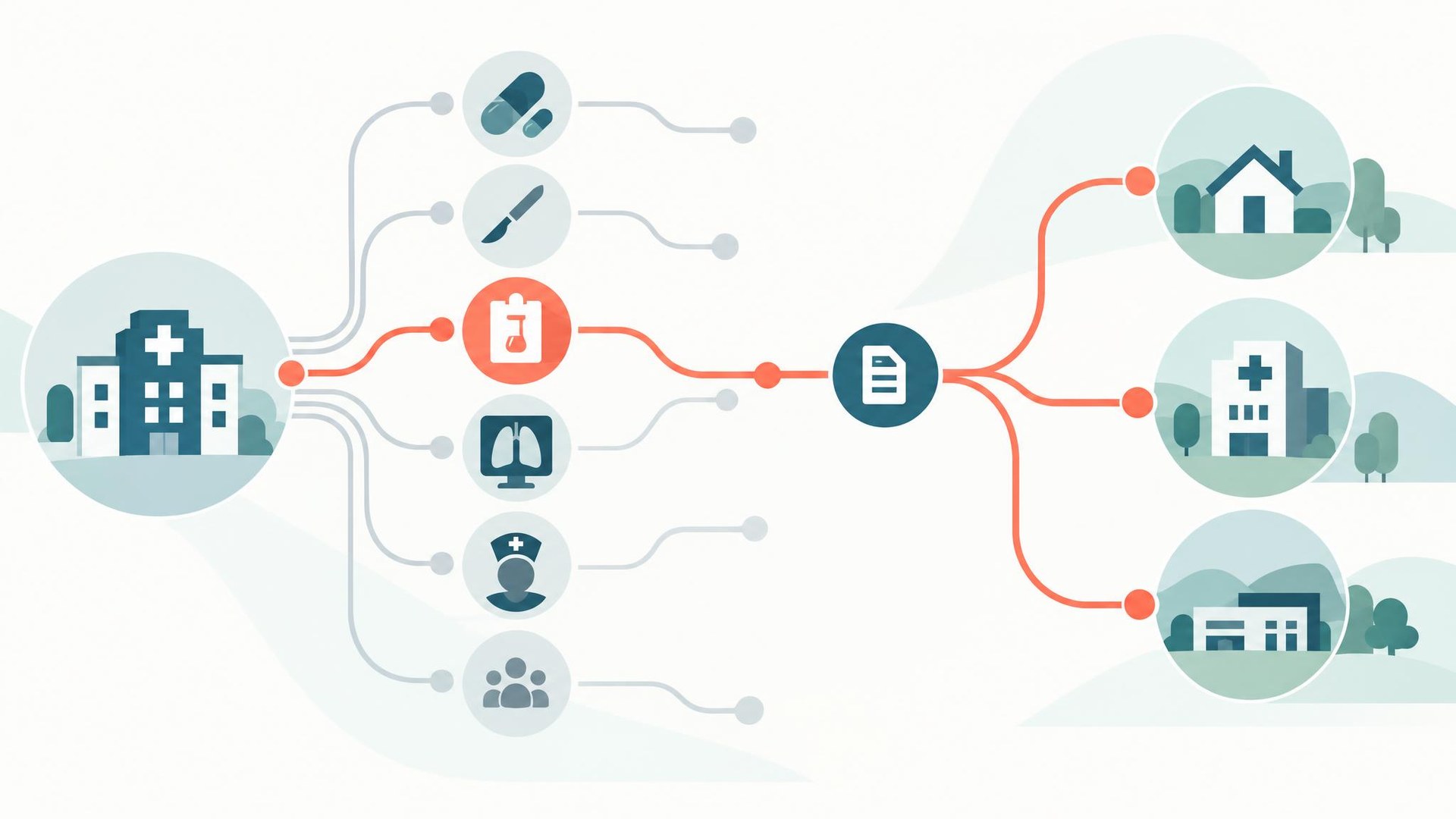
Knit is targeting the mechanisms that connect patients with existing care: referrals depend heavily on professional relationships, scheduling on rigid rules and appointment availability, and clinical pathways on simplified categories and scores. The company argues that these mechanisms can leave patients waiting for suitable care while clinicians spend time on work others could do more effectively. Its example is a surgeon whose clinic is filled with patients who do not need surgery while patients who could benefit from an operation wait weeks or months.
Knit plans to provide a shared clinical-intelligence foundation rather than own every application or workflow. Health systems, technology companies and developers could build on that foundation instead of independently developing the underlying intelligence, giving Knit a platform role beyond its initial navigation and operations products.
Early Benchmark Results and Their Limits
Separate benchmark documentation published November 16, 2026 tested Med-BEAM against Anthropic’s Claude Opus 4.8, Claude Sonnet 5 and Claude Haiku 4.5. The task used records for 200 patients admitted to the hospital from the emergency department, none of which had been used to train Med-BEAM.
Given each patient’s history through admission and a full list of possible actions, the models predicted what would happen over the next 24 hours across medications, procedures, laboratory orders, imaging, nursing actions and referrals. No particular outcome was selected in advance.
Knit reported an average precision of 0.565 for Med-BEAM, using a 0-to-1 measure of how well each model ranked the care that actually occurred. Opus 4.8 scored 0.228, Sonnet 5 scored 0.222 and Haiku 4.5 scored 0.124, giving Med-BEAM an advantage of 2.48 to 4.56 times on this task.
The speed and cost comparisons used different methods. Measured language-model response times ranged from 216 seconds for Haiku 4.5 to 408 seconds for Opus 4.8, with 307 seconds for Sonnet 5; Med-BEAM’s roughly two-second figure was an estimated processing time. Knit estimated per-patient costs at 37 to 257 times lower than the language models, using actual Anthropic benchmark usage at published rates for those models and, for Med-BEAM, inference time and hourly compute cost multiplied by three to match the provider margin.
Knit characterized the evaluation as an initial result on one defined prediction task and plans broader benchmarks across additional tasks, models and clinical settings. The distinction is significant: predicting subsequent clinical actions is an early test of the model, while the company’s causal-AI objective concerns how alternative decisions would change patient outcomes.
Earlier Financing and Company Background
The Series A follows an $11.6 million seed round co-led by Uncork Capital and Frist Cressey Ventures, according to a company-hosted account dated May 12, 2026. Moxxie Ventures led the pre-seed round with participation from Coalition Operators. Knit is a UC Berkeley spin-out, and its earlier model used Truveta data covering more than 130 million patients to learn real clinical-practice patterns.
Broader evaluation is therefore central to the financing’s purpose: Knit’s clinical deployments and shared developer foundation depend on translating an early predictive advantage into routing and operational tools that work across institutions with different clinicians, resources and practice patterns.